CECA: The Civil Engineering Contractors Association — A Guide for QSs
If you work in civil engineering or infrastructure, you will come across CECA — directly or indirectly. Their subcontract forms appear on tenders, their workload data feeds into cost plans, and their policy campaigns shape the spending environment your projects depend on. This guide explains what CECA does, why it matters for the built environment, and how quantity surveyors can use it as a professional resource.
What is the Civil Engineering Contractors Association?
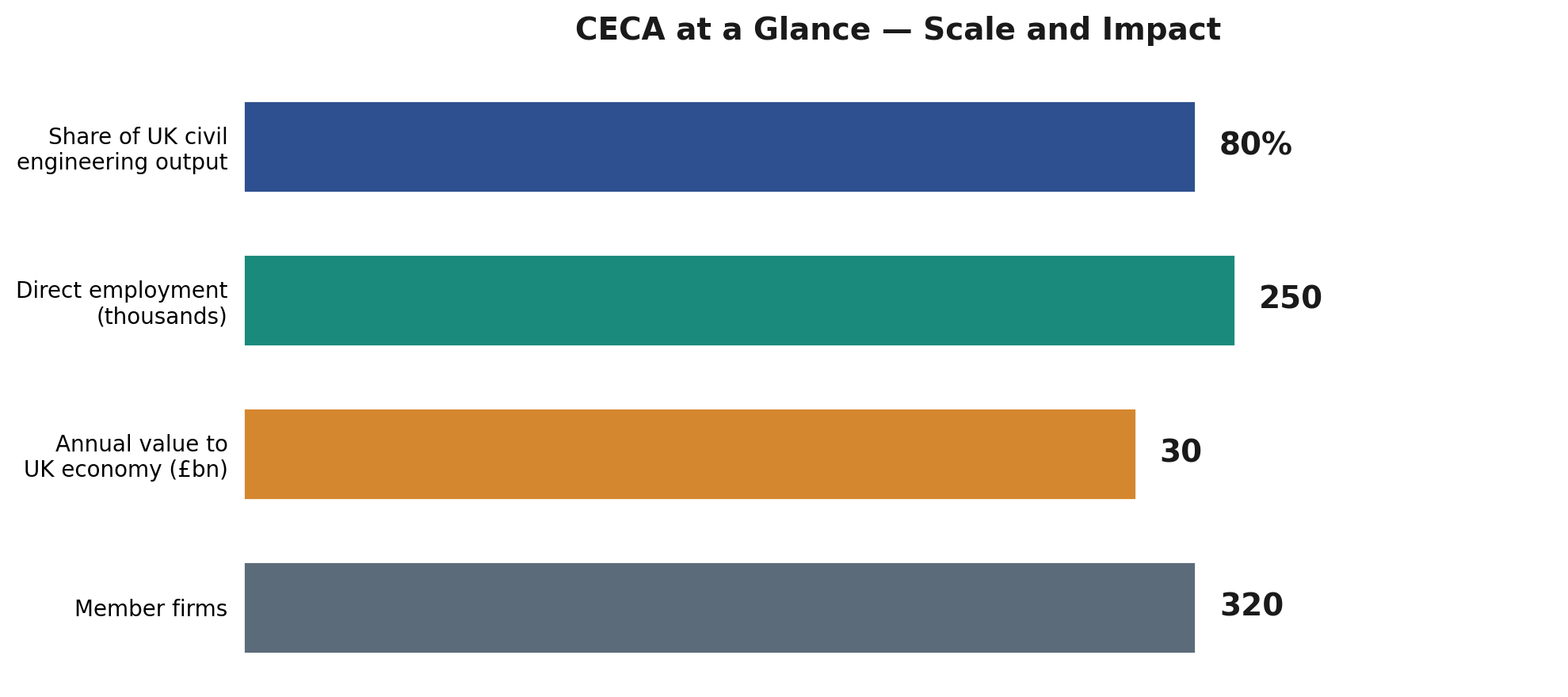
The Civil Engineering Contractors Association (CECA) is the representative body for civil engineering contractors in the United Kingdom. Established in 1996 following the dissolution of the Federation of Civil Engineering Contractors, CECA represents over 320 member firms that collectively deliver approximately 80% of UK civil engineering output — around £30 billion of work annually, employing some 250,000 people directly.
CECA operates from a national office in Westminster alongside eight regional offices: six across England (Southern, South West, Midlands, Yorkshire & The Humber, North East, North West) plus dedicated offices for Scotland and Wales. This regional structure allows the association to engage with devolved administrations and local clients while maintaining a unified national voice on policy.
Membership is open to civil engineering contractors of all sizes operating in England, Scotland, or Wales — from specialist regional firms through to the largest multinational contractors. There are no minimum turnover thresholds. Members gain access to advocacy, training, market intelligence, contract guidance, and networking across the sector.
What Does CECA Do?
CECA’s work falls into six broad areas, each of which has practical consequences for quantity surveyors and the wider built environment.
Government Advocacy and Infrastructure Policy
CECA lobbies UK Government, the Scottish Parliament, and the Senedd on behalf of civil engineering contractors. Their campaigns focus on sustained infrastructure investment across transport, energy, water, waste, and communications; efficient procurement processes that reduce cost and delay; and equitable funding distribution across the UK’s nations and regions. When a spending review is announced or a major programme is at risk, CECA’s advocacy directly influences the outcome — and that outcome determines how much work is in the pipeline for QSs and contractors alike.
Training and Skills Development
Civil engineering faces well-documented skills shortages. CECA addresses this through its Training and Development Forum and a portfolio of specialist courses — many part-funded by the Construction Industry Training Board (CITB). Offerings include NEC contract training, site supervisor and manager safety training (SSSTS/SMSTS), temporary works coordination, and personal skills development. For QSs looking to build their CPD profile, CECA training courses offer sector-specific content that goes beyond generic construction management programmes.
Health, Safety, and Wellbeing
CECA runs a sector-specific accident Alert System that rapidly informs members of incidents and provides benchmarking data so contractors can compare their safety performance against peer organisations. Their Health Management Toolkit helps contractors implement proactive occupational health systems. The association also leads on mental health through campaigns including the “Stop. Make a Change” initiative — a half-day industry stand-down involving thousands of workers — and CECA’s chief executive chairs the Construction Leadership Council’s workplace culture workstream.
Contract Guidance and Standard Forms
This is where CECA becomes directly relevant to day-to-day QS practice. The association publishes several widely used documents:
- CECA Generic Form of Sub-Contract (the “Blue Form”) — a step-down subcontract designed for use under NEC, ICE, JCT, and bespoke main contracts. QSs encounter this regularly on civil engineering projects and need to understand its risk allocation, payment terms, variation mechanisms, and retention provisions.
- Schedules of Dayworks Carried Out Incidental to Contract Work (3rd Edition, August 2025) — reference rates for pricing dayworks variations, a core QS activity on measured-term and remeasurable contracts.
- Contractor Equipment Rates (2nd Edition, April 2022) — hire rates for plant and equipment, useful for estimating and valuation.
- Monthly NEC4 Bulletins — practical guidance on NEC contract administration topics such as managing subcontractors, contract data completion, project manager instructions, and pre-signing checklists. These are gold for QSs administering NEC contracts.
- Infrastructure Conditions of Contract (ICC) — co-owned by CECA and the Association of Consulting Engineers (ACE), successor to the ICE Conditions of Contract.
Fair Payment and Supply Chain Transparency
CECA is a vocal advocate for fair payment practices — a subject close to every QS’s heart. Key positions include support for Project Bank Accounts (PBAs), which ring-fence project funds and pay the supply chain directly and simultaneously; endorsement of the Construction Supply Chain Payment Charter; and backing for the Build UK Roadmap to Zero Retentions. CECA has noted that “cash flow is the lifeblood of our industry.” For QSs managing payment certification and supply chain relationships, understanding CECA’s position on these mechanisms adds context to commercial negotiations and client advice.
Sustainability and Environmental Guidance
CECA provides members with guidance on pollution and waste management, waste classification, and corporate responsibility. Their free Corporate Responsibility Toolkit supports contractors implementing ESG programmes. As clients increasingly mandate carbon reduction and net-zero alignment in procurement, understanding the environmental standards that CECA promotes helps QSs assess compliance and cost implications.
Why CECA Matters for the Built Environment
CECA’s influence on UK infrastructure is substantial. Their advocacy secures funding commitments and shapes procurement policy; their training provision addresses the skills gap constraining project delivery; their safety initiatives reduce incidents, delays, and costs; and their fair payment campaigns improve financial stability across the supply chain. When Project Bank Accounts reduce payment risk for SME subcontractors, or when CECA’s lobbying helps maintain an infrastructure programme through a spending review, the ripple effects reach every project team — including the QS.
How Quantity Surveyors Can Use CECA as a Resource
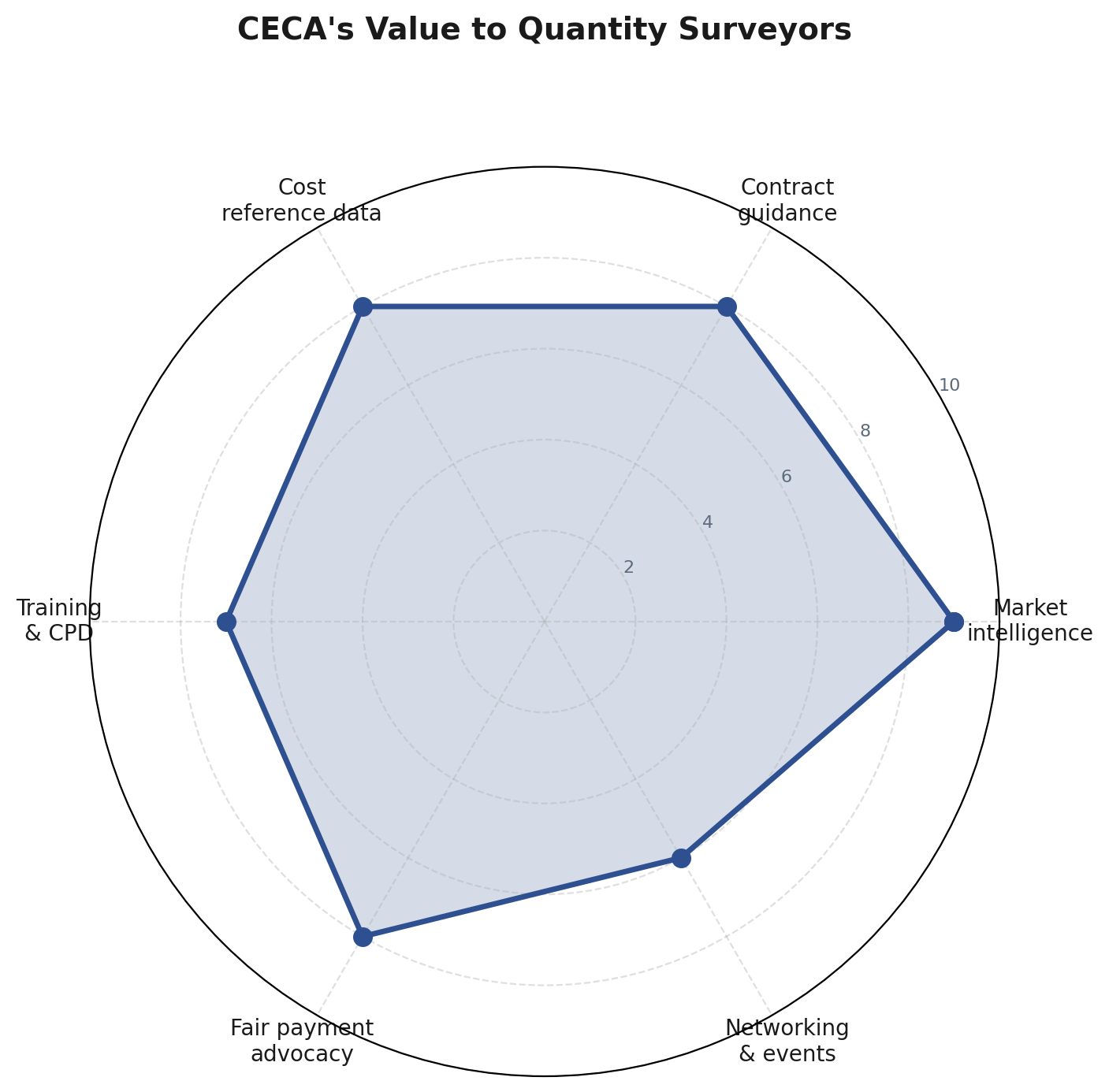
CECA is not just for contractors. QSs — whether working client-side, in consultancy, or for contractors — can draw on CECA resources in several practical ways.
Market Intelligence: The Workload Trends Survey
CECA’s quarterly Workload Trends Survey is one of the most useful market intelligence tools available to civil engineering QSs. It reports on contractor order books, workload levels, cost pressures, and labour availability. For QSs, this data directly informs cost planning (is the market hot or soft?), feasibility studies (are contractors capacity-constrained?), programme planning (how quickly can resources be mobilised?), and risk assessment (what contingency should we carry for inflation or labour shortages?). The most recent survey (Q4 2025) showed sustained activity on existing projects but weak new order books — a mixed signal that QSs should factor into pre-contract estimates.
Cost Reference Data
The Schedules of Dayworks and Contractor Equipment Rates are practical cost reference documents. Dayworks pricing is a routine QS task on civil engineering contracts, and having an industry-standard reference point strengthens both estimating accuracy and commercial negotiation. Equipment rates feed into preliminary cost estimates and the assessment of contractor claims.
Contract Guidance
If you are working on a project that uses the CECA Generic Form of Sub-Contract, you need to understand its step-down risk allocation and how it interacts with the main contract. CECA’s NEC4 Bulletins are equally valuable — short, practical, and focused on common administration issues. Bulletin 55 (July 2025), for example, provides a pre-signing checklist that any QS should run through before a contractor commits to an NEC subcontract.
CPD and Professional Development
CECA’s training courses — particularly on NEC contracts and commercial management — count toward RICS and CIOB CPD requirements. The regional delivery model means courses are accessible across the country, and CITB part-funding keeps costs manageable.
Industry Networking
CECA’s regional events, annual awards, and sector forums offer QSs networking opportunities with contractors, clients, and supply chain partners. For QSs in consultancy or considering a move into civil engineering, these events provide useful market exposure and relationship-building.
CECA and Other Industry Bodies
CECA works alongside several organisations that QSs will recognise. It collaborates with the Institution of Civil Engineers (ICE) on technical and policy matters; with Build UK on cross-sector construction industry representation; with the Construction Leadership Council (CLC) on industry strategy and workplace culture; and with the Association of Consulting Engineers (ACE) on the Infrastructure Conditions of Contract. CECA was also a signatory to the 2017 Conflict Avoidance Pledge alongside RICS, promoting collaborative dispute avoidance in construction.
Frequently Asked Questions
What is CECA?
The Civil Engineering Contractors Association is the representative body for civil engineering contractors in the UK. It represents over 320 member firms responsible for approximately 80% of UK civil engineering output, advocating on infrastructure policy, training, safety, contracts, and fair payment.
Who can join CECA?
Membership is open to civil engineering contractors of any size operating in England, Scotland, or Wales. There are no minimum turnover or employee thresholds. Associate and affiliate membership is available for organisations providing specialist services to the sector.
How does CECA benefit quantity surveyors?
CECA provides QSs with market intelligence (the Workload Trends Survey), cost reference data (Schedules of Dayworks, equipment rates), contract guidance (CECA subcontract forms, NEC4 Bulletins), training and CPD opportunities, and insight into fair payment mechanisms such as Project Bank Accounts. Understanding CECA’s resources strengthens a QS’s commercial practice in civil engineering.
What is the CECA Workload Trends Survey?
A quarterly survey of CECA member firms reporting on workload levels, order books, cost pressures, and labour availability. It is one of the most widely cited market intelligence sources in UK civil engineering, used by QSs for cost planning, feasibility studies, and risk assessment.
Does CECA publish standard contract forms?
Yes. CECA publishes the Generic Form of Sub-Contract (the “Blue Form”), designed for use under NEC, ICE, JCT, and bespoke main contracts. CECA also co-owns the Infrastructure Conditions of Contract (ICC) with the Association of Consulting Engineers, and publishes Schedules of Dayworks and Contractor Equipment Rates.
How does CECA support fair payment in construction?
CECA advocates for Project Bank Accounts (ring-fenced accounts paying the supply chain directly), endorses the Construction Supply Chain Payment Charter, and supports the Build UK Roadmap to Zero Retentions. These mechanisms improve cash flow security for contractors and subcontractors throughout the supply chain.
What is the CECA Generic Form of Sub-Contract?
Known as the “Blue Form,” it is a step-down subcontract that mirrors the risk allocation of the main contract while providing appropriate protections for subcontractors. It can be used under various main contract forms including NEC, JCT, and bespoke contracts. QSs should understand its payment, variation, and retention provisions.
Is CECA relevant to QSs who do not work in civil engineering?
Primarily, CECA serves the civil engineering and infrastructure sector. However, QSs in general construction may encounter CECA subcontract forms on projects with civil engineering elements (groundworks, drainage, highways), and the Workload Trends Survey data is relevant to anyone forecasting construction market conditions.
Related reading on ProQS.site
- NRM 2 Measurement Guide — measurement principles that underpin QS practice across all sectors including civil engineering
- Interim Valuations and Certification — the payment cycle that CECA’s fair payment advocacy seeks to improve
- Post-Contract Cost Management — managing cost and change on live projects, where CECA data and contract forms are used daily
- Earthworks and Groundworks Measurement — a core civil engineering measurement topic where CECA member firms dominate delivery
External references
- CECA (ceca.co.uk) — the association’s main website, with membership information, publications, events, and policy updates
- CECA Publications — subcontract forms, Schedules of Dayworks, equipment rates, and technical guidance
- CECA NEC4 Bulletins — monthly practical guidance on NEC contract administration
- CECA Training and Development — course listings and CPD opportunities for built environment professionals
- Institution of Civil Engineers (ICE) — CECA’s primary professional institution partner, with complementary technical resources and knowledge