Estimating as an M&E Quantity Surveyor: A Complete Guide
Estimating as an M&E Quantity Surveyor: A Complete Guide for Students and Professionals
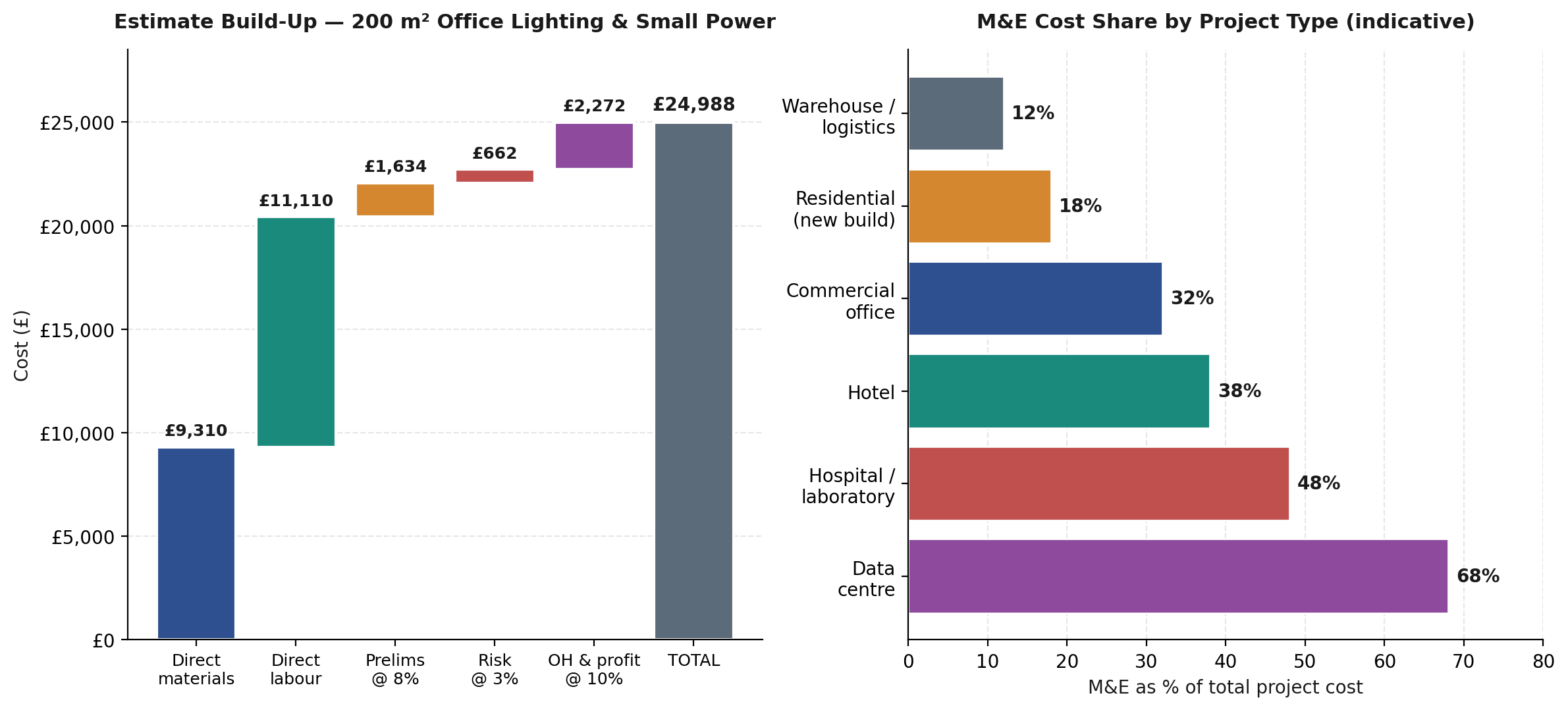
Mechanical and electrical (M&E) cost management has become one of the most valuable specialisms a QS can develop. On modern commercial projects, services frequently account for 25–45% of total cost — and on data centres and hospitals, considerably more. This guide explains what M&E estimating involves, how the methodology works in practice, and walks through a full worked example for a small office fit-out with realistic UK rates. It is written for both QS students preparing for the APC and experienced QSs moving into the M&E space.
Why M&E Estimating Matters
Building services have quietly become the most cost-sensitive part of most commercial projects. As buildings get smarter, more energy-efficient, and more tightly regulated, the mechanical and electrical package drives a growing share of the contract sum — and much of the risk. A QS who can estimate M&E with confidence is substantially more valuable to a contractor or consultancy than one who relies on outline prices and percentage add-ons.
For students, M&E is also one of the clearer routes to career specialisation. The market is crying out for QSs who can navigate services drawings, price plant and equipment, and challenge contractor quotations on technical grounds. If you can do that, you will stand out.
What Does an M&E QS Estimator Do?
An M&E QS estimator prices the mechanical and electrical services elements of a project — from concept estimates at feasibility stage right through to firm tenders and post-tender negotiation. The work sits alongside general building QS practice but differs in several important ways.
A general building QS typically works off architectural drawings, a Bill of Quantities or cost plan, and established measurement rules (NRM 1 and NRM 2). An M&E QS works from services drawings, schedules of equipment, specifications written by mechanical and electrical consultants, and often reams of manufacturer technical data. The measurement conventions are less standardised, the risk profile is different, and a large proportion of cost sits in plant and equipment items that need careful specification matching.
M&E QS estimators are typically employed by one of three types of business:
- Main contractors — pricing the M&E element of an overall tender, often using specialist subcontractor quotations that need adjustment, levelling, and risk assessment before inclusion in the bid.
- Cost consultancies — preparing client-side cost plans, benchmarking, and post-tender reports; sometimes employed specifically as M&E cost managers within a wider QS team.
- Specialist M&E subcontractors — building full priced bids for their own tenders, where the estimator owns the rate build-up from first principles and works closely with the design and installation teams.
Key M&E Systems to Understand
You do not need to be an engineer to estimate M&E, but you do need enough technical literacy to read a drawing, ask the right questions, and spot scope gaps. The main systems you will encounter fall into four broad families.
Mechanical Services
Heating, ventilation and air-conditioning (HVAC) dominates the mechanical package on most commercial buildings. The big-ticket items are plant (chillers, boilers, air-handling units, heat pumps), distribution (pipework, ductwork, insulation), and terminals (fan-coil units, VRF cassettes, radiators, grilles). Pipework is typically priced per metre with fittings as an allowance; ductwork by the square metre of surface area; plant as individual equipment items.
Electrical Services
The electrical package typically includes LV distribution (main incoming, switchgear, sub-mains, distribution boards), containment (cable tray, basket, trunking, conduit), small power (sockets, fused connection units), lighting (luminaires, emergency lighting, controls), and specialist elements such as earthing and lightning protection. Most items can be priced per number or per metre once you have a reliable take-off.
Public Health
Public health services cover hot and cold water distribution, sanitary drainage, rainwater drainage, and above-ground soil and waste. Pipework and fittings dominate, with sanitary ware and water heaters as discrete items. On commercial fit-outs, PH is usually a smaller proportion of cost than mechanical or electrical, but it is no less demanding to measure accurately.
Specialist Systems
A growing proportion of modern M&E cost sits in specialist systems: building management systems (BMS), fire detection and alarm, security and access control, structured data cabling, audio-visual, and lifts and vertical transportation. These are often priced as lump-sum packages from specialist subcontractors, but the QS still needs to understand the scope boundaries to avoid double-counting or scope gaps.
How M&E Estimating Works — The Methodology
The basic approach mirrors general building estimating, but the devil is always in the detail. A good M&E estimate follows a disciplined sequence.
1. Tender Documents and Drawings Review
Before touching a take-off, spend time understanding what you are being asked to price. Read the specification. Compare architectural drawings against services drawings for clashes and assumptions. Identify which elements are contractor’s design portion (CDP) and which are fully detailed by the consultant. Note any provisional sums, PC sums, or named subcontractors, and any performance requirements that might drive unusual costs.
2. Measurement Approach
M&E measurement is less formally codified than general building measurement. In practice, three approaches dominate:
- Elemental estimating — used at concept and feasibility stage, where cost is allocated per m² or per element based on benchmark data from similar projects. Useful for order-of-magnitude estimates but too coarse for tendering.
- Trade or system-based take-off — the core methodology for firm estimates. Each system is measured item by item against the drawings, with quantities aggregated into a schedule.
- Unit rate pricing — each measured item is priced using a composite rate (material + labour + plant + profit), built up from first principles or drawn from a database of historic rates.
3. Build-Up of Rates
A sound M&E unit rate combines four cost elements:
- Material — the purchased cost of the item, including an allowance for waste (typically 5–10% for cable and containment, less for discrete items).
- Labour — the hours required to install the item, priced at the appropriate all-in labour rate. For 2024–2025, UK M&E labour all-in rates sit roughly in the range of £32–42 per hour for electricians and £30–40 per hour for mechanical fitters, depending on region and project type.
- Plant and tools — access equipment, specialist tools, test equipment. Often absorbed into preliminaries rather than unit rates.
- Preliminaries, overheads and profit — site management, supervision, welfare, transport, insurance, head-office overheads, and the margin. Typically applied as percentage uplifts on the direct cost subtotal.
4. Subcontractor Quotation Analysis
On main-contractor tenders, a substantial portion of the M&E price comes from specialist subcontractor quotations. Never take these at face value. Level them against the tender documents: have they priced the full scope? Are exclusions creeping in? What attendances have they assumed? Is their programme realistic? A good estimator builds a comparison matrix, normalises each quotation onto a common scope, and challenges outliers before placing reliance on any single number.
5. Risk and Contingency
Finally, consider what could go wrong. Scope uncertainty, design development, interface risk with other trades, market volatility on copper and cable prices — all warrant a considered risk allowance. On firm tenders this might be 2–5% of the direct cost subtotal; on concept estimates it can be substantially higher.
Worked Example: Pricing a Small Office Lighting and Small Power Package
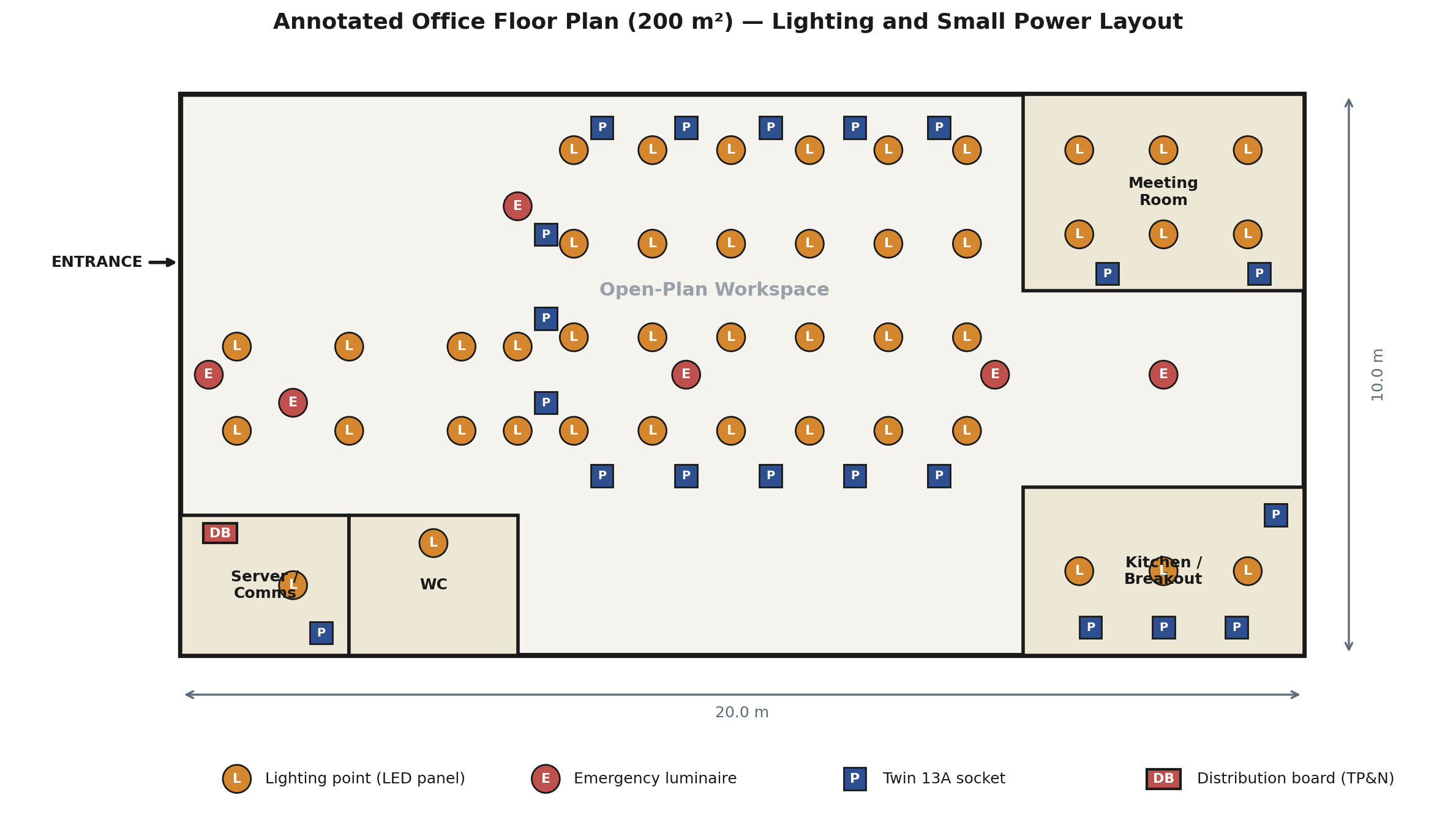
Let’s walk through a realistic example. A small commercial Cat B fit-out has engaged your firm to price the lighting and small power element of the works. The demised floor is 200 m² — a single open-plan workspace with a meeting room, kitchen/breakout, WC, and small server/comms room. The distribution board is to be installed in the comms room, fed from an existing landlord sub-main.
Step 1 — Take-Off Schedule
From the floor plan and specification, the take-off looks like this:
| Ref | Item | Qty | Unit |
|---|---|---|---|
| 1 | LED 600×600 recessed panel luminaire, 36W, 4000K | 36 | no |
| 2 | Emergency luminaire, 3-hour maintained | 6 | no |
| 3 | Grid-plate lighting switch, 2-gang | 8 | no |
| 4 | PIR presence detector for lighting control | 4 | no |
| 5 | Twin 13A switched socket outlet, white moulded | 30 | no |
| 6 | Single 13A switched socket outlet (cleaners) | 4 | no |
| 7 | Fused connection unit (FCU), switched, with neon | 6 | no |
| 8 | 12-way TP&N distribution board with RCBOs | 1 | no |
| 9 | 25 mm² 4-core SWA sub-main cable, clipped direct | 30 | m |
| 10 | 1.5 mm² 3-core LSF lighting cable in containment | 300 | m |
| 11 | 2.5 mm² 3-core LSF power cable in containment | 400 | m |
| 12 | Fire-rated cable to emergency luminaires | 80 | m |
| 13 | 300 mm wire basket containment, galvanised | 40 | m |
| 14 | 3-compartment dado trunking with accessories | 60 | m |
| 15 | Testing, commissioning and certification | 1 | item |
Step 2 — Rate Build-Up
Each item is priced at a composite unit rate combining material and labour. Rates below reflect typical UK contractor pricing for 2024–2025; they are indicative only — always use your own rate database for live tenders.
| Ref | Qty | Unit | Mat £ | Lab £ | Rate £ | Total £ |
|---|---|---|---|---|---|---|
| 1 | 36 | no | 45.00 | 55.00 | 100.00 | 3,600 |
| 2 | 6 | no | 75.00 | 45.00 | 120.00 | 720 |
| 3 | 8 | no | 15.00 | 25.00 | 40.00 | 320 |
| 4 | 4 | no | 55.00 | 45.00 | 100.00 | 400 |
| 5 | 30 | no | 12.00 | 35.00 | 47.00 | 1,410 |
| 6 | 4 | no | 8.00 | 30.00 | 38.00 | 152 |
| 7 | 6 | no | 18.00 | 40.00 | 58.00 | 348 |
| 8 | 1 | no | 950.00 | 400.00 | 1,350.00 | 1,350 |
| 9 | 30 | m | 18.00 | 12.00 | 30.00 | 900 |
| 10 | 300 | m | 2.50 | 3.50 | 6.00 | 1,800 |
| 11 | 400 | m | 3.50 | 4.00 | 7.50 | 3,000 |
| 12 | 80 | m | 4.50 | 4.50 | 9.00 | 720 |
| 13 | 40 | m | 12.00 | 18.00 | 30.00 | 1,200 |
| 14 | 60 | m | 22.00 | 28.00 | 50.00 | 3,000 |
| 15 | 1 | item | 600.00 | 900.00 | 1,500.00 | 1,500 |
| Direct cost subtotal | 20,420 | |||||
Step 3 — Applying Preliminaries, Risk, and Margin
The direct cost subtotal captures labour and materials installed on site. To arrive at a tender figure, three further uplifts are applied:
| Line | Description | £ |
|---|---|---|
| A | Direct cost subtotal (from take-off) | 20,420 |
| B | Site preliminaries & supervision @ 8% | 1,634 |
| C | Risk and design development @ 3% | 662 |
| D | Overheads & profit @ 10% | 2,272 |
| Total tender price | 24,988 | |
| Rate per m² (200 m² GIA) | 124.94 | |
The resulting rate of about £125 per m² sits squarely within the typical range published by cost databases for Cat B lighting and small power on UK commercial fit-outs, which is a useful confidence check on the take-off and rates.
Key Takeaways from the Worked Example
- Direct material and labour together accounted for roughly 82% of the final tender price; preliminaries, risk, and margin made up the remaining 18%.
- Labour typically outweighs material on electrical fit-out packages — in this example, labour was £11,110 against material of £9,310.
- Cable and containment, which look like minor items on paper, contributed around £9,700 (nearly half the direct cost). Always take off linear items carefully.
- Sanity-check the final rate against elemental benchmarks before submitting. £125 per m² is in range for Cat B office lighting and small power; £300 per m² would prompt serious questions.
- Keep a clear record of your assumptions — labour rates used, waste allowances, exclusions — so you can defend the price in post-tender discussion.
Common Pitfalls in M&E Estimating
Experienced M&E estimators will tell you that the biggest risks are not in the rates themselves but in what sits around them. Five pitfalls come up repeatedly.
1. Scope gaps between trades. Who provides the fire-rated riser penetrations — the M&E contractor or the fit-out contractor? Who installs the containment above the ceiling — main contractor or M&E? These interfaces are where cost leaks. Read the scope matrix carefully and challenge ambiguity before tender return.
2. Drawing issue management. M&E drawings are typically revised multiple times during tender. Pricing an early revision and failing to update the take-off when a newer issue arrives is a classic error. Always price the latest issue and keep a revision log.
3. Provisional sums and PC sums. These are placeholders, not prices. If the scope behind a provisional sum is unclear, either resolve it or quarantine it explicitly from the fixed price. Clients and contractors fall out over provisional sums more than almost any other issue.
4. Attendances on other trades. The M&E package relies on other trades providing access, power, scaffolding, and logistics. If your price assumes free attendance and the main contractor expects you to pay for it, there will be a gap at post-tender.
5. Builders’ work in connection (BWIC). Cutting chases, forming holes, fire-stopping penetrations, lifting and relaying ceiling tiles — these are small items individually but add up quickly. Clarify in writing whether BWIC is in the M&E price or excluded and priced by the main contractor.
Tools and Software Used in Practice
Most M&E estimators still work extensively in Microsoft Excel, often with bespoke rate databases and templated take-off sheets. For firm tenders on larger projects, specialist estimating and take-off software is increasingly common:
- Causeway Estimating — widely used in UK M&E contracting, with integrated rate libraries and tender build-up workflows.
- Trimble Accubid (formerly WinQS / Trimble Estimation) — strong across electrical and mechanical take-off with database-driven pricing.
- CostX by Exactal — popular among consultancies for on-screen measurement from PDF and CAD drawings, with BIM integration for models.
- Revit / BIM-linked take-off tools — as more projects deliver services in BIM, quantities can be extracted directly from the model. This reduces take-off time but increases the importance of model quality and validation.
AI-assisted estimating is the newest development in the toolbox. Machine-learning tools that extract quantities from drawings, suggest rates from historic databases, and flag missing items are starting to appear in mainstream M&E practice. They will not replace the estimator’s judgement — knowing why a rate is wrong is a human skill — but they are rapidly becoming an accelerator for the routine parts of the job.
Tips for Students Starting Out in M&E Estimating
If you are beginning a career in M&E cost management, four habits will accelerate your learning.
Read drawings until it hurts. Nothing substitutes for the ability to look at a services drawing and understand what you are seeing. Ask your colleagues to explain unfamiliar symbols. Walk finished jobs and match what you see to the as-built drawings. This is the single biggest skill gap between new starters and experienced estimators, and the fastest one to close with deliberate practice.
Build your own rate library. Start a personal spreadsheet of typical M&E rates with a clear note of where each rate came from (quotation, historic project, published source). Update it as you work. By the time you reach APC final assessment, you will have a resource nobody else in your intake possesses.
Ask about assumptions. When a senior estimator prices an item, ask what waste allowance they have used, what labour rate, what productivity assumption. The numbers are easy to copy; the reasoning is the thing worth learning.
Invest in CPD outside the QS mainstream. CIBSE (Chartered Institution of Building Services Engineers) publishes technical guides that are gold for understanding what you are pricing — the CIBSE Guide series covers everything from electrical design to lighting and HVAC. RICS and CIOB both offer CPD routes directly relevant to QS practice. Attend M&E trade shows when you can — Elex, CIBSE Build2Perform Live, and UK Construction Week are good starting points.
Conclusion
M&E estimating is a demanding, rewarding specialism that sits right at the heart of modern construction cost management. The fundamentals — measurement, rate build-up, risk assessment, sanity checking — are the same as any other branch of QS practice. What differs is the technical literacy needed to read services drawings, the discipline required to level specialist quotations, and the attention to detail needed to avoid scope gaps between trades. Build those skills deliberately and you will find yourself in one of the most sought-after roles in the profession.
The worked example in this article shows the core methodology in miniature — take-off, rate build-up, preliminaries and margin, sanity check. Scale the same approach up to a full commercial project and you have the framework for any M&E estimate you are likely to encounter.
Related reading on ProQS.site
- Unit Rate Pricing in Estimating — the fundamentals of rate build-up applied to building work
- NRM 1 and Cost Planning — the elemental framework that underpins M&E concept estimating
- Post-Contract Cost Management — what happens to your estimate after it becomes a contract sum
- Specification Writing for QS — understanding the documents that drive M&E scope
External references
- CIBSE — Chartered Institution of Building Services Engineers: technical guides on electrical, lighting, and HVAC design
- RICS — Royal Institution of Chartered Surveyors: professional standards, cost data, and CPD for QS practitioners
- IET — Institution of Engineering and Technology: publishers of BS 7671 (the Wiring Regulations), essential for understanding electrical compliance costs
- BCIS — Building Cost Information Service: benchmarking data and elemental cost information for QSs
- BEAMA: trade association for electrical manufacturers, useful for market intelligence on plant and equipment costs