Measurement of Masonry
Why Masonry Measurement Matters
Masonry — brickwork, blockwork, and their associated sundries — accounts for a significant proportion of the cost of most UK building projects. For the quantity surveyor, accurate measurement of masonry is essential for producing a clear bill of quantities, obtaining competitive tenders, and managing costs through to final account. Get the measurement wrong and the consequences are real: ambiguous items that contractors cannot price fairly, cost overruns from missed sundries, and disputes over what was included in the rate.
This article covers the NRM 2 rules for masonry measurement, the types of masonry work a QS needs to measure, worked examples with full quantity breakdowns, material quantity data, and the most common pitfalls to avoid.
NRM 2 Measurement Rules for Masonry
Masonry is measured under Section 4: Masonry in NRM 2 (2nd edition). This section covers brick and block walling, damp-proof courses and membranes, lintels and arches, pointing and mortar jointing, and associated sundries such as cavity trays and bonding to existing structures.
The fundamental units of measurement are square metres (m²) for walls, DPC, and pointing; linear metres (m) for cavity trays; and number (nr) for lintels, arches, and cavity closure units.
Segregation Rules
NRM 2 requires masonry to be measured separately by wall type and thickness. This is non-negotiable — it directly affects how contractors price the work and how the QS values it during construction.
Brick walls must be segregated by thickness: half-brick (102.5 mm), one-brick (215 mm), one-and-a-half brick (327.5 mm), and two-brick (440 mm). Block walls are separated by thickness (100 mm, 140 mm, 215 mm) and by block type — heavyweight concrete, lightweight aerated concrete, lightweight aggregate, and clay blocks must all be measured as distinct items.
Cavity walls are measured as two separate leaves, not as a single combined element. The outer leaf (typically half-brick facework) and inner leaf (typically blockwork) are each measured independently in m². The cavity itself is not measured as a separate item, but cavity-related sundries — ties, trays, and closures — are measured separately where required.
Facework must distinguish between facework one side (one face visible and requiring high-quality finish), facework both sides (both faces exposed), and fair face blockwork (blockwork left unplastered with appearance quality assured). Each carries a different cost and must be measured as a separate item.
Treatment of Openings
Door and window openings are deducted in full from the wall area. This deduction applies to both leaves of a cavity wall. At each opening, the QS must also measure the associated sundries: cavity closure units at the jambs and head (typically 3 nr per opening — 2 jambs plus 1 head), a lintel over the opening (measured as nr with full specification), and a cavity tray DPC at the lintel level (measured in linear metres).
Small openings for pipes and ducts are generally not deducted unless they exceed the threshold area specified in the project preambles (commonly 1.0 m²). Chases for services cut after construction are not deducted.
Types of Masonry Work
Brick Walls
Half-brick walls (102.5 mm) are the most common masonry element measured. They form the outer leaf of cavity walls (as facework) and internal partitions. A half-brick wall uses approximately 60 bricks per m² of face area — a figure every QS should know instinctively.
One-brick walls (215 mm) are solid walls used for load-bearing internal walls, basement external walls, and some older construction types. They use approximately 120 bricks per m². One-and-a-half brick walls (327.5 mm) and two-brick walls (440 mm) are rarely encountered in new build but appear in conservation and heritage work.
Block Walls
Concrete blockwork forms the inner leaf of most cavity walls and the majority of internal partitions. Standard block face dimensions are 440 mm × 215 mm, giving approximately 10 blocks per m² regardless of thickness. What changes with thickness is the weight, thermal performance, and cost per block.
The QS must specify the block type clearly: lightweight aerated concrete blocks (such as Thermalite or Celcon) are the most common for inner leaves and partitions, while heavyweight aggregate concrete blocks are used where structural capacity or acoustic performance is the priority.
Facework and Finishes
Facework one side applies where one face of the wall is visible and requires a high-quality finish — typically external elevations. Facework both sides applies to free-standing walls or feature walls where both faces are exposed. This effectively doubles the material and labour cost for finishing, and must be measured as a separate item or noted clearly in the item description.
Fair face blockwork — blockwork left unplastered with joints finished to an appearance standard — is increasingly common in modern commercial and educational buildings. It carries a cost premium over standard blockwork because of the higher quality control required, and must be measured separately.
Sundries
Damp-proof courses (DPC) are measured in m² for horizontal applications (plinth level, below ground floor) and in linear metres (m) for cavity trays at opening heads. The QS must segregate by type: bituminous, plastic sheet, slate, or proprietary cavity tray systems.
Lintels are measured individually (nr) and must be fully specified: material type (concrete, steel, timber), external dimensions, bearing length at each end, load capacity, and any protective finish. A description of “concrete lintel” alone is insufficient — the contractor needs enough information to procure and install the correct component.
Cavity closure units are measured at the jambs and head of every opening in a cavity wall: typically 3 nr per opening (2 jambs plus 1 head). Bonding to existing masonry is measured in linear metres where new construction meets an existing wall, with the bonding method specified.
Worked Example: External Cavity Wall
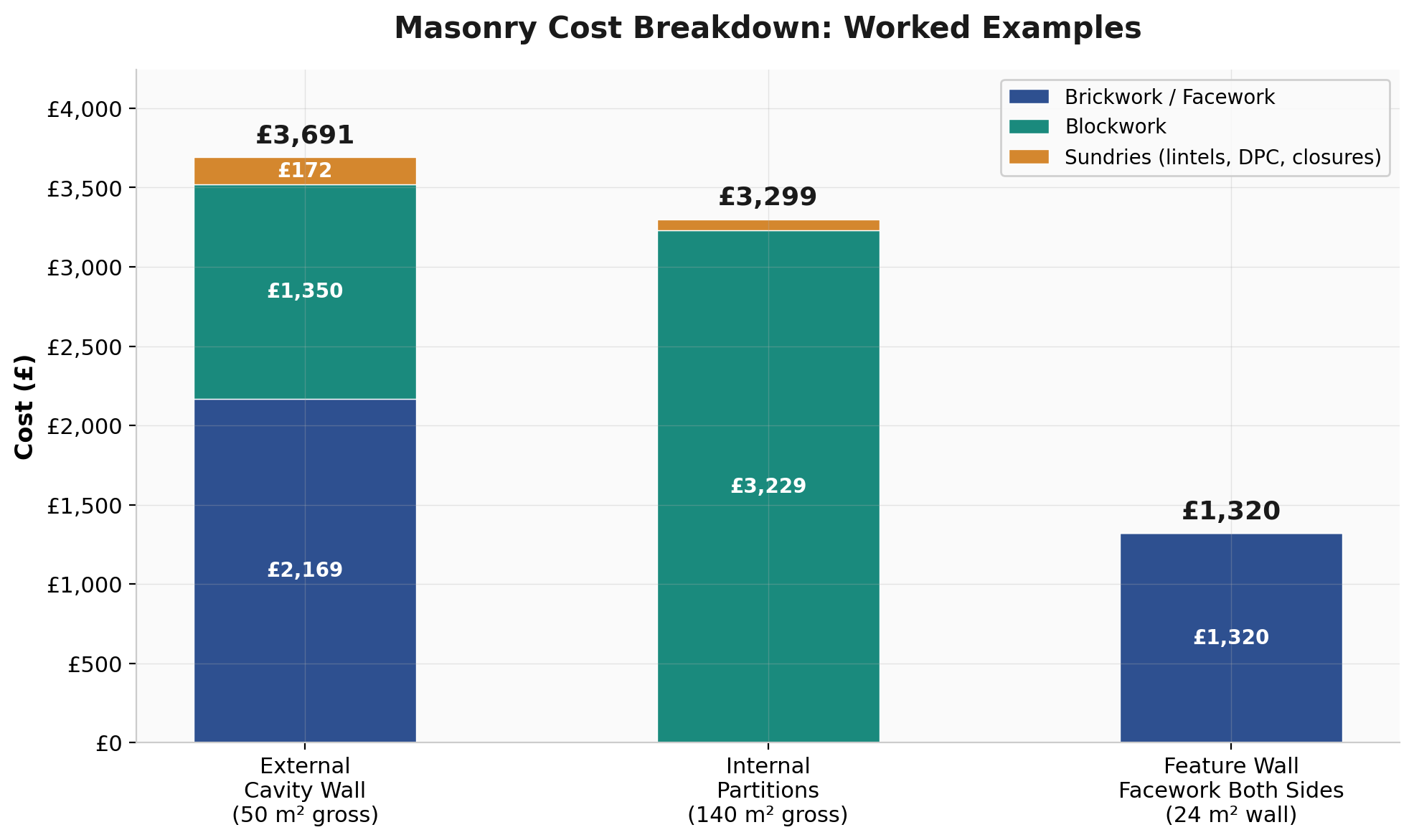
A residential extension has an external cavity wall measuring 10 m long × 5 m high (50 m² gross area). The outer leaf is half-brick facework and the inner leaf is 140 mm lightweight aerated concrete blockwork. There is one window opening measuring 1.5 m wide × 1.2 m high.
Outer leaf — facing brickwork (half-brick, 102.5 mm):
Gross area: 10 × 5 = 50.00 m². Less window opening: 1.5 × 1.2 = 1.80 m². Net area: 48.20 m².
Material check: 48.20 m² × 60 bricks/m² = 2,892 bricks. Add 7% waste = 3,094 bricks required. At £0.32 per brick, that is approximately £990 in brick supply alone.
Inner leaf — 140 mm lightweight blockwork:
Net area: also 48.20 m² (same opening deducted from both leaves). Material check: 48.20 × 10 blocks/m² = 482 blocks. Add 5% waste = 506 blocks required.
Sundries for the window opening:
Cavity closure units: 3 nr (2 jambs + 1 head). Precast concrete lintel: 1 nr, specified as 1350 × 225 × 215 mm, reinforced, 100 mm bearing both ends. Cavity tray DPC at lintel level: 1.50 m (width of opening).
DPC at plinth level:
Horizontal bituminous DPC at the base of the wall, measured as area: 10 m length × 0.225 m width = 2.25 m².
Illustrative cost build-up:
Facing brickwork: 48.20 m² at £45/m² = £2,169. Inner leaf blockwork: 48.20 m² at £28/m² = £1,350. Cavity closures: 3 nr at £12 = £36. Lintel: 1 nr at £95 = £95. Cavity tray DPC: 1.50 m at £15/m = £23. Plinth DPC: 2.25 m² at £8/m² = £18. Total: approximately £3,691.
The key discipline here is measuring each leaf separately, deducting the opening from both, and measuring every sundry item at the opening — closures, lintel, and cavity tray. Miss any of these and the bill is incomplete.
Worked Example: Internal Blockwork Partitions
An office fitout requires two internal partitions. Partition A is 100 mm lightweight blockwork, 20 m long × 4 m high = 80 m² gross, with one single door opening (0.9 m × 2.1 m = 1.89 m²). Partition B is 140 mm lightweight blockwork, 15 m long × 4 m high = 60 m² gross, with one single door opening (0.9 m × 2.1 m = 1.89 m²).
Partition A — 100 mm blockwork:
Net area: 80.00 − 1.89 = 78.11 m². Materials: 78.11 × 10 = 781 blocks + 5% waste = 820 blocks. Lintel: 1 nr over the door opening.
Partition B — 140 mm blockwork:
Net area: 60.00 − 1.89 = 58.11 m². Materials: 58.11 × 10 = 581 blocks + 5% waste = 610 blocks. Lintel: 1 nr over the door opening.
Illustrative cost build-up:
100 mm blockwork: 78.11 m² at £22/m² = £1,718. 140 mm blockwork: 58.11 m² at £26/m² = £1,511. Lintels: 2 nr at £35 = £70. Total: approximately £3,299.
The critical point is that the two thicknesses must be measured as separate items in the bill. They use different blocks, carry different structural loads, and attract different unit rates. No cavity closures are needed here — these are solid internal partitions, not cavity walls.
Worked Example: Facework Both Sides — Feature Wall
A modern office reception area features a free-standing half-brick wall, 8 m long × 3 m high, with facing bricks on both sides and flush-pointed joints. There are no openings.
Measurement:
Each face is measured separately. Face 1: 8 × 3 = 24.00 m². Face 2: 8 × 3 = 24.00 m². Total facework area: 48.00 m².
Materials: The wall is half-brick thick, so 48.00 m² of facework requires the same number of bricks as 24.00 m² of wall — approximately 24 × 60 = 1,440 bricks + 7% waste = 1,541 bricks. The material quantity is based on the wall area (24 m²), not the combined face area (48 m²), because the same bricks serve both faces.
However, the labour cost is significantly higher because the bricklayer must achieve facework quality on both sides — careful selection of bricks for colour consistency, clean joints on both faces, and no mortar smears. This is why facework both sides carries a premium rate. Illustrative rate: 24 m² at £55/m² (facework both sides rate) = £1,320, compared with 24 m² at £45/m² = £1,080 for facework one side.
Material Quantities Reference
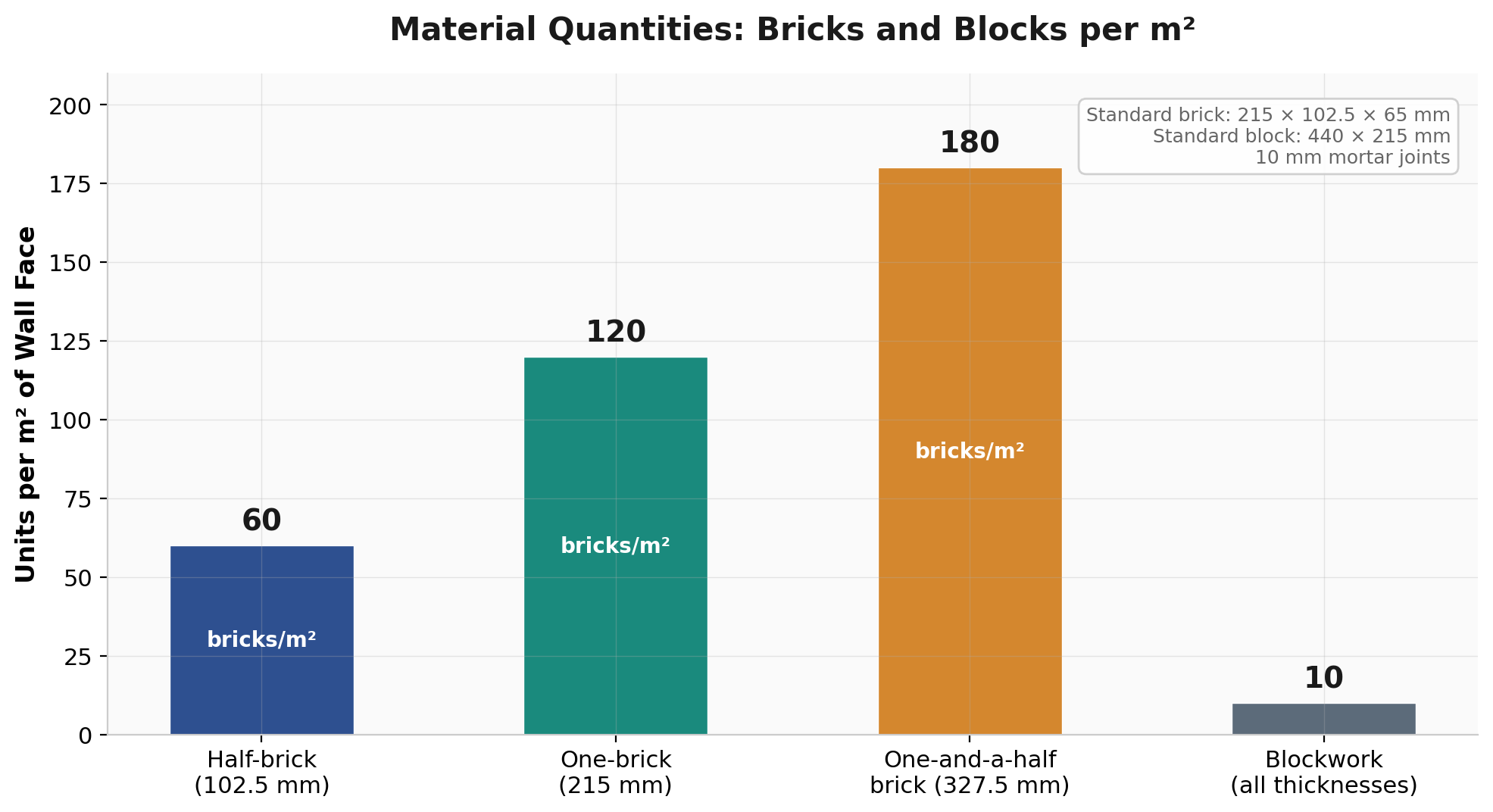
Bricks per m² of wall face: half-brick wall = 60; one-brick wall = 120; one-and-a-half brick wall = 180. These figures assume standard UK brick dimensions (215 × 102.5 × 65 mm) with 10 mm mortar joints.
Blocks per m² of wall face: approximately 10 for all thicknesses (standard block face: 440 × 215 mm with 10 mm joints).
Mortar consumption: half-brick wall approximately 0.025–0.03 m³/m²; one-brick wall approximately 0.05–0.06 m³/m²; blockwork approximately 0.015–0.02 m³/m² regardless of block thickness.
Typical waste allowances: facing bricks 5–10% (breakage, cutting, colour sorting); common bricks 3–5%; concrete blocks 3–5%; mortar 10–15% (spillage, uneven application); DPC materials 5%.
Cavity wall ties: stainless steel butterfly ties at 450 mm horizontal × 600 mm vertical centres = approximately 3.7 ties per m² of wall face. For a 50 m² wall, that is approximately 185 ties.
Common Measurement Pitfalls
Measuring a cavity wall as one element. This is the most fundamental error. A cavity wall comprises two separate leaves measured independently — the outer leaf (facework) and inner leaf (blockwork). Each has a different material, rate, and specification. Measuring “cavity wall: 50 m²” is ambiguous and will cause pricing problems. Always measure: “Facing brickwork, half-brick: 48.20 m²” and “Blockwork, 140 mm lightweight: 48.20 m²” as separate items.
Forgetting to deduct openings. Every window and door opening must be deducted in full from the wall area — and the deduction must be applied to both leaves separately. A wall with three windows at 1.5 × 1.2 m deducts 5.4 m² from the brickwork and 5.4 m² from the blockwork. Miss the deduction and the contractor is overpaid; miss it on one leaf only and the quantities are inconsistent.
Missing cavity sundries at openings. For every opening in a cavity wall, the QS must measure cavity closure units (typically 3 nr per opening), a lintel (1 nr, fully specified), and a cavity tray DPC (linear metres). These items are easily overlooked but represent real cost — and their absence from the bill creates uncertainty over who pays for them.
Confusing plinth DPC with cavity tray DPC. Plinth DPC at the base of the wall is measured in m² (area of the horizontal membrane). Cavity tray DPC at opening heads is measured in linear metres (m). They use different materials, serve different functions, and must be measured as separate items.
Insufficient lintel specification. “Concrete lintel” is not a measurable item. The QS must specify material type, external dimensions, bearing length, load capacity, and protective finish. Without this detail, the contractor cannot price the item accurately and building control cannot verify compliance.
Not separating fair face blockwork. Standard blockwork and fair face blockwork attract different rates. Fair face requires higher quality blocks, more careful laying, and finished joints to an appearance standard. If the drawings show exposed blockwork in a reception area, that must be measured as a separate item with its own specification — not lumped in with standard partition blockwork at the lower rate.
Getting Masonry Measurement Right
Masonry measurement rewards precision and punishes shortcuts. The NRM 2 rules exist to ensure that every item in the bill is clear enough for the contractor to price and the QS to value. That means separating by type and thickness, deducting openings from both leaves, measuring every sundry at every opening, and specifying materials fully. The worked examples in this article show the mechanics — in practice, the key is methodical discipline: work through each wall elevation systematically, list every opening, and check that every associated sundry has been picked up.
For related measurement guidance, see our articles on Measurement of Concrete Works and NRM 2: A Practical Measurement Guide.
Further Reading
Brick Development Association: Technical Guidance — Industry guidance on brickwork design, construction, movement, and aesthetic standards from the UK brick industry body.
Concrete Block Association: Technical Datasheets — Detailed technical data on aggregate concrete block selection, specification, acoustics, thermal performance, and movement control.
BS EN 771: Specification for Masonry Units — The British and European standard covering dimensions, strength, and material properties for clay bricks, concrete blocks, and manufactured stone masonry units.
NHBC Standards: Chapter 6.1 — External Masonry Walls — Construction standards for domestic masonry including cavity wall ties, DPC requirements, lintel specification, and workmanship standards.
RICS: New Rules of Measurement (NRM) — The official RICS page for the NRM suite, including NRM 2 which governs detailed measurement of masonry and all other building work sections.