The Role of the Employer’s Agent
The Role of the Employer’s Agent
Who protects the Employer in a Design and Build contract? On traditional JCT jobs, the Contract Administrator holds the ring impartially between the parties. But when design responsibility passes to the contractor, the Employer needs someone acting squarely on their side — that role is the Employer’s Agent. This article explains what the EA does, how the role compares with the CA and the NEC Project Manager, and what QSs need to know if they are asked to take the position on.
What is the Employer’s Agent?
The Employer’s Agent (EA) is the person or firm appointed by the client to administer a Design and Build (D&B) contract on their behalf — most commonly under the JCT Design and Build Contract 2016 or 2024, or the JCT Major Project Construction Contract. They are, in the classic phrase, “the eyes and ears of the client”: managing relationships with the contractor, monitoring progress and compliance, assessing payments and claims, and protecting the Employer’s commercial interests from pre-tender through to final account.
The role exists because of a fundamental difference in design responsibility. Under a traditional JCT Standard Building Contract, the Employer (through their architect) retains design control, and a Contract Administrator is appointed to certify and administer the contract impartially. Under D&B, the contractor assumes full responsibility for design and construction. The Employer, having ceded design control, needs a dedicated representative to protect their interests — not a neutral arbiter, but an agent acting actively on their behalf.
Under Article 3 of JCT DB 2016/2024, the EA has “full authority to receive and issue applications, consents, instructions, notices, requests or statements and otherwise to act for the employer under any of the conditions.” In plain English: the EA is the Employer’s voice and signature on the contract, with authority delegated within the limits set out in the appointment.
Core Duties: Pre-Contract to Final Account
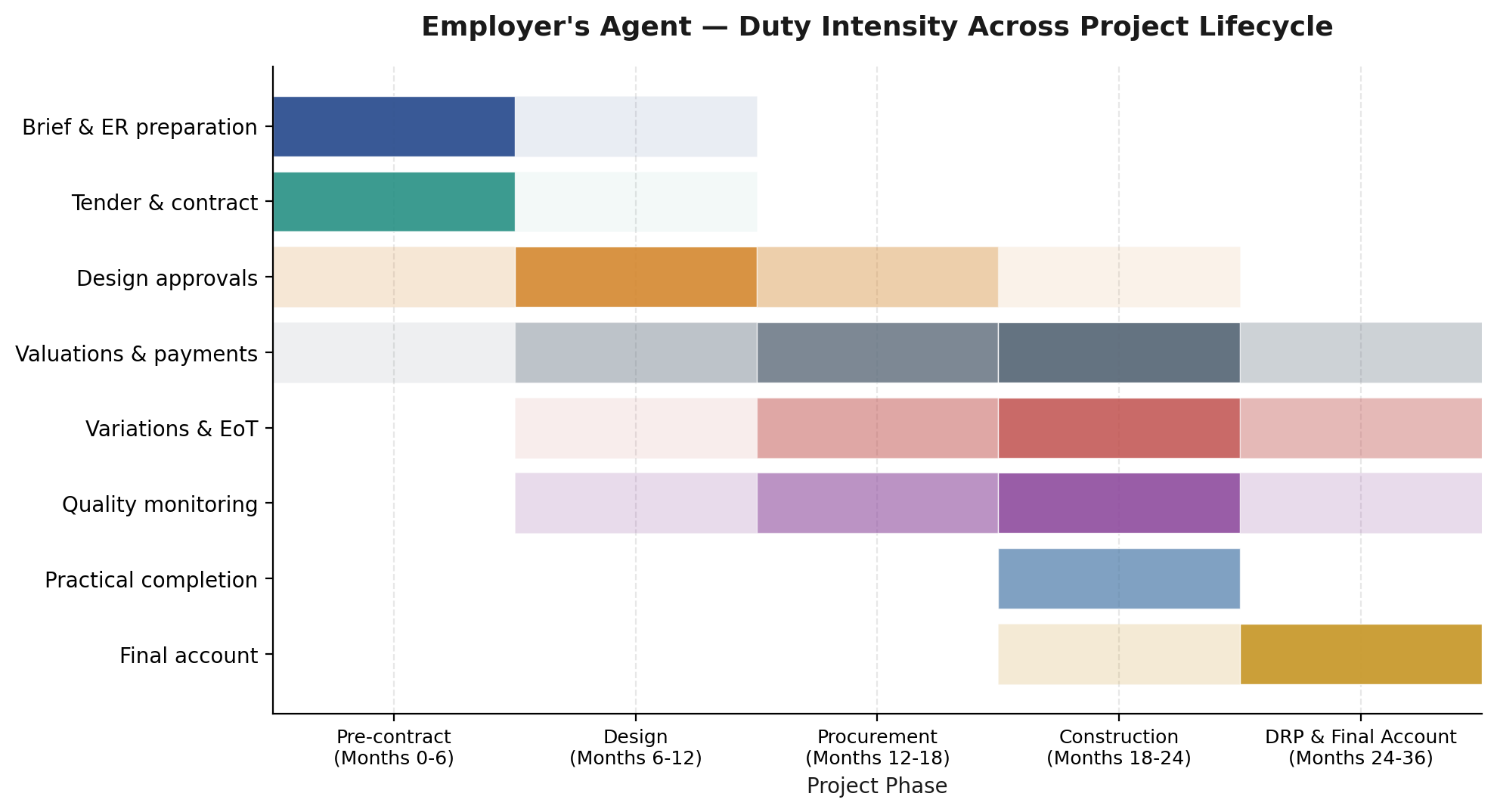
The EA’s duties span the entire project lifecycle. Getting them appointed before tender is the single biggest factor in whether the role delivers value.
Pre-Contract Stage
Before a single brick is laid, the EA works with the client to define the scope, budget, programme, and risk appetite. The central deliverable is the Employer’s Requirements (ER) — the document that tells the contractor what they are designing and building against. A well-drafted ER defines performance standards, design parameters, any Employer-specified elements, and which risks sit with which party. The EA will typically also manage the tender process: preparing documentation, handling contractor clarifications, evaluating proposals, and recommending the preferred bidder. Poor ER preparation is the single most common cause of disputes later, so time invested here pays back many times over.
Post-Contract Stage
Once the contract is signed, the EA’s day-to-day duties include:
- Issuing instructions — in writing, referenced to the appropriate contract clause, for variations, omissions or clarifications.
- Assessing interim valuations — under JCT DB, the EA must issue a Payment Notice within 5 days of the due date, stating the sum considered due and the basis for calculation. Final date for payment is typically 14 days after the due date.
- Change control — reviewing contractor quotations for variations, agreeing time and cost impacts, and formalising the revised contract sum.
- Extensions of time — assessing contractor notifications against Relevant Events and the critical path. Under JCT DB 2024 (clause 2.25.2), the Employer now has eight weeks (reduced from twelve) to notify whether an interim extension has been granted.
- Loss and expense — ascertaining claims within 28 days of receiving the required information, then updating every 14 days as further information arrives.
- Practical completion — inspecting the works, preparing snagging lists, and ultimately issuing the Statement of Practical Completion, which releases the first half of retention and starts the Defects Rectification Period clock.
- Final account — reviewing the contractor’s Final Statement (due within 3 months of PC), verifying every variation and claim is properly accounted for, and certifying final payment.
EA vs CA vs Project Manager — Why the Distinction Matters
One of the most misunderstood aspects of this role is how it differs from other contract administrators a QS might encounter. The three roles look superficially similar — they all administer contracts and certify payments — but their philosophical stance is different, and that difference changes everything about how you should behave in the job.
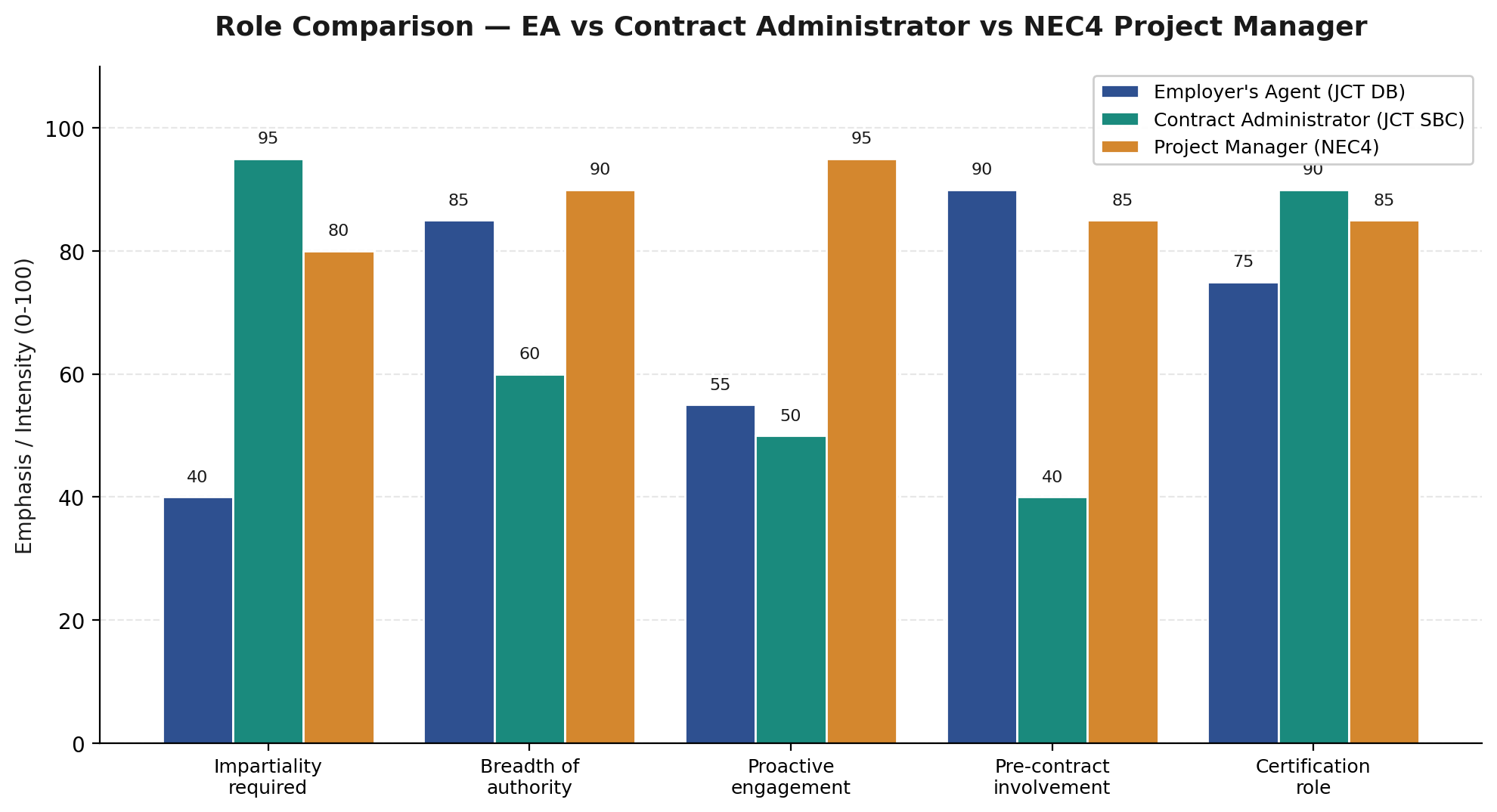
The Contract Administrator under JCT SBC (usually an architect or engineer) must act impartially when certifying — their decisions bind both parties, and a CA who favours the Employer risks exposing themselves and their client to challenge. The NEC4 Project Manager is also expected to act impartially, but with a far more proactive, collaborative stance: continuous early-warning management, drive on risk registers, and unilateral decision-making under tight contractual timescales.
The EA sits in a different position. They are appointed by and for the Employer. Their pre-contract brief is entirely partial: secure the best value for the client. But when they cross over into certification functions — assessing payments, extensions of time, loss and expense — they must still act fairly and honestly. Case law (notably Imperial Chemical Industries v Merit Merrell Technology [2017] EWHC 1763 (TCC)) has made clear that an EA making decision-making judgements must be independent, impartial, fair and honest, even while representing the Employer overall. This dual nature is the hardest part of the role to get right.
Common Pitfalls and How to Avoid Them
The conflicts inherent in the role produce predictable problems. Five come up again and again:
1. Certification conflict. Over-certifying to keep the contractor sweet, or under-certifying to please the Employer, will both end badly. Document every decision with written reasoning; separate your advocacy role (negotiating variations, challenging claims) from your certification role (assessing what’s contractually due).
2. Authority confusion. Agreeing major variations or granting long extensions of time without Employer sign-off creates legal exposure. The appointment letter should specify clear financial and time thresholds (e.g. variations up to £100k, EoT up to 4 weeks). Escalate anything beyond.
3. Poor record-keeping. Verbal instructions confirmed informally, meetings with no minutes, Payment Notices without clear breakdowns — these are the raw material of disputes. Everything in writing, referenced to the contract, circulated promptly.
4. Slow claims management. Contractor EoT and loss and expense notifications that sit in an inbox for six weeks turn into disputes. Keep a claims register. Respond within contractual timescales. Demand complete information upfront; reject vague submissions with a clear statement of what’s missing.
5. Thin quality oversight. Focusing on cost and time while quality drifts produces snagging nightmares at PC. Weekly site visits on small jobs, more frequent on large ones; engage the Employer’s design team; commission independent testing on structural, M&E and waterproofing elements.
Skills, Qualifications, and Who Makes a Good EA
QSs make particularly good EAs — the skill set (cost control, valuation, claims assessment, contract interpretation) maps almost perfectly onto the role. Typical routes in are MRICS (via the Quantity Surveying or Commercial Management pathway) or MCIOB, plus five or more years of hands-on JCT contract administration. RICS publishes formal guidance on EA services in its Black Book, which is worth reading cover to cover before taking on the role for the first time.
The qualifications get you to the door; the soft skills decide whether you succeed. Clear written communication, forensic attention to detail, commercial pragmatism when deals need to be done, and the integrity to make fair certification calls even when the client is leaning on you — these matter as much as knowing the JCT clauses. And a stomach for difficult conversations, because the role is full of them.
Practical Takeaway
The EA role is a natural progression for experienced QSs working on D&B projects. The technical demands — contract administration, cost control, claims assessment — are familiar territory. The harder part is holding the dual-nature position: representing the Employer robustly in commercial negotiation, while still certifying fairly when the contract requires it.
Three things make the difference between a good EA and a mediocre one: early appointment (before tender, not after contract signing), clearly documented authority limits in the appointment letter, and meticulous record-keeping throughout. Get those right, and most of the rest follows.
Related reading on ProQS.site
- Interim Valuations and Certification — the monthly payment cycle in detail
- Post-Contract Cost Management — managing cost, change and risk after contract award
- Final Account Preparation — closing out the contract sum
- Extensions of Time and Loss and Expense — claims and their assessment
External references
- JCT (jctltd.co.uk) — primary source for the Design and Build Contract and accompanying guidance notes
- RICS Black Book: Employer’s Agent (Design and Build) — authoritative guidance on the EA role, duties, and ethical standards
- RICS Guidance: Interim Valuations and Payment — detailed procedure for payment cycles under JCT contracts
- CIOB (ciob.org) — Chartered Institute of Building, alternative qualification pathway for EA practitioners
- Shoosmiths: Navigating the new JCT Design and Build 2024 — summary of updated timescales and procedural changes relevant to EA practice