Early Warning Under NEC4: The Quantity Surveyor’s Role in Managing Risk
Updated April 2026 — a practical guide to the NEC4 early warning process written specifically for quantity surveyors. Covers clause 15, the Early Warning Register, the financial consequences of late notification, what changed between NEC3 and NEC4, and three worked examples showing how the QS adds value at every stage.
Why Early Warning Is a Commercial Issue, Not Just a Project Management One
Most articles about NEC4 early warning focus on the Project Manager’s obligations. This one is different — it focuses on the quantity surveyor, because early warning is, at its core, a commercial process. Every item on the Early Warning Register carries a potential cost and time impact. The QS who treats the register as a commercial management tool — not just someone else’s admin — will protect entitlement (contractor side) or manage exposure (client side) far more effectively than one who leaves it to the PM.
And the financial stakes are real. Under clause 63.7, if the contractor fails to give early warning that an experienced contractor could have given, the compensation event is assessed as if the warning had been given. That means money the contractor will never recover. For the client-side QS, this is a powerful lever to reduce compensation event costs. For the contractor-side QS, it is a trap that must be avoided.
What Is Early Warning Under NEC4?
Early warning is the proactive risk management mechanism embedded in clause 15 of the NEC4 Engineering and Construction Contract. Either the Project Manager or the Contractor must notify an early warning as soon as they become aware of any matter that could:
- Increase the total of the Prices
- Delay Completion
- Delay meeting a Key Date
- Impair the performance of the works in use
The word “could” is critical. Early warnings deal with potential problems — things that might happen — not events that have already occurred. This is what distinguishes them from compensation events, which address matters that have happened or are expected to happen.
Both parties have a mutual, reciprocal obligation to notify. The duty is continuous throughout the contract. There is no penalty for raising an early warning that turns out to be unnecessary — but there is a significant financial penalty for failing to raise one (see clause 63.7 below).
The Early Warning Register
Under clause 15.1, the PM enters early warnings into the Early Warning Register — a live project document that records every notified risk, the actions to be taken and who is responsible. The register must be reissued within one week of every early warning meeting.
For the QS, the register should be treated as a forward-looking cost report. Each item represents a potential cost or time impact. The QS should review it regularly, track cumulative exposure, spot trends and flag items that are transitioning from risks into live compensation events.
Early Warning Meetings
Early warning meetings (called “risk reduction meetings” under NEC3) are where the real value is created. Clause 15.2 requires the first meeting to be held within two weeks of the starting date, with subsequent meetings at intervals stated in the Contract Data.
At the meeting, attendees review the register, discuss how problems can be avoided or their impact reduced, and agree actions. The PM may instruct subcontractors or specialists to attend. In practice, the QS should attend every meeting — the commercial input is essential for informed decision-making.
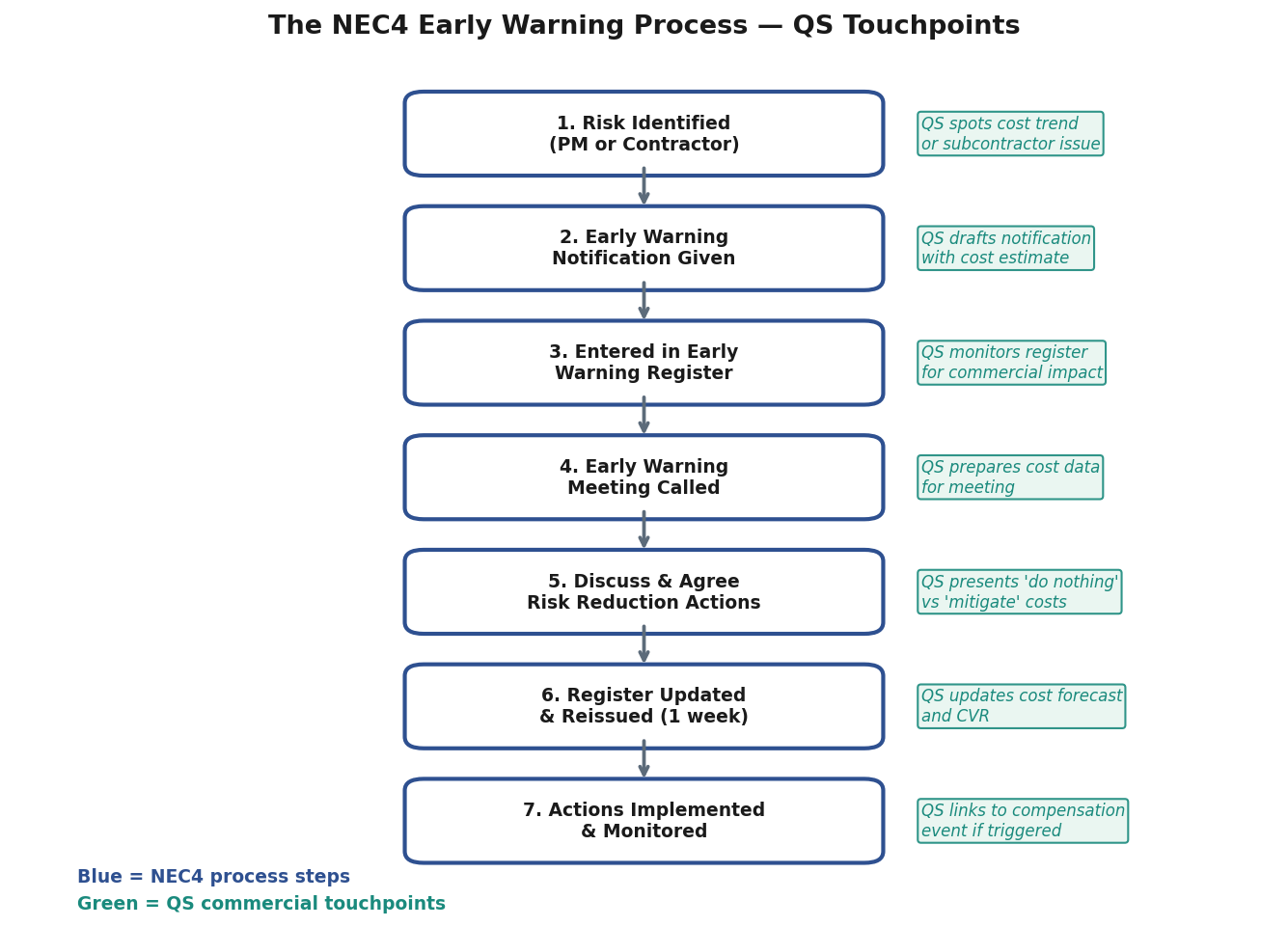
The NEC4 Early Warning Process — With QS Touchpoints
What Happens When Early Warning Is Not Given: Clauses 61.5 and 63.7
This is the most commercially significant aspect of early warning for the QS.
Clause 61.5: If the PM decides that the contractor did not give an early warning which an experienced contractor could have given, the PM states this in the instruction to submit quotations for the compensation event.
Clause 63.7: The compensation event is then assessed as if the contractor had given early warning. In practice, this means the quotation is reduced by the amount that could have been avoided or mitigated had the warning been given in time. In extreme cases — where the entire event could have been avoided — the assessment can be nil.
Under the cost-reimbursable options (C, D, E and F), there is a further sting: clause 11.2(26) classifies costs incurred because of a failure to give early warning as Disallowed Cost. The contractor gets hit twice — a reduced compensation event assessment and costs excluded from Defined Cost.
The “experienced contractor” test: Would a reasonably experienced contractor in that position have recognised the risk and notified it? This is an objective test of reasonable competence, not perfection. But the longer the contractor waits, the harder it is to argue that an experienced contractor would not have spotted the issue sooner.
The QS Role: Contractor Side
For a QS working for the contractor, the early warning process is fundamentally about protecting entitlement.
Spot cost risks early. The QS is often the first person to see trouble coming — through subcontractor payment patterns, procurement delays, measurement discrepancies, CVR trends or a prelim burn rate that is running ahead of programme. Each of these can be an early warning trigger.
Notify early, notify often. There is no downside to raising an early warning that turns out to be unnecessary. There is a significant downside to missing one. The QS should draft the notification with a cost estimate attached — this creates a contemporaneous record that supports any later compensation event quotation.
Prepare cost data for meetings. The QS should attend every early warning meeting with quantified estimates: what does this risk cost if it materialises (the “do nothing” figure) and what does the proposed mitigation cost (the “mitigate” figure)? This allows the team to make rational commercial decisions rather than guessing.
Link to the programme. Every time impact has a prelim cost impact. The QS should have the weekly time-related burn rate at their fingertips and apply it to any programme risk on the register.
The QS Role: Client Side
For a QS advising the employer or Project Manager, early warning is a tool for managing client exposure.
Monitor compliance. Is the contractor giving timely early warnings? If risks are surfacing late — or only when they become compensation events — the contractor may not be meeting its obligations.
Advise on clause 61.5. When a compensation event arises and the contractor did not give early warning that an experienced contractor could have given, the QS should flag this to the PM. The PM can then invoke clause 61.5, resulting in a reduced assessment under clause 63.7 — directly saving the client money.
Forecast exposure. The QS should aggregate the potential cost of all open items on the Early Warning Register and report this to the client as a forward-looking risk allowance. This avoids surprises.
Three Worked Examples
Example 1: Subcontractor Insolvency Risk
The QS notices a key M&E subcontractor submitting increasingly aggressive payment applications, requesting early payment and disputing retention. Credit checks reveal declining financial health.
| Scenario | Cost (£) |
|---|---|
| “Do nothing” — subcontractor goes insolvent | |
| Re-procurement premium | 180,000 |
| Programme delay (8 weeks × £12,000 prelims) | 96,000 |
| Total “do nothing” exposure | 276,000 |
| “Mitigate” — early action | |
| Overtime premium to accelerate remaining works | 25,000 |
| Standby subcontractor retainer | 5,000 |
| Total mitigation cost | 30,000 |
The early warning meeting agrees the mitigation actions. The QS has demonstrated a cost-benefit ratio of roughly 9:1.
Example 2: Unexpected Ground Conditions
Rock is encountered at a level not indicated in the Site Information — likely a compensation event under clause 60.1(12). The QS presents three options at the early warning meeting:
| Option | Cost (£) | Delay |
|---|---|---|
| A — Do nothing (break rock with current methods) | 143,000 | 3 weeks |
| B — Redesign foundations (shallower pads + ground beams) | 60,000 | None |
| C — Hydraulic splitting (instead of rock-breaking) | 95,000 | 1 week |
By giving early warning promptly, the contractor protects full entitlement under clause 63.7. The QS’s cost comparison enables a rational decision — in this case Option B saves £83,000 and avoids any programme delay.
Example 3: Material Price Escalation
Structural steel prices have risen 15% since tender. The QS flags the exposure: original budget £420,000, current market price £483,000, potential further increase to £504,000 if delayed. The early warning meeting explores early procurement (lock in the price now), alternative materials and alternative suppliers. Whether this triggers a compensation event depends on the option and any X-clauses, but the early warning ensures the team makes an informed decision before the window closes.
What Changed from NEC3 to NEC4
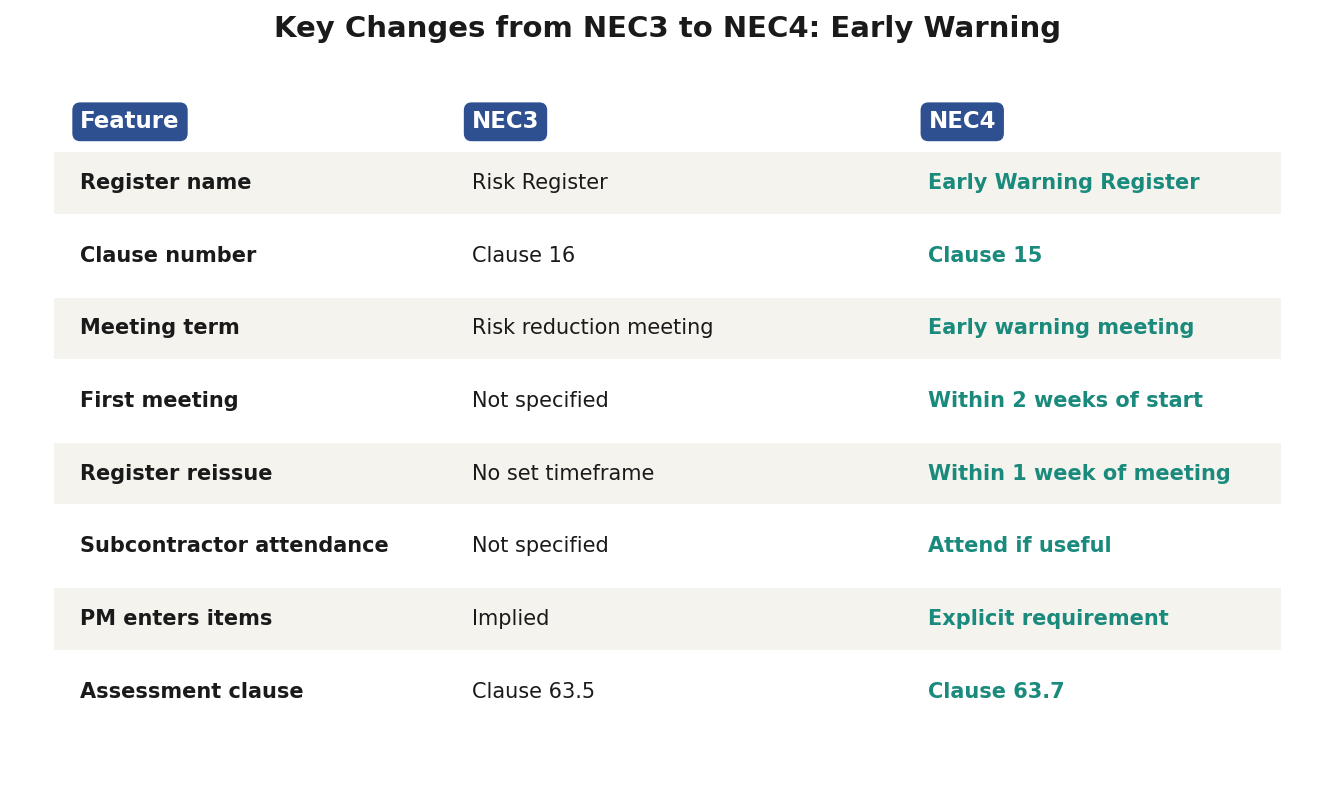
The biggest practical change is the rename from “Risk Register” to “Early Warning Register”. Under NEC3, the “Risk Register” caused persistent confusion with the project risk register used for general project management. NEC4’s rename makes the document’s purpose immediately clear.
NEC4 also tightened the process: the first meeting must now be held within two weeks of the starting date (NEC3 was silent on timing), the register must be reissued within one week of each meeting (NEC3 had no set timeframe), and there is an explicit requirement for the PM to enter items in the register rather than merely notifying them. The clause moved from 16 to 15 (renumbered), and the assessment consequence moved from clause 63.5 to clause 63.7.
The substantive principle is unchanged: if the contractor fails to give early warning that an experienced contractor could have given, the compensation event is assessed as if early warning had been given.
Best Practice for QSs
Treat the register as a commercial document. Review it with the same rigour as the cost report. Attach a cost range to every item.
Attend every early warning meeting. The QS’s cost data is what turns a vague discussion into an informed decision.
Prepare “do nothing” vs “mitigate” comparisons. For every significant early warning item, quantify both options. This is the QS’s distinctive contribution.
Update the cost forecast after every meeting. The register should feed directly into the monthly cost report, CVR and cash flow.
Train site teams to recognise triggers. The QS cannot be everywhere. Site managers, engineers and foremen should know to flag potential cost and time risks immediately.
Never confuse early warning with compensation event notification. They are different processes with different triggers. An early warning may or may not become a compensation event — but giving the warning protects entitlement if it does.
Frequently Asked Questions (FAQ)
What is early warning under NEC4?
Early warning is a proactive risk notification under clause 15 of the NEC4 ECC. Either the Project Manager or the Contractor must notify as soon as they become aware of any matter that could increase the Prices, delay Completion, delay a Key Date or impair the performance of the works in use.
What is the Early Warning Register?
A live project document maintained by the PM that records all notified early warnings, the actions to be taken and who is responsible. It forms the agenda for early warning meetings and must be reissued within one week of each meeting.
What happens if the contractor does not give early warning?
Under clause 63.7, the compensation event is assessed as if the contractor had given early warning — effectively reducing the entitlement by the amount that could have been avoided. Under Options C/D/E/F, the cost may also be classified as Disallowed Cost under clause 11.2(26).
What is the “experienced contractor” test?
An objective test: would a reasonably experienced contractor in that position have recognised the risk and notified it? It is a test of reasonable competence, not perfection. The longer the delay in notifying, the harder it is to defend.
What changed between NEC3 and NEC4 early warning?
The “Risk Register” was renamed to “Early Warning Register,” the clause moved from 16 to 15, the first meeting must now be held within two weeks of the starting date, the register must be reissued within one week, and there is an explicit requirement for the PM to enter items. The assessment principle (clause 63.7, formerly 63.5) is substantively unchanged.
Why should QSs attend early warning meetings?
Because every item on the register has a cost and time impact that needs quantifying. The QS provides the commercial data — “do nothing” vs “mitigate” cost comparisons — that enables informed decisions rather than guesswork.
Is there a penalty for raising an unnecessary early warning?
No. There is no contractual penalty for raising an early warning that does not materialise. But there is a significant financial penalty for failing to raise one (clauses 61.5 and 63.7). The rule is: notify early, notify often.
Key Takeaways
- Early warning is a commercial process, not just project management admin — the QS should own the cost dimension.
- Clause 63.7 reduces compensation event assessments where early warning was not given. Contractor QSs: notify everything. Client QSs: check compliance and advise the PM accordingly.
- Under Options C/D/E/F, failure to give early warning creates a double penalty — reduced CE assessment plus Disallowed Cost.
- NEC4 tightened the process vs NEC3: renamed register, mandatory first meeting within 2 weeks, 1-week reissue deadline, explicit PM entry requirement.
- The QS’s distinctive contribution is quantifying risk — “do nothing” vs “mitigate” cost comparisons at every early warning meeting.
Further Reading on ProQS.site
- Post-Contract Cost Management: A QS Guide
- NRM 1 and Cost Planning Explained
- Change Management in Construction Contracts
- CECA: The Civil Engineering Contractors Association