Professional Ethics for Quantity Surveyors
Professional ethics for quantity surveyors is not an abstract subject. A QS handles a client’s budget, a contractor’s prices and often the money that passes between them. So the QS’s honesty, independence and judgement matter to everyone on the project. This guide explains the rules that actually apply, from the RICS Rules of Conduct to the law on bribery, fraud and data. It also shows how they work in everyday practice.
It is written for practising QSs, for firms, and for APC candidates preparing for the ethics competency. Where ProQS has a detailed guide on a related topic, this page summarises it and links to it.
Why professional ethics matter for quantity surveyors
Construction is full of competing interests. The client wants value, the contractor wants margin, and subcontractors want to be paid on time. The QS often sits between them. On a traditional contract, for example, the client’s QS values the work, and the contract administrator certifies payment on that basis. Both must act fairly between the parties when they do so.
Clients also trust the QS with commercially sensitive information, such as budgets, tender prices and claims strategy. If that trust is misplaced, the damage goes beyond one project. It affects the reputation of the profession as a whole. That is why chartered status carries regulatory duties, not just a title. Our guide to why consultancies value chartership explains the commercial side.
The RICS Rules of Conduct
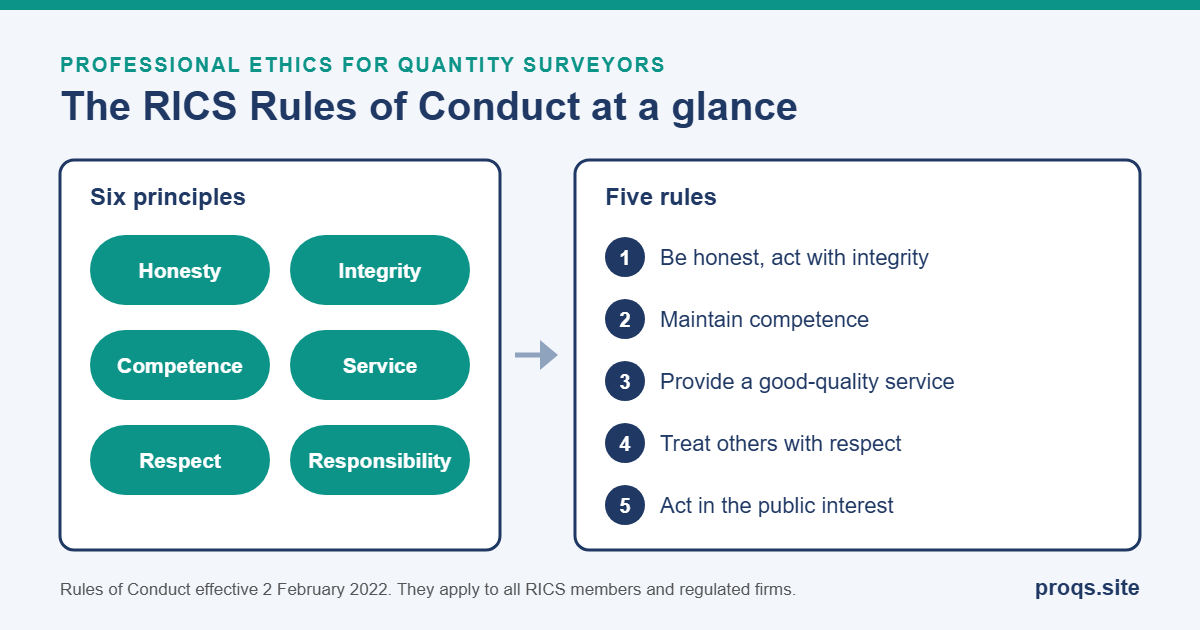
The current RICS Rules of Conduct took effect on 2 February 2022. They apply to every RICS member and every RICS-regulated firm, wherever they work. They rest on six professional and ethical principles. These are honesty, integrity, competence, service, respect and responsibility.
The principles are then set out as five rules. Each rule comes with examples of the behaviour expected.
| Rule | What it requires | What it means for a QS |
|---|---|---|
| 1. Honesty and integrity | Be honest and act with integrity, manage conflicts of interest, protect confidential information and do not facilitate financial crime | Give an honest valuation even when the client wants a lower one. Never pass one tenderer’s prices to another. |
| 2. Competence | Only take on work you can do competently, supervise others and keep skills up to date | Decline or get help with work outside your experience, such as an unfamiliar contract form or a specialist package. |
| 3. Service | Provide a good-quality, diligent service, agree the scope and keep proper records | Confirm your appointment and scope in writing, and keep clear records of valuations and instructions. |
| 4. Respect | Treat others with respect and encourage diversity and inclusion, including checking supply chains for modern slavery | Deal fairly and courteously with contractors and subcontractors, even in a dispute. |
| 5. Responsibility | Act in the public interest, respond to complaints, cooperate with RICS and report significant breaches | Raise concerns in good faith, and report serious misconduct by others to RICS. |
Firms have further obligations. They must publish a complaints procedure, hold adequate professional indemnity insurance and keep any client money safe. A breach of the Rules can lead to RICS disciplinary action, from a fine to expulsion. Members of other bodies, such as the CIOB or CICES, must also follow those bodies’ own codes. Our guide to professional membership compares them.
Conflicts of interest
Conflicts of interest are the most common problem in professional ethics for quantity surveyors. RICS sets the rules in its Conflicts of interest professional standard. It first took effect on 1 January 2018 and was reissued as a professional standard in July 2023, without material change. The standard recognises three kinds of conflict.
- Party conflict. The firm’s duty to one client conflicts with its duty to another client on the same or a related matter.
- Own interest conflict. The firm or individual has a personal or financial interest that conflicts with its duty to the client.
- Confidential information conflict. Information the firm holds for one client is material to another client.
The basic rule is to identify conflicts early, record them and not act where a conflict exists. In limited cases, a firm may act with the informed consent of all affected clients, normally in writing. It may also need information barriers that keep the two teams and their files apart. However, consent does not cure every conflict. If the firm cannot act objectively for both clients, it must decline.
RICS is now consulting on a second edition of the standard, from 5 November 2026 to 27 January 2027. The draft would allow reliance on consent only in exceptional circumstances. Check the current position before relying on consent.
A worked scenario
A consultancy is the client’s cost manager on a new school. Late in the project, the contractor approaches the same firm’s claims team to prepare a loss and expense claim on that school. This is a party conflict. The firm cannot advise the contractor on a claim against its own client, whatever barriers it puts in place. So it must decline.
Now suppose a senior QS leaves the consultancy and joins the contractor. That QS knows the client’s budget and contingency. This is a confidential information risk for the individual. They must not use or disclose that information, even though they now work for the other side.
Confidentiality and data protection
Confidentiality is a core part of professional ethics for quantity surveyors. A QS owes it in three ways. First, most appointments contain an express confidentiality clause. Second, Rule 1 of the Rules of Conduct requires members and firms to protect confidential information. Third, where the information is about identifiable people, data protection law applies.
UK GDPR and the Data Protection Act 2018 cover personal data. For a QS, that can include operatives’ names on daywork sheets, timesheets on a cost reimbursable contract or staff details in a contractor’s Defined Cost. So collect only what you need, store it securely, and do not keep it longer than necessary.
In practice, most breaches are careless rather than deliberate. Examples include an email sent to the wrong tenderer, a tender comparison left on a shared drive, or a project discussed in detail at an industry event. Confidentiality also continues after the project ends and after you change employer.
Acting fairly when valuing and certifying
On many contracts, the client’s QS values the work and someone acting for the client certifies payment. Under JCT, the Quantity Surveyor values the work and the Architect or Contract Administrator certifies. The courts have long held that a certifier must act fairly between the parties when certifying. In Sutcliffe v Thackrah (1974), the House of Lords also held that an architect who negligently over-certified could be liable to the client.
Under NEC4, the Project Manager assesses the amount due, often supported by the client’s QS. Clause 10.2 requires the Parties, the Project Manager and the Supervisor to act in a spirit of mutual trust and co-operation.
The practical test is simple. Value the work on the evidence, under the contract’s rules. Do not undervalue to help the client’s cash flow, or overvalue to keep a contractor afloat. Equally, record the basis of every assessment, so you can explain it later. Our guides to interim valuations and the role of the employer’s agent cover the mechanics.
Bribery, fraud, money laundering and sanctions
The Bribery Act 2010 makes it an offence to offer, pay or accept a bribe. Under section 7, a company also commits an offence if someone performing services for it pays a bribe, unless it had adequate procedures to prevent bribery. For a QS, the risk points are hospitality from tenderers, gifts during a final account negotiation and pressure to favour a supplier. Keep a gifts and hospitality register, and decline anything that could look like an inducement.
Since 1 September 2025, large organisations can also commit the offence of failure to prevent fraud. It applies where an employee or agent commits fraud intending to benefit the organisation, unless it had reasonable prevention procedures. An organisation is large if it meets two of three tests: more than 250 employees, more than £36 million turnover or more than £18 million in total assets. Inflated claims and false valuations are obvious risk areas in construction.
Money laundering and sanctions
Most QS work falls outside the regulated sector under the Money Laundering Regulations 2017. However, the money laundering offences in the Proceeds of Crime Act 2002 apply to everyone. In addition, RICS’s Countering financial crime professional standard took effect on 17 December 2025. It applies to all members and regulated firms, and covers bribery, corruption, money laundering, terrorist financing and sanctions. It requires firms to assess their risks, carry out proportionate checks on clients and counterparties, train staff and report suspicions.
Collusion between tenderers is a separate competition law issue. Our guide to tendering in construction covers bid rigging and cover pricing.
Competence and CPD
Rule 2 requires you to take on only work you are competent to do. Competence also has to be maintained. From 1 January 2026, RICS CPD rules require at least 20 hours of CPD a year, of which at least 10 must be structured.
Three topics are now mandatory, each for at least one hour of structured CPD in every rolling three-year period. They are RICS professional and ethical standards, AI, data and technology, and sustainability. You must record your CPD, with a learning outcome for each activity and an annual reflection, by 31 January after the end of the year. Our guide to continuing professional development covers planning and recording CPD.
Insurance, complaints and raising concerns
RICS-regulated firms must hold professional indemnity insurance that meets RICS requirements and covers both current and past work. They must also publish a complaints procedure that includes access to an approved independent dispute resolution provider, and keep a log of complaints. Our guide to insurance in construction projects explains how PI cover works.
Rule 5 asks members to raise concerns in good faith and to report significant breaches of the Rules to RICS. Workers who report wrongdoing, such as fraud or a danger to health and safety, may also be protected under the Public Interest Disclosure Act 1998. In practice, start with your firm’s own procedure where it is safe to do so.
AI and technology
RICS’s standard on the responsible use of artificial intelligence in surveying practice took effect on 9 March 2026. It does not stop QSs using AI for measurement, estimating or drafting. Instead, it requires firms to govern their use of AI, with a policy and a risk register, and to check tools before adopting them. Above all, the surveyor stays responsible for the advice. So validate AI outputs before relying on them, and explain to clients how AI has been used where it matters.
QSs who give expert evidence should note that RICS’s fifth edition of Surveyors acting as expert witnesses takes effect on 30 November 2026. Among other changes, it requires experts to disclose their use of AI in preparing evidence. Our guide to construction dispute resolution explains the expert’s role.
Professional ethics for quantity surveyors in the APC
Ethics, Rules of Conduct and professionalism is a mandatory competency in the RICS APC, and candidates must reach level 3. Candidates also need to complete RICS’s online ethics module before final assessment. At interview, assessors often pose a practical dilemma, such as a conflict of interest or an offer of hospitality. They want to see that you can identify the issue, refer to the rules and explain what you would do. So learn the six principles and five rules, the three types of conflict and a few real examples from your own work.
Frequently asked questions
What are the RICS professional and ethical principles?
The Rules of Conduct rest on six principles: honesty, integrity, competence, service, respect and responsibility. They are set out as five rules, covering honesty and integrity, competence, service, respect, and responsibility.
Can a QS act for two clients on the same project?
Only where there is no conflict of interest, or in limited cases where all affected clients give informed consent and the firm can still act objectively for each. A firm cannot advise the contractor on a claim against its own client on the same project.
Can a QS accept hospitality from a contractor?
Modest, proportionate hospitality may be acceptable, but not during a tender or a negotiation where it could look like an inducement. Record what you are offered in your firm’s gifts and hospitality register and follow its policy.
Does the Bribery Act apply to small firms?
Yes. The offences of offering, paying and accepting bribes apply to everyone, and the section 7 corporate offence applies to commercial organisations of any size. The separate failure to prevent fraud offence applies only to large organisations.
How many hours of CPD do RICS members need?
At least 20 hours a year, with at least 10 structured. Ethics, sustainability and AI, data and technology are mandatory topics, each at least once in every rolling three-year period.
Must a QS report misconduct by another member?
Yes, where it is a significant breach of the Rules of Conduct. Rule 5 requires members and firms to report suspected significant breaches to RICS and to cooperate with any investigation.
Related guides
- Professional membership for construction professionals
- Continuing professional development
- Why consultancies value chartership
- Construction law for the quantity surveyor
- UK construction legislation
- Tendering in construction
- Types of quantity surveyor