Quantity Surveying in Mainland Europe
Introduction: Quantity Surveying in Mainland Europe
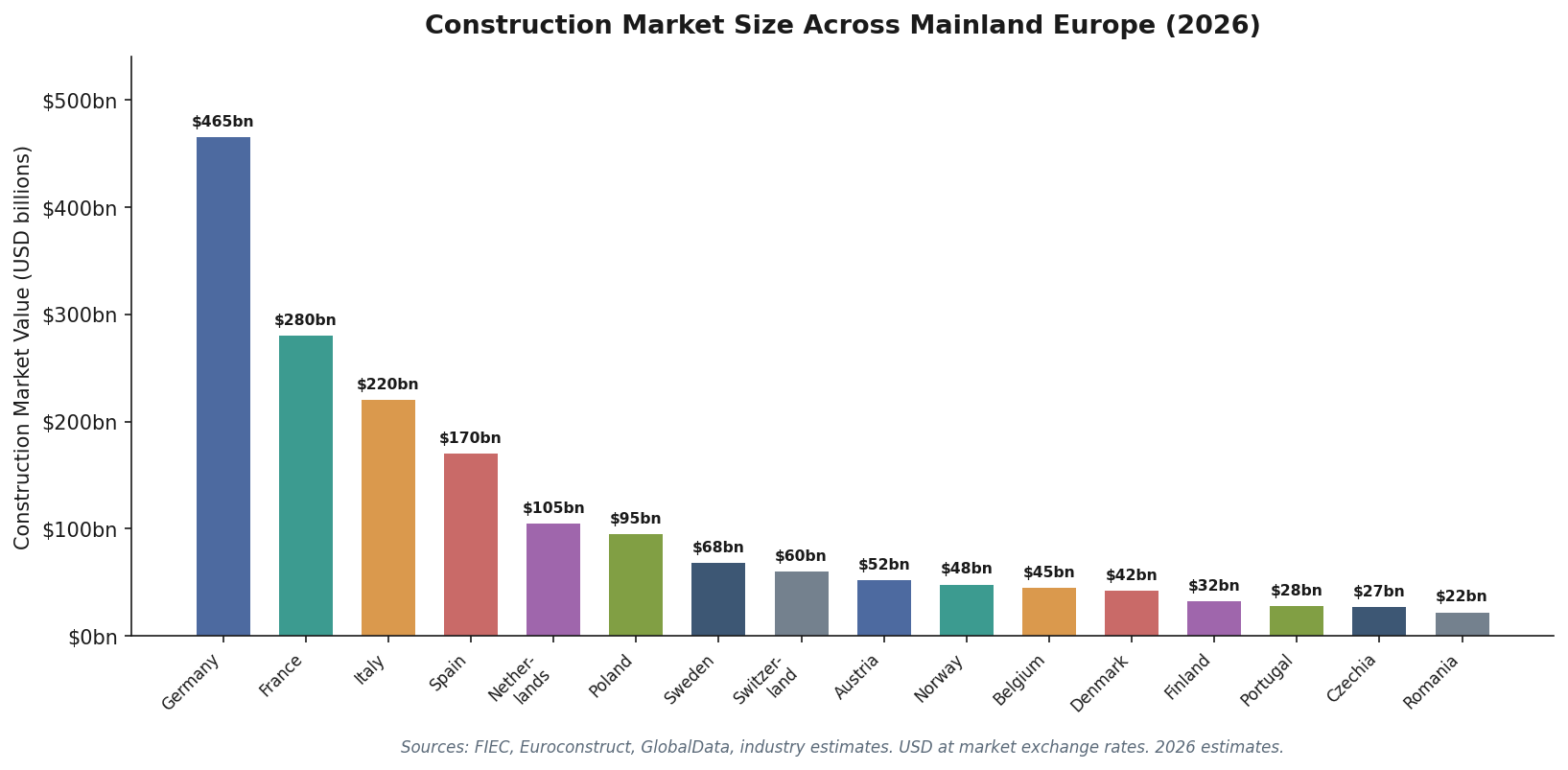
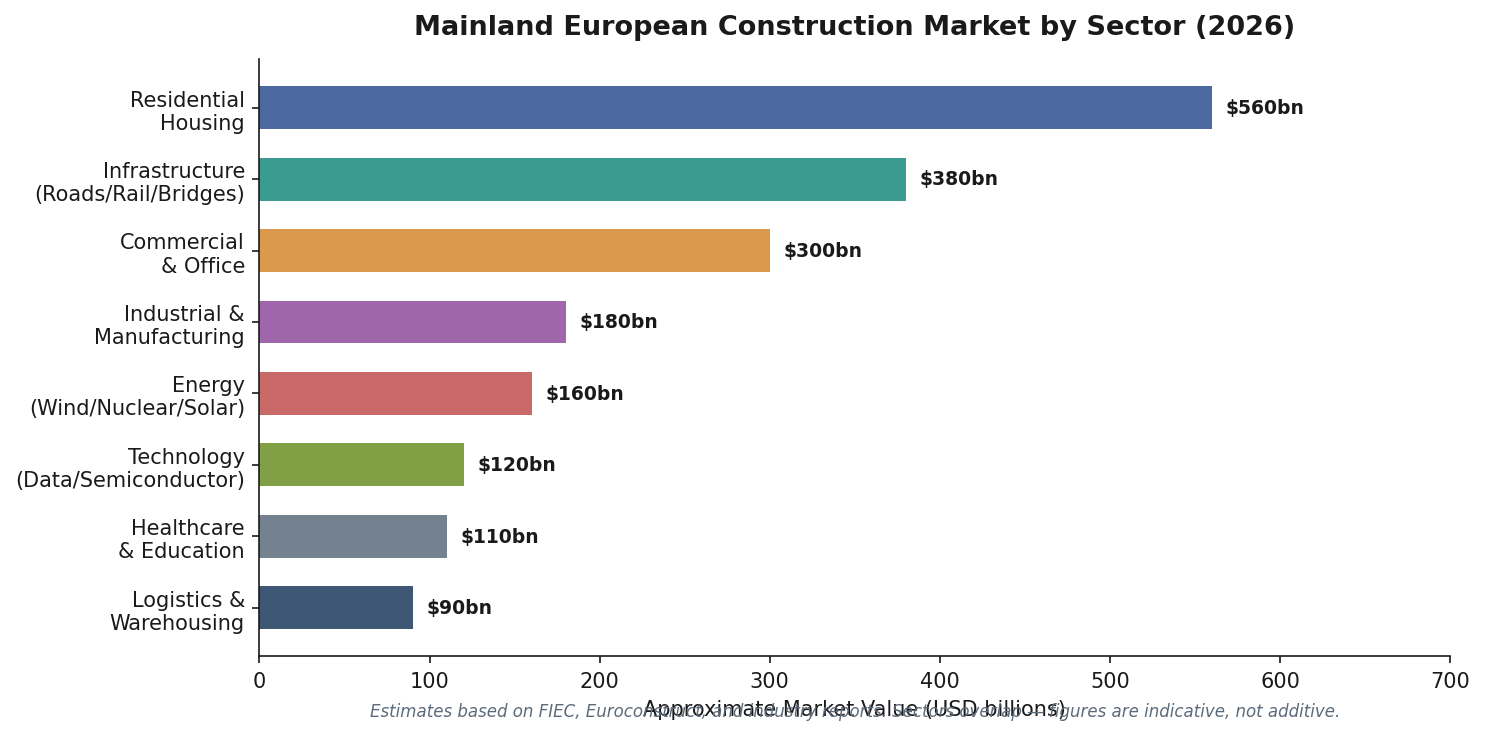
Mainland Europe’s combined construction market exceeds $1.9 trillion annually — making it one of the largest construction regions in the world. Germany ($465 billion), France ($280 billion), Italy ($220 billion), Spain ($170 billion), the Netherlands ($105 billion), Poland ($95 billion), and Switzerland ($60 billion) are among the continent’s major markets.
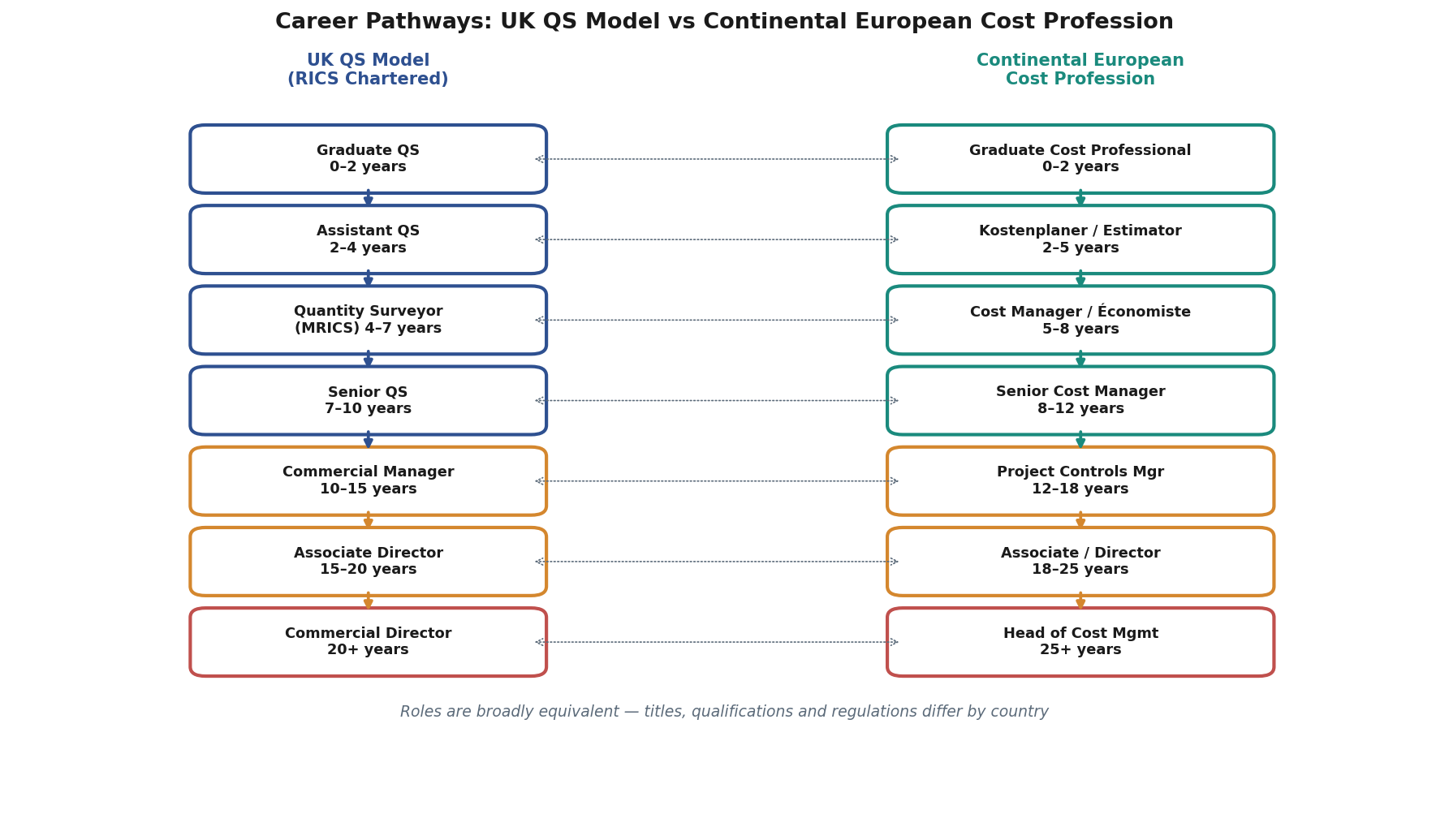
Yet the term “Quantity Surveyor” is not universally used across continental Europe. The profession that manages construction costs exists in every European country — but the title, regulatory framework, education pathway, and professional culture differ fundamentally from the British model.
In Germany, cost planning is performed by Kostenplaner, Kostenmanager, or by architects and engineers as part of their HOAI fee-scale services, governed by DIN 276. In France, the Économiste de la construction is a distinct, regulated profession with its own qualification body (OPQTECC). In Italy, the Computo Metrico Estimativo tradition governs measurement and pricing. In Scandinavia, cost management is integrated into engineering and project-management practices with a strong emphasis on sustainability and life-cycle costing. In Central and Eastern Europe, EU-funded infrastructure programmes have driven widespread adoption of FIDIC contracts and international cost-management practices.
This guide explains the profession across mainland Europe — its origins, national traditions, qualifications, institutions, career pathways, salaries, contracts, major employers, construction markets, and future. Europe is not a single construction market. The professional structures, contract forms, measurement conventions, and career opportunities differ between every country.
The Relationship Between Professional Titles
| Title | Focus | Where Used |
|---|---|---|
| Quantity Surveyor | Full lifecycle cost management — measurement, cost planning, procurement, contract admin, valuations, final account | International consultancies across Europe, UK-heritage markets |
| Kostenplaner / Kostenmanager | Cost planning, cost estimation, cost control under DIN 276 | Germany, Austria, German-speaking Switzerland |
| Économiste de la construction | Construction economics — cost estimation, measurement, tendering, cost control | France, Belgium (Wallonia), Luxembourg |
| Cost Manager / Cost Consultant | Client-side cost planning, benchmarking, cost control, change management | International consultancies across Europe |
| Cost Engineer | Engineering-based cost management, project controls, earned value, scheduling | Oil & gas, energy, mining, heavy industry — Europe-wide |
| Estimator / Pricing Engineer | Quantity take-off, unit pricing, bid preparation | Contractors across Europe |
| Commercial Manager | Contractor-side cost, procurement, subcontracts, claims, CVR | International contractors across Europe |
The Origins of Cost Management in Europe
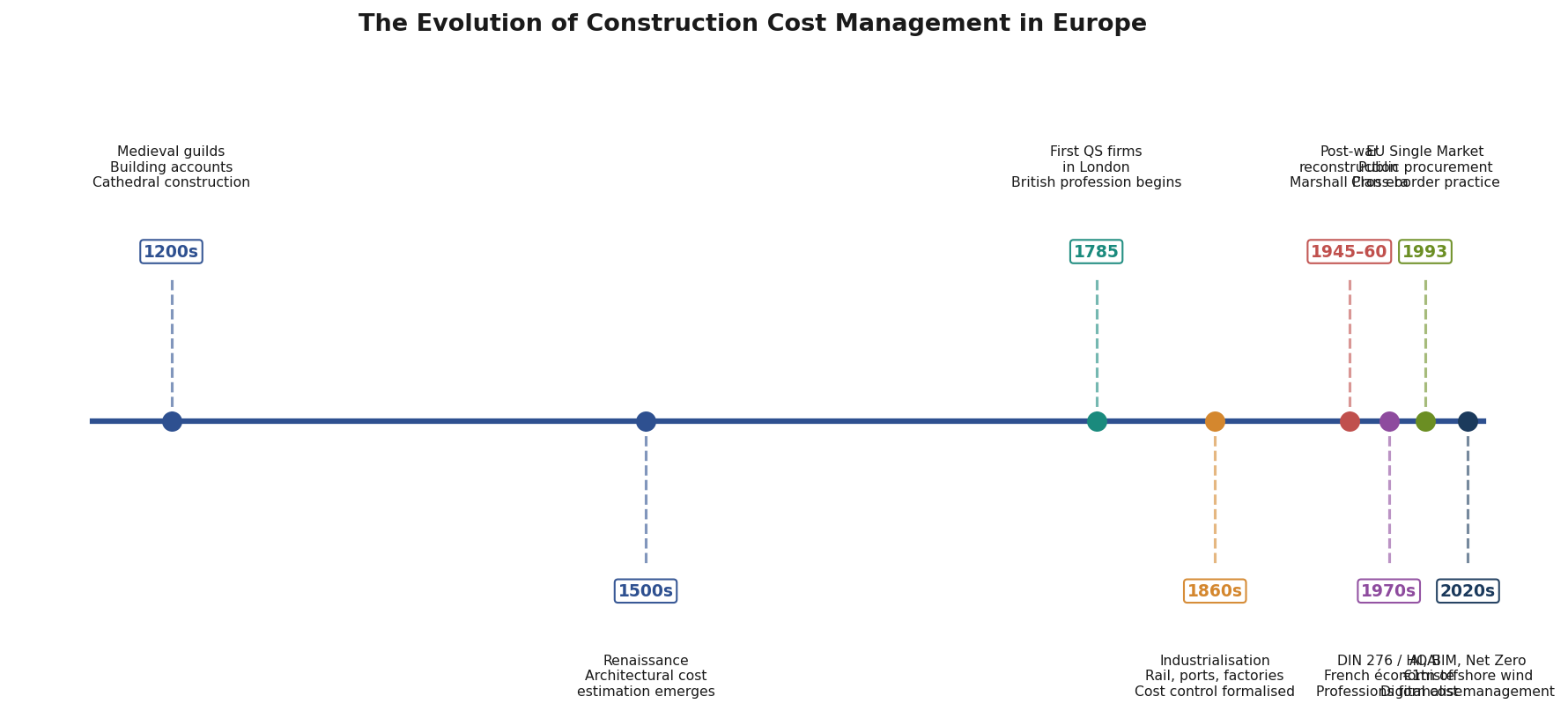
Construction cost management in Europe predates the British Quantity Surveying profession. Medieval building accounts from cathedral construction (Cologne, Chartres, Milan, Florence) demonstrate sophisticated cost tracking. Renaissance-era architects in Italy and France were expected to provide cost estimates. The first dedicated QS firms appeared in London in the late 18th century, but continental Europe developed cost management within the architecture and engineering professions rather than as a separate discipline.
The critical divergence came in the 19th century. Britain developed independent Quantity Surveying — a separate profession providing independent cost advice. Continental Europe retained cost planning as an integrated function within the architect or engineer’s service. This fundamental structural difference persists today, though international consultancies increasingly bridge the gap.
Evolution of the Profession
| Period | Development | Impact on Cost Profession |
|---|---|---|
| Pre-1800 | Medieval guilds, cathedral building accounts, Renaissance architectural cost estimation. | Cost tracking embedded in master builder / architect role. No separate profession. |
| 19th Century | Industrialisation. Railways, ports, factories. British QS profession formalises (RICS 1868). | UK develops independent QS profession. Continental Europe retains cost management within engineering/architecture. |
| 1945–1970 | Post-war reconstruction. Marshall Plan. Massive rebuilding across Europe. | German DIN standards develop. French construction economics formalises. OPQTECC founded (1965). |
| 1970s–1990s | HOAI established. EU formation. Cross-border infrastructure. International consultancies expand. | DIN 276 codified. HOAI defines cost-planning service scope. FIDIC adopted for EU-funded projects. |
| 1993–2010s | EU Single Market. Public procurement directives. EU expansion to Central/Eastern Europe. | EU procurement standardises tendering. FIDIC becomes standard for EU-funded CEE projects. RICS expands across Europe. |
| 2020s | EU Green Deal. Offshore wind. Nuclear. Semiconductor fabs. Data centres. AI. | $1.9tn+ market. Net Zero drives whole-life costing. Digital cost management. AI-assisted estimating. |
Germany
Germany has Europe’s largest construction market, valued at approximately $465 billion in 2026. After five years of decline, the industry returned to growth in 2026 (2.5% forecast), driven by residential recovery and increased infrastructure investment.
The German construction cost profession differs structurally from the British QS model. Cost planning (Kostenplanung) is governed by DIN 276 and is traditionally performed by architects or engineers as part of their HOAI fee-scale services. DIN 276 classifies costs into numbered groups (KG 100 Site, KG 200 Preliminary works, KG 300 Building construction, KG 400 Building services, etc.) and defines cost-determination stages from Kostenschätzung (estimate, ±30%) through Kostenberechnung (calculation, ±20%) to Kostenfeststellung (final determination).
VOB/B (Vergabe- und Vertragsordnung für Bauleistungen, Teil B) is the standard construction contract form — mandatory for public procurement and widespread in private projects. It is significantly shorter and less prescriptive than FIDIC or NEC.
UK QS vs German Terminology
| UK QS Term | German Equivalent | Notes |
|---|---|---|
| Cost Plan | Kostenplanung | Governed by DIN 276 |
| Cost Estimate | Kostenschätzung | HOAI LPH 2 — ±30% accuracy |
| Cost Plan (developed) | Kostenberechnung | HOAI LPH 3 — ±20% accuracy |
| Bill of Quantities | Leistungsverzeichnis (LV) | Specification of works with quantities and prices |
| Tender | Ausschreibung | Public procurement regulated by VOB/A |
| Final Account | Kostenfeststellung | Final cost determination after completion |
| Quantity Surveyor | Kostenplaner / Kostenmanager | Not a direct equivalent — function often within architect/engineer role |
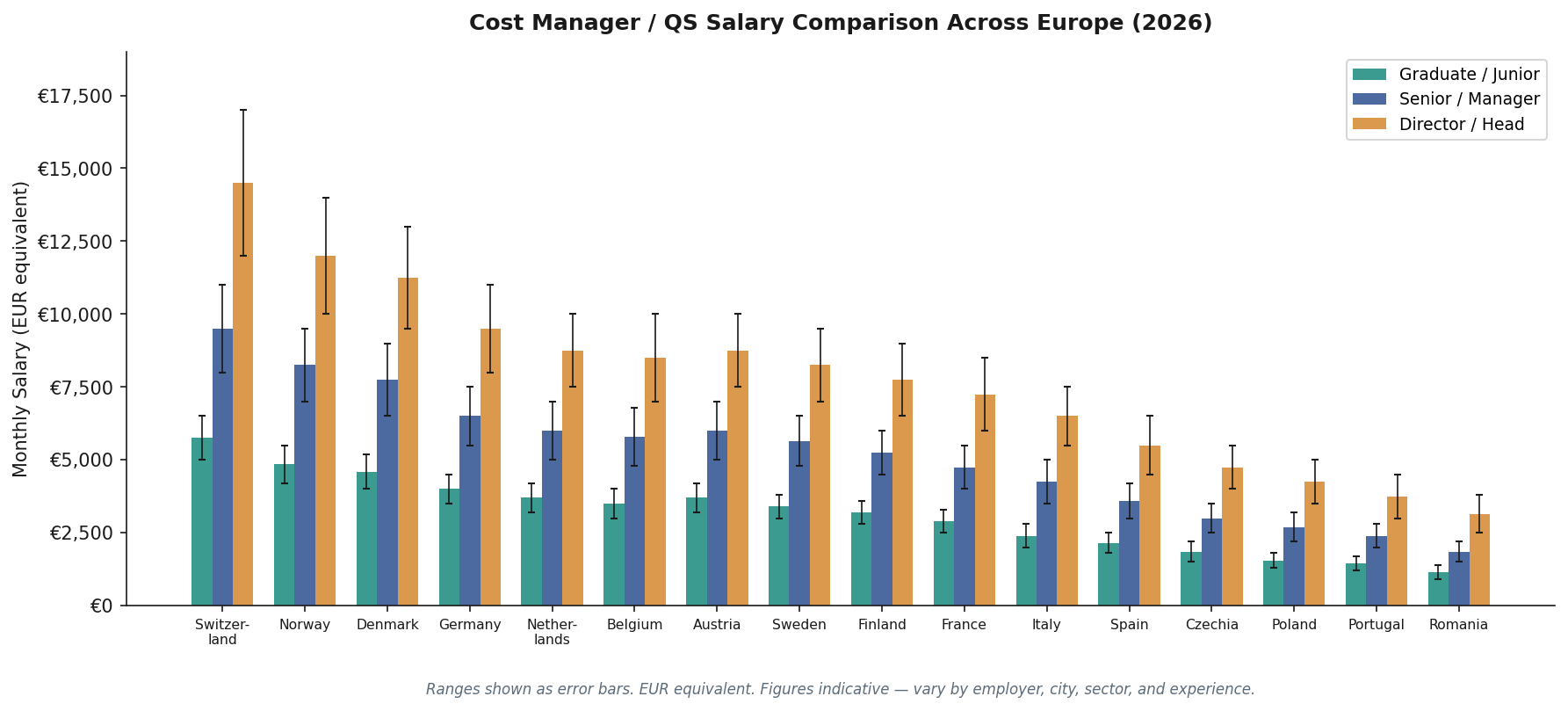
Salary ranges (2026): Graduate €3,500–4,500/month; Senior €5,500–7,500/month; Director €8,000–11,000+/month. Average QS/Cost Manager salary approximately €70,000/year.
Major sectors: Rail modernisation (Deutsche Bahn — €86 billion modernisation programme), Stuttgart 21 (€12 billion rail/urban development), automotive (BMW, Mercedes-Benz, Volkswagen plant investment), semiconductor (Intel Magdeburg, TSMC Dresden), data centres, residential (acute housing shortage), offshore wind (North Sea), energy transition (Energiewende), defence infrastructure, and healthcare.
France
France has Europe’s second-largest construction market, valued at approximately $280 billion in 2026. The French construction cost profession is the Économiste de la construction — a distinct, recognised profession with approximately 2,500 specialist firms.
The professional qualification body is OPQTECC (Organisme Professionnel de Qualification Technique des Économistes et Coordonnateurs de la Construction), established in 1965. OPQTECC qualification requires a minimum Bac+2/3 education (BTS, BUT, or licence professionnelle in Études et Économie de la Construction) and two years of professional experience.
The Économiste de la construction performs all core QS functions: cost estimation, quantity measurement (using the Descriptif Quantitatif Estimatif — DQE), tendering, cost control, and final account. The profession works alongside architects, engineers, and project managers.
Salary ranges (2026): Graduate €2,500–3,300/month; Senior €4,000–5,500/month; Director €6,000–8,500+/month.
Major sectors: Grand Paris Express (€36 billion — Europe’s largest infrastructure project, 200 km of new metro, 68 stations), nuclear (EDF — new EPR reactors, decommissioning), high-speed rail (LGV extensions), airports (Charles de Gaulle modernisation), Olympic 2024 legacy, residential (national housing programme), offshore wind (Normandy, Brittany, Mediterranean), defence, and healthcare.
Netherlands
The Netherlands has a construction market valued at approximately $105 billion in 2026. The Dutch construction industry is a European leader in digital construction, BIM, and sustainability. Cost management is well integrated into construction practice, with a strong tradition of quantity measurement and project controls.
The Netherlands is one of the most accessible European markets for English-speaking professionals. English is widely spoken in business and on international projects. International consultancies have significant Dutch operations. RICS has an active Regional Advisory Board for the BeNeLux region.
Salary ranges (2026): Graduate €3,200–4,200/month; Senior €5,000–7,000/month; Director €7,500–10,000+/month.
Major sectors: Data centres (Amsterdam is Europe’s largest data centre hub), infrastructure (Delta Programme — flood protection and climate adaptation), rail (ProRail investment programme), residential (acute housing shortage — 900,000+ homes needed), offshore wind (North Sea), logistics and warehousing (Rotterdam, Schiphol corridor), high-rise (Rotterdam, The Hague), and sustainable construction.
Spain and Portugal
Spain has Europe’s fifth-largest construction market, valued at approximately $170 billion in 2026 (3.9% growth forecast). Construction cost management in Spain is integrated into the engineering and architecture professions. Quantity measurement and cost estimation are performed by Arquitectos Técnicos (Technical Architects) and quantity specialists. Major sectors include high-speed rail (AVE network — one of Europe’s most extensive), renewable energy (Spain is Europe’s leading solar market), residential, tourism and hospitality, data centres, and infrastructure.
Portugal has a growing construction market valued at approximately $28 billion in 2026 (4.4% growth — among Europe’s highest). Major sectors include residential (Lisbon and Porto housing demand), tourism, infrastructure (new Lisbon airport at Montijo), and renewable energy. Portuguese-speaking markets (Brazil, Angola, Mozambique) provide international opportunities for Portuguese-trained professionals.
Italy
Italy has Europe’s third-largest construction market, valued at approximately $220 billion in 2026, significantly boosted by the PNRR (Piano Nazionale di Ripresa e Resilienza) — Italy’s €194.4 billion Recovery and Resilience Plan funded by the EU.
Italian construction cost management centres on the Computo Metrico Estimativo — the traditional system for quantity measurement and cost estimation using regional price books (prezzari regionali). Cost management is performed by engineers (ingegneri), architects (architetti), and quantity specialists (geometri).
Salary ranges (2026): Graduate €2,000–2,800/month; Senior €3,500–5,000/month; Director €5,500–7,500+/month.
Major sectors: High-speed rail (AV/AC — Italy has one of Europe’s most advanced HSR networks), metro systems (Milan M4, Naples, Rome), bridges (Strait of Messina Bridge — under construction), road and motorway, residential (Superbonus renovation programme), energy (nuclear return under consideration), and PNRR-funded infrastructure and digitisation projects.
Switzerland and Austria
Switzerland has a construction market valued at approximately $60 billion in 2026. Swiss construction is characterised by exceptionally high quality standards, precision, and cost. The Swiss cost planning system uses BKP (Baukostenplan) — the standardised construction cost code (SN 506 500) — and SIA (Swiss Society of Engineers and Architects) norms. Bills of quantities are based on the NPK (Normpositionen-Katalog). Language requirements depend on canton: German (Zürich, Bern, Basel), French (Geneva, Lausanne), or Italian (Ticino).
Austria has a construction market valued at approximately $52 billion in 2026. Austrian construction practice is closely aligned with Germany, using DIN standards and ÖNORM (Austrian national standards). Cost planning follows similar principles to Germany. Vienna, Graz, and Salzburg are major construction centres.
Swiss salary ranges (2026): Graduate CHF 5,500–7,500/month; Senior CHF 8,500–12,000/month; Director CHF 13,000–18,000+/month. Switzerland offers the highest absolute salaries for cost professionals in Europe.
Scandinavia
The Nordic countries — Sweden, Denmark, Norway, Finland — have combined construction markets exceeding $190 billion. Scandinavian construction is characterised by sustainability leadership, advanced BIM adoption, life-cycle costing, whole-life carbon assessment, and strong public-sector investment.
Norway ($48 billion market) offers the highest salaries after Switzerland, driven by oil and gas infrastructure, offshore wind, road and tunnel construction, and residential. Denmark ($42 billion) is home to major infrastructure projects including the Fehmarnbelt Fixed Link (€7.4 billion — world’s longest immersed tunnel). Sweden ($68 billion) has a strong construction market led by Skanska and NCC. Finland ($32 billion) has a smaller but technologically advanced market.
Key Scandinavian characteristics: Life-cycle costing and whole-life carbon are integrated into procurement. BIM is advanced. Sustainability requirements are among the world’s most demanding. English is widely spoken, though local language skills are valued. International consultancies have Nordic offices.
Central and Eastern Europe
Poland is Central Europe’s largest and most dynamic construction market, valued at approximately $95 billion in 2026 (exceeding PLN 400 billion). Poland is launching the CPK (Centralny Port Komunikacyjny) high-speed rail programme — the first in Central and Eastern Europe — with PLN 40 billion+ in tenders during 2026. EU funding of approximately €8 billion (2021–2027) supports railway modernisation. FIDIC is widely used on EU-funded projects.
Czechia ($27 billion), Romania ($22 billion), Hungary, Slovakia, Slovenia, Croatia, and the Baltic States all have growing construction markets driven by EU cohesion funding, infrastructure investment, and urbanisation. FIDIC is the standard contract form for EU-funded projects across the region. International consultancies and contractors are active.
Major Construction Markets
Professional Institutions
| Country | Institution / Body | Professional Title | RICS Recognition |
|---|---|---|---|
| Germany | Architects’ / Engineers’ Chambers; HypZert (valuation) | Kostenplaner, Kostenmanager, Dipl.-Ing. | RICS cooperation with HypZert |
| France | OPQTECC | Économiste de la construction | RICS present in France |
| Netherlands | RICS BeNeLux RAB | Cost Manager, QS, Project Manager | RICS active (BeNeLux RAB) |
| Spain | Colegios de Arquitectos Técnicos | Arquitecto Técnico, Ingeniero | RICS present in Spain |
| Italy | Ordine degli Ingegneri; Ordine degli Architetti; Collegio dei Geometri | Ingegnere, Architetto, Geometra | RICS present in Italy |
| Switzerland | SIA (Swiss Society of Engineers and Architects) | Kostenplaner, Bauleiter, Ingenieur | RICS recognised |
| Scandinavia | National engineering associations | Cost Manager, Project Manager, Ingeniør | RICS present in Nordics |
| Poland | PIIB (Polish Chamber of Civil Engineers) | Inżynier budowy, Kosztorysant | RICS growing presence |
Education Pathways
| Country | University | Qualification | Duration |
|---|---|---|---|
| Germany | TU München | BSc/MSc Bauingenieurwesen (Civil Engineering) | 3+2 years |
| Germany | TU Berlin | BSc/MSc Bauingenieurwesen | 3+2 years |
| France | ESTP Paris | Diplôme d’Ingénieur / BTS EEC | 2–5 years |
| France | CNAM | Licence Pro / Master Génie Civil | 3–5 years |
| Netherlands | TU Delft | MSc Construction Management & Engineering | 2 years (MSc) |
| Italy | Politecnico di Milano | BSc/MSc Ingegneria Edile | 3+2 years |
| Spain | UPM Madrid | Grado en Ingeniería de Edificación | 4 years |
| Switzerland | ETH Zürich | BSc/MSc Bauingenieurwissenschaften | 3+2 years |
| Sweden | KTH Stockholm | MSc Civil & Architectural Engineering | 2 years (MSc) |
| Denmark | DTU Copenhagen | MSc Civil Engineering | 2 years (MSc) |
| Poland | Warsaw University of Technology | BSc/MSc Budownictwo (Construction) | 3.5+1.5 years |
| Austria | TU Wien | BSc/MSc Bauingenieurwesen | 3+2 years |
Career Pathways
Salaries and Compensation
| Country | Graduate (monthly) | Senior (monthly) | Director (monthly) | Currency |
|---|---|---|---|---|
| Switzerland | CHF 5,500–7,500 | CHF 8,500–12,000 | CHF 13,000–18,000+ | CHF |
| Norway | NOK 42,000–55,000 | NOK 60,000–85,000 | NOK 90,000–130,000+ | NOK |
| Denmark | DKK 30,000–39,000 | DKK 45,000–62,000 | DKK 68,000–95,000+ | DKK |
| Germany | €3,500–4,500 | €5,500–7,500 | €8,000–11,000+ | EUR |
| Netherlands | €3,200–4,200 | €5,000–7,000 | €7,500–10,000+ | EUR |
| Belgium | €3,000–4,000 | €4,800–6,800 | €7,000–10,000+ | EUR |
| Austria | €3,200–4,200 | €5,000–7,000 | €7,500–10,000+ | EUR |
| Sweden | SEK 32,000–40,000 | SEK 45,000–60,000 | SEK 65,000–90,000+ | SEK |
| Finland | €2,800–3,600 | €4,500–6,000 | €6,500–9,000+ | EUR |
| France | €2,500–3,300 | €4,000–5,500 | €6,000–8,500+ | EUR |
| Italy | €2,000–2,800 | €3,500–5,000 | €5,500–7,500+ | EUR |
| Spain | €1,800–2,500 | €3,000–4,200 | €4,500–6,500+ | EUR |
| Poland | PLN 6,500–9,000 | PLN 11,000–16,000 | PLN 18,000–25,000+ | PLN |
| Czechia | CZK 35,000–50,000 | CZK 55,000–80,000 | CZK 90,000–130,000+ | CZK |
| Portugal | €1,200–1,700 | €2,000–2,800 | €3,000–4,500+ | EUR |
| Romania | RON 4,500–7,000 | RON 8,000–11,000 | RON 13,000–19,000+ | RON |
Major Construction Sectors
Major Projects in Europe
| Project | Country | Est. Value | Sector |
|---|---|---|---|
| Grand Paris Express | France | €36 billion | Metro (200 km, 68 stations) |
| Stuttgart 21 | Germany | €12 billion | Rail / urban development |
| Fehmarnbelt Fixed Link | Denmark–Germany | €7.4 billion | Tunnel (18 km immersed) |
| CPK High-Speed Rail | Poland | PLN 40 billion+ | HSR (Warsaw–Łódź–Wrocław/Poznań) |
| DB Rail Modernisation | Germany | €86 billion | Rail infrastructure |
| North Sea Offshore Wind | Multiple (DE, NL, DK, NO) | €1 trillion+ (pipeline) | Offshore wind (100 GW target) |
| Intel Magdeburg | Germany | €30 billion+ | Semiconductor fabrication |
| TSMC Dresden | Germany | €10 billion+ | Semiconductor fabrication |
| Strait of Messina Bridge | Italy | €12 billion+ | Bridge (3.3 km) |
| French EPR Nuclear Programme | France | €50 billion+ | Nuclear new-build (6 EPR2 reactors) |
| European Data Centres | NL, DE, DK, SE, IE | €50 billion+ (pipeline) | Data centres / AI infrastructure |
| Lyon–Turin Rail Link | France–Italy | €26 billion+ | HSR / base tunnel (57 km) |
Major Consultancy and Contractor Firms
| Firm | Type | HQ | European Presence |
|---|---|---|---|
| Arcadis | Consultancy | Amsterdam, NL | Europe-wide — largest European-HQ’d cost consultancy |
| Turner & Townsend | Consultancy | Leeds, UK | Germany, France, Netherlands, Spain, Nordics, Poland |
| AECOM | Consultancy | Dallas, USA | Europe-wide — infrastructure, energy, commercial |
| Mace | Consultancy | London, UK | Data centres, commercial across Europe |
| Linesight | Consultancy | Dublin, IE | Data centres specialist — Europe-wide |
| VINCI | Contractor | Nanterre, FR | Europe’s largest contractor — concessions, construction, energy |
| Bouygues | Contractor | Paris, FR | France, UK, Central Europe — building, civil, energy |
| STRABAG | Contractor | Vienna, AT | Central Europe, Germany, Austria — €17.4bn revenue |
| HOCHTIEF | Contractor | Essen, DE | Germany, Europe-wide — part of ACS Group |
| Skanska | Contractor | Stockholm, SE | Nordics, Central Europe, UK — sustainability leader |
| Ferrovial | Contractor | Amsterdam (ex-Madrid) | Spain, UK, Poland — infrastructure, concessions |
| Webuild | Contractor | Milan, IT | Italy, Europe-wide — HSR, tunnels, dams |
Contracts and Procurement
| Contract / Framework | Main Countries | Typical Use | Cost Professional Role |
|---|---|---|---|
| VOB/B | Germany | Standard form — public (mandatory) and private. Short and less prescriptive than FIDIC. | LV preparation, cost control, final account (Kostenfeststellung). |
| FIDIC | CEE (PL, RO, BG, CZ), cross-border | EU-funded infrastructure, energy, mining. Red, Yellow, Silver Books. | BOQ, IPC, variations, claims, post-contract cost management. |
| French Standard Forms | France | CCAG (public works), NF P 03-001 (private). | DQE, cost control, décompte général. |
| SIA Standards | Switzerland | SIA 118 (general conditions), BKP cost codes, NPK measurement. | Cost planning (BKP), LV, cost control. |
| EU Procurement Directives | All EU/EEA member states | Public procurement above thresholds. Open, restricted, competitive dialogue. | Cost estimation, tender evaluation, value engineering. |
| EPC / EPCM | Europe-wide (energy, industrial) | Turnkey. Oil & gas, nuclear, offshore wind, semiconductor. | Cost engineering, earned value, project controls. |
EU Procurement and Regulation
EU public procurement directives establish common rules for all member states when awarding contracts above specified thresholds. The principles of transparency, equal treatment, non-discrimination, and proportionality govern all public procurement across the EU. Framework agreements, competitive dialogue, and design contests are common procurement mechanisms. Sustainability criteria, social-value considerations, and environmental requirements are increasingly embedded in EU procurement. The European Single Procurement Document (ESPD) simplifies cross-border tendering.
Construction Cost Standards
| Standard | Country | Purpose |
|---|---|---|
| DIN 276 | Germany, Austria | Construction cost classification, determination, and control |
| BKP (SN 506 500) | Switzerland | Construction cost code — standardised cost classification |
| NRM | UK (used internationally) | New Rules of Measurement — RICS cost management standard |
| ICMS | International | International Cost Management Standard — global framework bridging national systems |
| Computo Metrico | Italy | Quantity measurement and cost estimation using regional price books |
Working in Europe as a UK Quantity Surveyor
What transfers directly: Cost planning, measurement, contract administration, claims management, commercial reporting, and RICS chartership. The core QS skill set is valued across Europe, particularly at international consultancies.
Post-Brexit considerations: UK professionals need work permits and residence permits for EU/EEA countries. Recognition of qualifications varies by country. The EU Mutual Recognition of Professional Qualifications Directive no longer applies automatically to UK-qualified professionals, though bilateral agreements exist in some countries.
Language requirements: German essential in Germany and Austria. French essential in France and Wallonia. Dutch an advantage in the Netherlands (though English widely used). Spanish essential in Spain. Italian essential in Italy. English is widely sufficient in Scandinavia and the Netherlands for international consultancy roles.
Most accessible markets for UK QS professionals: Netherlands (English-speaking), Scandinavia (English widely used), Germany (international consultancy roles), and Ireland (common law, English-speaking).
Sustainability and the European QS
The EU Green Deal and European Climate Law are transforming the cost profession. European cost professionals are increasingly involved in whole-life carbon assessment, embodied carbon measurement, life-cycle costing, circular economy principles, and sustainable procurement. Scandinavia leads in integrating cost and carbon. The Netherlands is a leader in circular construction. Germany’s Energiewende drives massive investment in renewable energy infrastructure. The European QS is evolving from cost-only to cost + carbon + value + sustainability advisory.
Digital Transformation
BIM is advanced across Northern Europe, particularly in Scandinavia, Netherlands, and Germany. 5D BIM (cost-linked models) is growing. CostX, Bluebeam, Autodesk Construction Cloud, Primavera P6, SAP, Oracle, and Power BI are widely used. AI-assisted estimating and automated quantity take-off are emerging. Digital twins are being adopted for major infrastructure. The Netherlands and Scandinavian countries lead in digital construction maturity.
The Future of Quantity Surveying in Europe
The outlook for cost management professionals in Europe is exceptionally strong. The continent faces €1 trillion+ in offshore wind investment, nuclear new-build and decommissioning programmes, high-speed rail expansion (Grand Paris Express, CPK Poland, Lyon–Turin), acute housing shortages across Germany, Netherlands, and Scandinavia, data centre and semiconductor facility construction, defence infrastructure investment, and climate adaptation programmes. The cost professional who combines measurement and estimating skills with digital fluency, sustainability expertise, FIDIC/VOB knowledge, and European market understanding will be in extraordinary demand.
Best European Markets for Cost Professionals — Ranking
| Rank | Country | Strength | Notes |
|---|---|---|---|
| 1 | Germany | Largest European market ($465bn). Rail, semiconductor, data centres, energy. Strong salaries. | German language essential. DIN 276 / VOB/B knowledge needed. |
| 2 | Netherlands | Digital leader. Data centres. English-speaking. RICS active. Strong salaries. | Most accessible for English-speaking QS. Housing shortage drives demand. |
| 3 | Switzerland | Highest salaries in Europe. Premium quality. World-class infrastructure. | German/French/Italian required. Non-EU — separate work permits. |
| 4 | Norway | Second-highest salaries. Oil & gas, offshore wind, infrastructure. | Norwegian useful but English widely spoken. Non-EU (EEA). |
| 5 | Denmark | Fehmarnbelt. Offshore wind. Sustainability leader. Strong salaries. | English widely spoken. Advanced BIM and sustainability. |
| 6 | France | Second-largest market. Grand Paris Express. Nuclear. HSR. | French essential. Économiste profession well established. |
| 7 | Sweden | Sustainability leader. Skanska HQ. Strong construction market. | English widely spoken. Advanced life-cycle costing. |
| 8 | Poland | Fastest-growing major European market. CPK HSR. EU funding. FIDIC standard. | Polish useful. Growing international consultancy presence. |
| 9 | Italy | Third-largest market. PNRR investment. HSR. Messina Bridge. | Italian essential. Strong local profession. |
| 10 | Spain | Fifth-largest market. Renewables leader. AVE HSR. Tourism construction. | Spanish essential. Solar energy construction booming. |
This ranking is indicative and based on a composite assessment of market size, salary potential, demand, professional recognition, infrastructure pipeline, and accessibility for international professionals. It is not absolute.
Frequently Asked Questions
Is Quantity Surveying a profession in Germany?
The British QS title is not widely used. The equivalent functions are performed by Kostenplaner, Kostenmanager, or by architects and engineers as part of their HOAI services. International consultancies use the Cost Manager and Quantity Surveyor titles.
What is the German equivalent of a Quantity Surveyor?
The closest equivalents are the Kostenplaner (cost planner) and Kostenmanager (cost manager). Cost planning is governed by DIN 276 and traditionally performed by architects or engineers under HOAI.
What is an Économiste de la construction?
The French equivalent of a Quantity Surveyor. Approximately 2,500 specialist firms operate in France. The professional qualification body is OPQTECC, established in 1965. The Économiste manages all construction costs from pre-design through completion.
Is Quantity Surveying common in France?
Yes, but under the Économiste de la construction title. The profession is well established and regulated through OPQTECC.
Can a UK Quantity Surveyor work in Germany?
Yes. International consultancies actively recruit MRICS-qualified professionals. Post-Brexit, a work permit is required. German language skills are a significant advantage.
Can a UK QS work in France?
Yes. International consultancies employ MRICS-qualified professionals. French language skills are essential. Post-Brexit, a work permit is required.
Is RICS recognised in Europe?
Yes. RICS has a Europe World Regional Board and regional advisory boards across the continent. RICS has cooperation agreements with national bodies including HypZert (Germany). MRICS is widely recognised by international consultancies.
Is RICS recognised in Germany?
Yes. RICS has a cooperation agreement with HypZert renewed in 2024. RICS is recognised by international consultancies operating in Germany.
Is RICS recognised in France?
Yes. RICS operates in France with a regional advisory board. MRICS is recognised by international consultancies.
What is DIN 276?
DIN 276 is the German standard for construction cost classification and management. It provides a systematic framework for determining, structuring, and controlling costs across all project phases. It classifies costs into numbered groups and defines cost-determination stages.
What is HOAI?
HOAI (Honorarordnung für Architekten und Ingenieure) is the German fee scale for architects and engineers. It defines services across nine performance phases, including cost estimation (LPH 2), cost calculation (LPH 3), and cost control. HOAI integrates cost planning as a core architect/engineer responsibility.
What is VOB/B?
VOB/B is the German standard construction contract form. It covers execution deadlines, acceptance, remuneration, variation orders, warranty, and termination. It is mandatory for public procurement and widespread in private projects.
What is the European equivalent of a Bill of Quantities?
Germany uses the Leistungsverzeichnis (LV). France uses the Descriptif Quantitatif Estimatif (DQE). Italy uses the Computo Metrico Estimativo. Switzerland uses the LV based on NPK. Each country has its own conventions.
Is FIDIC used in Europe?
Yes, particularly on EU-funded infrastructure in Central and Eastern Europe (Poland, Romania, Bulgaria, Czechia) and on cross-border projects. Western European countries tend to use domestic standard forms for domestic projects.
Is NEC used in Mainland Europe?
NEC has limited use in mainland Europe. Domestic standard forms dominate. Some UK-headquartered organisations use NEC on European projects.
What contracts are common in Germany?
VOB/B is the standard form. FIDIC is used on internationally funded projects. BGB (German Civil Code) provides the underlying legal framework. HOAI governs architect and engineer fees.
What does a Cost Manager earn in Germany?
Graduate €3,500–4,500/month; Senior €5,500–7,500/month; Director €8,000–11,000+/month. Average approximately €70,000/year (2026 figures).
What does a Quantity Surveyor earn in France?
Graduate €2,500–3,300/month; Senior €4,000–5,500/month; Director €6,000–8,500+/month (2026 figures). Paris salaries significantly higher than regional France.
Which European country pays QS professionals the most?
Switzerland offers the highest absolute salaries, followed by Norway and Denmark. Germany, Netherlands, and Belgium offer strong salaries relative to cost of living.
Is Switzerland a good market for Quantity Surveyors?
Yes. Strong construction market, highest European salaries, world-class infrastructure, demanding quality standards. Language skills (German, French, or Italian) are essential.
Do I need to speak German to work as a QS in Germany?
For most positions, yes. International consultancies sometimes operate in English on international projects (data centres, semiconductors). Basic professional German is a minimum for most roles.
Do I need French to work in France?
Yes. French is essential for virtually all construction roles in France.
Can an English-speaking QS work in the Netherlands?
The Netherlands is one of the most accessible European markets for English-speaking professionals. International consultancies often operate in English. Dutch is an advantage for domestic projects.
Which European countries have the greatest demand for cost professionals?
Germany, Netherlands, and the Nordic countries have the strongest demand. Poland and Central Europe are growing rapidly. France and Spain have significant markets.
What universities offer Quantity Surveying in Europe?
Notable programmes include TU München, TU Berlin (Germany), ESTP Paris, CNAM (France), TU Delft (Netherlands), Politecnico di Milano (Italy), KTH Stockholm (Sweden), DTU Copenhagen (Denmark), ETH Zürich (Switzerland), and Warsaw University of Technology (Poland).
Can a European Cost Manager obtain RICS chartership?
Yes. RICS APC is available across Europe. European professionals with relevant degrees and experience can apply. Assessments are conducted in multiple European cities.
What is ICMS?
The International Cost Management Standard provides a global framework for classifying, defining, measuring, recording, analysing, and presenting construction costs. It helps bridge different national systems (DIN 276, NRM, etc.).
How is construction cost planning different in Europe?
In continental Europe, cost planning is often integrated into the architect or engineer’s service (e.g., under HOAI in Germany). In the UK, cost planning is typically performed by an independent Quantity Surveyor. The underlying principles are the same.
What is the difference between Cost Management and Quantity Surveying?
Quantity Surveying is the traditional British term. Cost Management is a broader, more internationally neutral term. In continental Europe, Cost Manager is more commonly used. At senior levels, the functions are identical.
How important is sustainability to the European QS?
Extremely important. The EU Green Deal and European Climate Law are driving sustainability into every project. European cost professionals are increasingly involved in whole-life carbon, life-cycle costing, circular economy, and sustainable procurement.
Will AI replace Quantity Surveyors in Europe?
AI will transform, not replace, the profession. AI-assisted take-off, automated benchmarking, and predictive modelling are in use. Commercial judgement, negotiation, and client advisory require human expertise.
What is the future of Quantity Surveying in Europe?
Exceptionally strong. €1 trillion+ offshore wind, nuclear programmes, HSR, housing, data centres, semiconductors, defence, and climate adaptation are driving unprecedented demand.
What are the biggest construction projects in Europe?
Grand Paris Express (€36bn), Stuttgart 21 (€12bn), Fehmarnbelt (€7.4bn), CPK Poland (PLN 40bn+), DB Rail Modernisation (€86bn), North Sea Offshore Wind (€1tn+ pipeline), Intel Magdeburg (€30bn+), and French EPR Nuclear (€50bn+).
Which firms employ Quantity Surveyors in Europe?
International consultancies: Arcadis, Turner & Townsend, AECOM, Mace, AtkinsRéalis, WSP, RLB, Gleeds, Linesight. Major contractors: VINCI, Bouygues, STRABAG, HOCHTIEF, Skanska, Ferrovial, Webuild.
What challenges do cost professionals face in Europe?
Multiple standards, multiple languages, regulatory differences, labour shortages, material-price volatility, EU procurement complexity, Brexit implications, currency differences, and continuous digital upskilling.
Europe Quantity Surveying Knowledge Hub
This article is the pillar page for ProQS.site’s Mainland Europe Quantity Surveying and Cost Management content network. Future dedicated country guides are planned for: Germany, France, Netherlands, Spain, Italy, Switzerland, Austria, Belgium, Sweden, Denmark, Norway, Finland, Poland, Czechia, Portugal, and Romania.
Cross-Links
- Quantity Surveying in the Middle East
- Quantity Surveying in Africa
- Quantity Surveying in the Americas
- Quantity Surveying in Asia
- Post-Contract Cost Management
- NRM 1 and Cost Planning
- Early Warning Under NEC4
- Bonds, Guarantees and Warranties
- Role of the Employer’s Agent
- Key Performance Indicators in Construction