Quantity Surveying in Australasia
Introduction: Quantity Surveying in Australasia
Australasia has one of the world’s most established Quantity Surveying professions. Both Australia and New Zealand inherited the British QS model through their colonial and Commonwealth heritage, and have developed it into a mature, internationally respected profession.
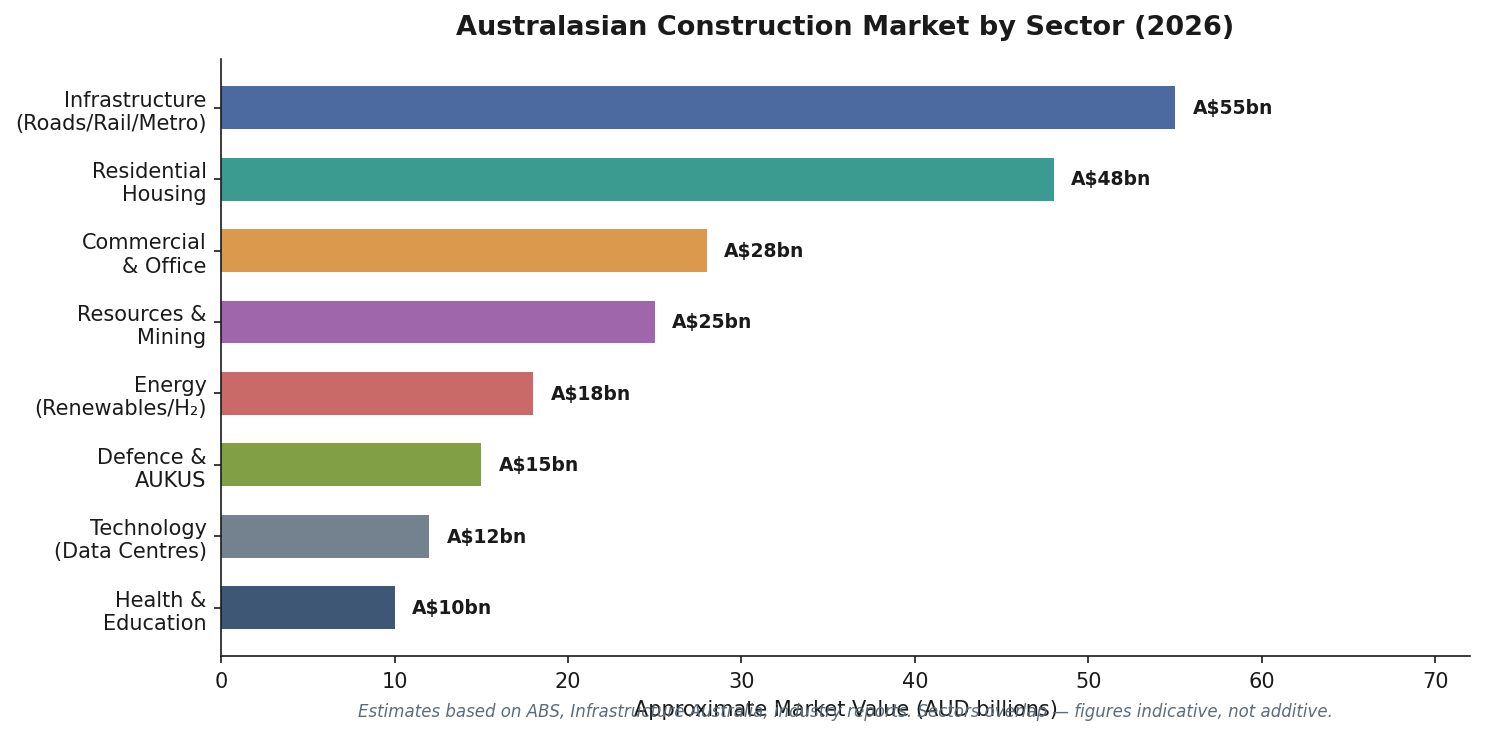
Australia’s construction market is valued at approximately AUD 193 billion in 2026 — the largest in Oceania and one of the largest in the Asia-Pacific. New Zealand’s market is approximately NZD 38 billion. Together with emerging Pacific markets (Papua New Guinea, Fiji, Samoa, and others), Australasia represents a significant global construction region.
The Quantity Surveying profession in Australasia is represented by the Australian Institute of Quantity Surveyors (AIQS), the New Zealand Institute of Quantity Surveyors (NZIQS), and RICS Oceania. The profession encompasses a range of titles and specialisations.
The Relationship Between Professional Titles
| Title | Focus | Typical Employer |
|---|---|---|
| Quantity Surveyor | Full lifecycle cost management — measurement, cost planning, procurement, contract admin, valuations, final account | Consultancies, government, client-side |
| Cost Manager / Cost Consultant | Client-side cost planning, benchmarking, cost control, change management, reporting | Consultancies (RLB, WT, T&T, AECOM) |
| Commercial Manager | Contractor-side commercial performance — subcontracts, variations, claims, CVR, forecasting | Contractors (CPB, Lendlease, Multiplex, John Holland) |
| Estimator | Quantity take-off, unit pricing, bid preparation, tender analysis | Contractors, specialist estimating firms |
| Contracts Administrator | Contract compliance, progress claims, variations, extensions of time, practical completion | Consultancies, contractors, government |
| Construction Economist | Market analysis, cost indices, forecasting, feasibility, development appraisal | Consultancies, research, government |
| Project Controls Professional | Integrated cost, schedule, risk, and performance management | Resources, energy, defence, major infrastructure |
The Origins of Quantity Surveying in Australasia
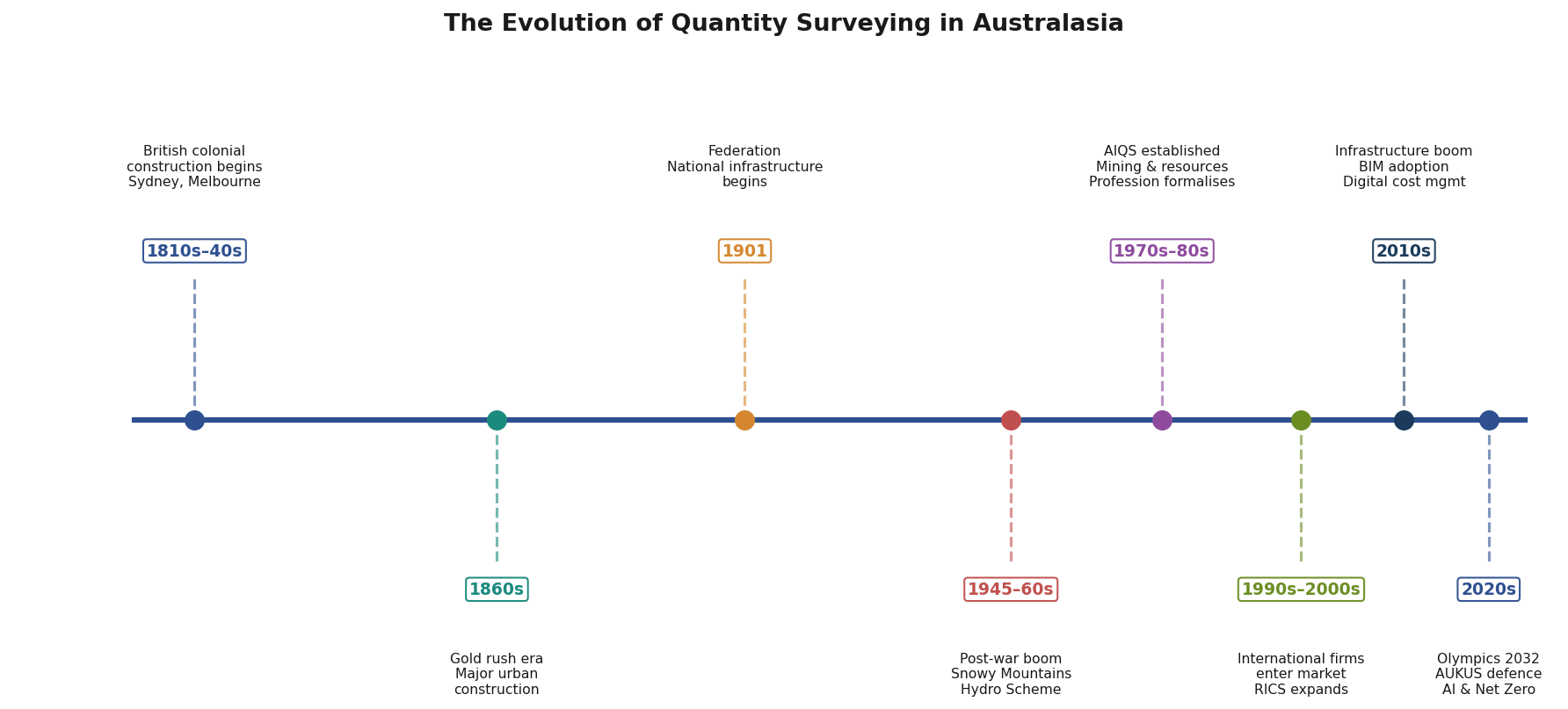
Quantity Surveying arrived in Australia with British colonial construction in the early 19th century. The discipline of measuring and pricing construction works was essential for the major public works of colonial Sydney, Melbourne, and other settlements. The gold rush era (1850s–1860s) accelerated urban construction across Victoria and New South Wales. Federation in 1901 brought national infrastructure programmes. The post-war boom (1945–1960s) — including the Snowy Mountains Hydro-Electric Scheme — drove massive construction growth and professional development.
The profession formalised in the second half of the 20th century. The AIQS was established, universities introduced dedicated QS and construction economics programmes, and international consultancies expanded into the Australian market. New Zealand followed a similar trajectory, with the NZIQS providing professional leadership.
Evolution of the Profession
| Period | Development | Impact on QS Profession |
|---|---|---|
| 1810s–1850s | British colonial construction. Public works departments established. Sydney, Melbourne, Hobart founded. | British QS practices imported. BOQ-based tendering established for public works. |
| 1860s–1900 | Gold rush. Major urban construction. Railways. Ports. | Construction industry grows rapidly. QS practices mature. |
| 1901–1945 | Federation. National infrastructure. Two World Wars. | National construction standards develop. Professional practices formalise. |
| 1945–1970s | Post-war boom. Snowy Mountains Scheme. Sydney Opera House. Mass immigration and urbanisation. | Major growth in QS demand. University programmes established. AIQS formalises. |
| 1980s–2000s | Mining boom. Sydney Olympics 2000. International consultancies expand. BIM begins. | Resources sector creates specialist cost-engineering roles. RICS expands to Oceania. |
| 2010s–present | Infrastructure mega-pipeline. AUKUS defence. Brisbane 2032. Data centres. Energy transition. AI. | AUD 193bn+ market. Major project pipeline peaks at AUD 80bn+ in FY2026. AI-assisted estimating. Net Zero. |
Australia: The Quantity Surveying Profession
Australia’s Quantity Surveying profession is mature, well-regulated, and in high demand. The AIQS is the peak professional body, accrediting university programmes and providing professional membership grades (Student, Graduate, Member MAIQS, Fellow FAIQS). RICS Oceania operates alongside AIQS — many senior professionals hold dual membership.
The QS title is used directly in Australia. Cost Manager and Cost Consultant are increasingly common at consultancy firms, reflecting a shift from measurement-focused to advisory-focused practice. Commercial Manager is the standard title on the contractor side. Estimator, Contracts Administrator, and Project Controls are specialist roles within the broader commercial function.
State-by-State Australian Construction Market
New South Wales
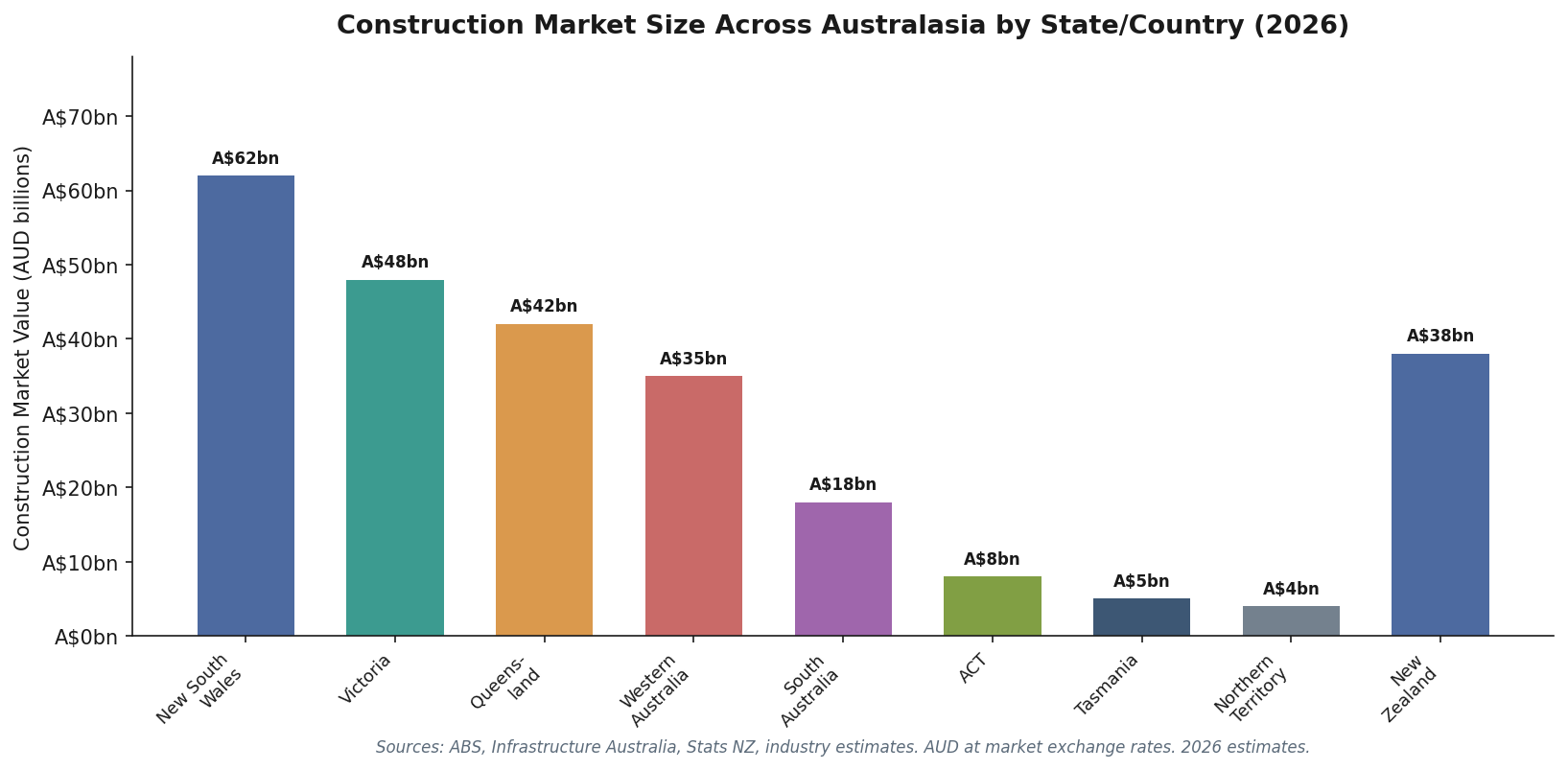
NSW contributes approximately 32% of Australia’s construction output — the largest state market at approximately AUD 62 billion in 2026. Sydney is the epicentre, with major programmes including Sydney Metro (AUD 27–29 billion), WestConnex, Western Sydney Airport and Aerotropolis, major hospital programmes, commercial development (Barangaroo, Sydney CBD towers), data centres, and residential construction. The concentration of international consultancies, Tier 1 contractors, and government agencies makes NSW the primary market for QS professionals in Australia.
Victoria
Victoria has a construction market of approximately AUD 48 billion in 2026, driven by a USD 208 billion rolling capital programme. Key projects include the Melbourne Metro Tunnel, Suburban Rail Loop (AUD 30–34.5 billion — one of Australia’s largest infrastructure programmes, with an additional AUD 3.8 billion federal funding in 2026–27), North East Link, West Gate Tunnel, major hospital redevelopments, and the Victorian Big Build programme. Labour shortages and contractor insolvencies are constraining delivery capacity.
Queensland
Queensland has one of Australia’s most dynamic construction outlooks, valued at approximately AUD 42 billion in 2026. The Brisbane 2032 Olympic and Paralympic Games are driving a AUD 7.1 billion Games Venue Infrastructure Program, including a new 63,000-seat stadium at Victoria Park (AUD 3.785 billion). Cross River Rail, renewable-energy projects, LNG expansion, and mining investment add to the pipeline. Unite32 (Laing O’Rourke and AECOM consortium) has been appointed to deliver the Olympic venue programme.
Western Australia
Western Australia has a construction market of approximately AUD 35 billion in 2026. By the end of the decade, WA may surpass NSW as the leading state for engineering construction. Mining and resources (iron ore, lithium, critical minerals), LNG, energy transition (hydrogen, solar, wind), METRONET rail expansion, and defence infrastructure drive demand. Perth offers some of Australia’s highest QS salaries, particularly for resources-sector roles.
South Australia
South Australia has a construction market of approximately AUD 18 billion in 2026, dominated by the AUKUS submarine programme. The AUD 30 billion Osborne submarine construction yard (with AUD 8.5 billion committed by mid-2026) is one of the world’s largest defence construction programmes. Other drivers include the Adelaide North-South Corridor, defence manufacturing, renewable energy, and healthcare infrastructure.
Australian Capital Territory
ACT has a construction market of approximately AUD 8 billion in 2026, driven by Commonwealth government construction, defence facilities, Canberra light rail, civic development, and health infrastructure. Government and defence roles offer strong salaries and employment stability.
Tasmania
Tasmania has a smaller construction market of approximately AUD 5 billion in 2026. Key sectors include renewable energy (Battery of the Nation — pumped hydro and wind), tourism infrastructure, residential, health, and education. The Marinus Link (Tasmania–Victoria interconnector) is a significant energy project.
Northern Territory
Northern Territory has a construction market of approximately AUD 4 billion in 2026. Key sectors include defence (RAAF Tindal upgrade, US force posture initiatives), resources and minerals processing, remote indigenous housing, and energy infrastructure. Remote construction logistics add complexity and cost.
New Zealand
New Zealand has a well-established QS profession represented by the NZIQS. The construction market is valued at approximately NZD 38 billion in 2026, with growth forecast at 4.4% per annum through 2029.
Key drivers include a NZD 10.4 billion transport upgrade programme, a NZD 13.8 billion water infrastructure plan, major hospital programmes, residential construction (housing shortage), earthquake-resilience projects (particularly Canterbury and Wellington), and the government’s commitment to 100% renewable electricity by 2030.
NZIQS membership grades include Student, Graduate, Member (MNZIQS), Fellow (FNZIQS), and Registered Quantity Surveyor. The standard construction contract is NZS 3910 (general conditions), with NZS 3916 (design and build), FIDIC, and NEC also used.
New Zealand differs from Australia in market scale, regulatory structure, and seismic-resilience requirements. Earthquake engineering and resilience are fundamental to New Zealand construction, creating specialist demand for QS professionals with seismic assessment and rebuild experience.
Pacific Markets
Papua New Guinea is the largest Pacific construction market, driven by LNG (PNG LNG, Papua LNG), mining (gold, copper), infrastructure, and international development funding. Fiji, Samoa, Tonga, Vanuatu, and Solomon Islands have smaller markets focused on tourism, ports, airports, climate resilience, housing, and infrastructure funded by the Asian Development Bank, World Bank, and bilateral aid. FIDIC is the standard contract form for internationally funded Pacific projects. International consultancies (RLB, AECOM, GHD, Aurecon) are active across the Pacific.
Professional Institutions
| Institution | Country | Membership Grades | Key Features |
|---|---|---|---|
| AIQS | Australia | Student, Graduate, Member (MAIQS), Fellow (FAIQS), Life Fellow | Peak QS body. Accredits universities. CPD. Industry advocacy. |
| NZIQS | New Zealand | Student, Graduate, Member (MNZIQS), Fellow (FNZIQS), Registered QS | Peak QS body. Approved qualifications. Registration. CPD. |
| RICS Oceania | Australia & NZ | AssocRICS, MRICS, FRICS | International recognition. APC pathway. Works alongside AIQS/NZIQS. |
| CIOB | International (AU/NZ presence) | MCIOB, FCIOB | Construction management focus. Relevant for project/commercial managers. |
Education Pathways
| Country | University | Qualification | Duration | Recognition |
|---|---|---|---|---|
| Australia | Western Sydney University | BSc Construction Management | 4 years | AIQS, RICS |
| Australia | University of Melbourne | Master of Construction Management | 2 years | AIQS, RICS |
| Australia | RMIT University | BAppSc (Construction Management) | 4 years | AIQS, RICS |
| Australia | QUT (Queensland University of Technology) | BSc Quantity Surveying & Cost Engineering | 4 years | AIQS, RICS |
| Australia | Curtin University | BSc Quantity Surveying | 4 years | AIQS, RICS |
| Australia | University of South Australia (Adelaide University) | BSc Construction Management & Economics | 4 years | AIQS, RICS |
| Australia | Bond University | BSc Construction Management & QS | 2 years (accelerated) | AIQS, RICS |
| New Zealand | Massey University | BSc Quantity Surveying | 3 years | NZIQS, RICS |
| New Zealand | Otago Polytechnic | BCS Quantity Surveying | 3 years | NZIQS |
| New Zealand | Unitec (Te Pūkenga) | BCS Construction Economics | 3 years | NZIQS |
Career Pathways
Salaries and Compensation
| City | Graduate (annual) | Senior QS (annual) | Director (annual) | Currency |
|---|---|---|---|---|
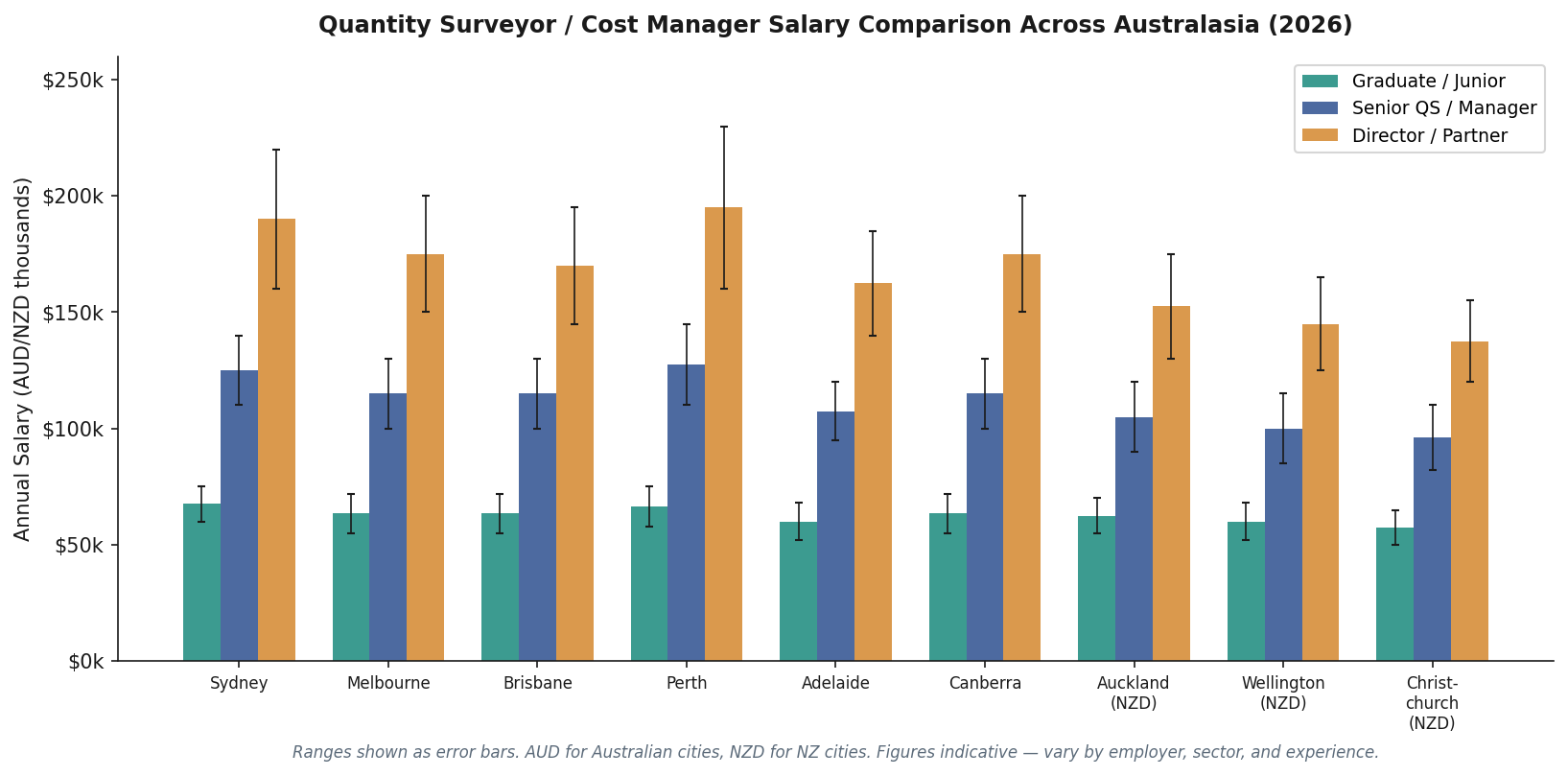
| Sydney | $60,000–75,000 | $110,000–140,000 | $160,000–220,000+ | AUD |
| Melbourne | $55,000–72,000 | $100,000–130,000 | $150,000–200,000+ | AUD |
| Brisbane | $55,000–72,000 | $100,000–130,000 | $145,000–195,000+ | AUD |
| Perth | $58,000–75,000 | $110,000–145,000 | $160,000–230,000+ | AUD |
| Adelaide | $52,000–68,000 | $95,000–120,000 | $140,000–185,000+ | AUD |
| Canberra | $55,000–72,000 | $100,000–130,000 | $150,000–200,000+ | AUD |
| Auckland | $55,000–70,000 | $90,000–120,000 | $130,000–175,000+ | NZD |
| Wellington | $52,000–68,000 | $85,000–115,000 | $125,000–165,000+ | NZD |
| Christchurch | $50,000–65,000 | $82,000–110,000 | $120,000–155,000+ | NZD |
All figures are base salary only (2026). Australian figures are exclusive of superannuation (11.5% in 2026–27), which is paid on top of base salary. Senior and director-level roles may include bonuses, company vehicle, and other benefits. Resources-sector and remote roles typically command a premium. NZD figures include KiwiSaver employer contribution (3%).
Major Construction Sectors
Major Projects
| Project | State / Country | Est. Value | Sector |
|---|---|---|---|
| Suburban Rail Loop | Victoria | AUD 30–34.5 billion | Rail (26 km underground orbital metro) |
| AUKUS Submarine Yard (Osborne) | South Australia | AUD 30 billion | Defence (nuclear submarine construction) |
| Sydney Metro | NSW | AUD 27–29 billion | Metro rail |
| Inland Rail | NSW / QLD / VIC | AUD 15 billion | Freight rail (1,700 km Melbourne–Brisbane) |
| Brisbane 2032 Olympics Venues | Queensland | AUD 7.1 billion | Sports venues (17 venues, 63,000-seat stadium) |
| Melbourne Metro Tunnel | Victoria | AUD 12+ billion | Rail (twin 9 km tunnels, 5 stations) |
| North East Link | Victoria | AUD 16+ billion | Motorway (twin tunnels, interchange) |
| Western Sydney Airport | NSW | AUD 11+ billion | Airport and Aerotropolis |
| NZ Transport Upgrade | New Zealand | NZD 10.4 billion | Transport infrastructure (Canterbury region) |
| NZ Water Infrastructure | New Zealand | NZD 13.8 billion | Water (three waters reform) |
| METRONET | Western Australia | AUD 7+ billion | Rail (new lines, stations, level crossings) |
| Marinus Link | Tasmania / Victoria | AUD 3.5+ billion | Energy (undersea interconnector) |
Major QS and Cost Consultancy Firms
| Firm | Origin | Australasian Presence | Key Sectors |
|---|---|---|---|
| RLB (Rider Levett Bucknall) | Australasian | 500+ experts across AU & NZ. Offices in all major cities. | All sectors. Iconic projects (Sydney Opera House, Queens Wharf Brisbane). |
| WT Partnership | Australasian | 75-year legacy. Independent. Offices across AU & Asia. | Commercial, infrastructure, health, education. |
| Slattery | Australian | 16,000+ projects delivered. Carbon-aware cost planning leader. | Commercial, residential, sustainability, health. |
| Turner & Townsend | International (UK) | Offices in Sydney, Melbourne, Brisbane, Perth, Auckland. | Infrastructure, data centres, resources, commercial. |
| AECOM | International (USA) | Major presence across AU & NZ. Olympics venue programme. | Infrastructure, energy, defence, transport. |
| Arcadis | International (NL) | Growing Australian presence. | Infrastructure, water, environment, commercial. |
| GHD | Australasian | Major AU/NZ/Pacific presence. | Infrastructure, water, energy, mining, environment. |
| Aurecon | Australasian | AU/NZ/Asia/Pacific. | Infrastructure, transport, energy, advisory. |
Major Contractors
| Contractor | Origin / Parent | Key Sectors | Notes |
|---|---|---|---|
| CPB Contractors | CIMIC Group (AUD 23bn revenue) | Infrastructure, tunnels, rail, roads | Australia’s largest infrastructure contractor |
| Lendlease | Australian | Commercial, residential, infrastructure, defence | Integrated property and construction group |
| Multiplex | Brookfield (sale to Obayashi announced June 2026) | Commercial, residential, mixed-use | ~US$3.8bn global revenue. AU, UK, Canada. |
| John Holland | CCCC (Chinese state-owned) | Rail, tunnels, transport, building | Major metro and rail contractor |
| Laing O’Rourke | UK | Infrastructure, defence, building, Olympics venues | Unite32 consortium for Brisbane 2032 |
| Downer Group | Australian | Transport, utilities, defence, facilities | Major services and infrastructure group |
| ACCIONA | Spanish | Infrastructure, water, renewable energy | Growing Australian presence |
| Fulton Hogan | New Zealand | Roads, infrastructure, utilities | NZ’s largest contractor. Active in AU. |
| Fletcher Construction | New Zealand (Fletcher Building) | Building, infrastructure, residential | NZ’s largest building contractor |
| Hansen Yuncken | Australian | Commercial, health, education, defence | Major Tier 2 builder |
Contracts and Procurement
| Contract / Procurement | Market | Typical Use | QS / Cost Professional Role |
|---|---|---|---|
| AS 4000 | Australia | General conditions — standard for building and civil works. | BOQ, progress claims, variations, post-contract cost management. |
| AS 4902 | Australia | Design and Construct. Contractor designs and builds. | Cost planning, tender assessment, cost control, variations. |
| Alliance Contracting | Australia (leader) | Collaborative model for complex infrastructure. Shared risk/reward. | Target cost, incentivised cost management, open-book accounting. |
| GC21 | NSW Government | NSW government standard form. | Progress claims, cost control, variations. |
| NZS 3910 | New Zealand | General conditions — standard NZ construction contract. | BOQ, progress claims, variations, final account. |
| NEC | AU & NZ | Collaborative. Used on major infrastructure. Early warning emphasis. | Cost forecasting, compensation events, programme management. |
| FIDIC | Pacific, resources | International projects, mining, energy, Pacific island infrastructure. | BOQ, IPC, variations, claims. |
| EPC / EPCM | AU (resources, energy) | Turnkey. Mining, LNG, offshore, renewable energy. | Cost engineering, earned value, project controls. |
| Managing Contractor | Australia | Client retains design. Contractor manages delivery. | Cost planning, trade procurement, cost reporting. |
| GMP (Guaranteed Maximum Price) | AU & NZ | Price certainty with shared savings. Commercial, health, education. | GMP negotiation, open-book cost management, savings share. |
Australia vs New Zealand vs UK
| Area | UK | Australia | New Zealand |
|---|---|---|---|
| Professional body | RICS | AIQS + RICS Oceania | NZIQS + RICS |
| Professional title | Quantity Surveyor, Cost Manager | QS, Cost Manager, Cost Consultant, Commercial Manager | QS, Cost Manager, Registered QS |
| Measurement | NRM | AIQS / ASMM | NZIQS / NZ standards |
| Contracts | JCT, NEC, FIDIC | AS 4000, AS 4902, Alliance, NEC, FIDIC, GC21 | NZS 3910, NZS 3916, NEC, FIDIC |
| Procurement | Traditional, D&B, NEC, Framework | Alliance, D&C, Managing Contractor, GMP, EPC | Traditional, D&B, Alliance, NEC |
| Salary (Senior QS) | £55,000–75,000 | AUD 100,000–145,000 | NZD 85,000–120,000 |
| Career progression | APC → MRICS → Senior → Director | MAIQS / MRICS → Senior → Associate → Director | MNZIQS / MRICS → Senior → Associate → Director |
Working in Australasia as a UK Quantity Surveyor
What transfers directly: Cost planning, measurement, contract administration, claims management, commercial reporting, and RICS chartership. The core QS skill set is highly valued. UK experience with NEC, FIDIC, and post-contract cost management is particularly sought after for infrastructure roles.
Visa pathways: Quantity Surveyor is on Australia’s skills shortage lists. Visa options include the Skilled Worker visa (subclass 482), employer-sponsored visas, and permanent residence pathways. A skills assessment through AIQS or VETASSESS may be required. New Zealand also has QS on skills shortage lists.
What to learn locally: Australian Standard contracts (AS 4000, AS 4902), Alliance contracting, state-specific procurement frameworks, superannuation, and local measurement conventions.
Sustainability and the Australasian QS
Australia and New Zealand are increasingly focused on Net Zero, embodied carbon, whole-life costing, and climate resilience. Bushfire resilience, flood resilience, and coastal infrastructure adaptation are uniquely Australian challenges. New Zealand’s seismic resilience adds further specialist demand. The QS is evolving from cost-only to cost + carbon + value + resilience advisory. Slattery is a recognised leader in carbon-aware cost planning.
Digital Transformation
CostX (developed by Exactal, an Australian company) is widely used for digital measurement. Bluebeam, BIM (Revit, Navisworks), Power BI, Primavera P6, SAP, and Oracle are standard tools. AI-assisted estimating and automated quantity take-off are emerging. 5D BIM (cost-linked models) is growing. Australia is a leader in digital construction adoption.
The Future of Quantity Surveying in Australasia
The outlook is exceptionally strong. Australia’s major project pipeline is peaking at AUD 80.3 billion in FY2026. AUKUS submarine construction (AUD 30 billion), Brisbane 2032 Olympics, Suburban Rail Loop, Sydney Metro, Inland Rail, energy transition (solar, wind, hydrogen, battery storage), data centres, defence infrastructure, housing construction, and climate adaptation are driving sustained demand. New Zealand’s transport, water, and resilience programmes add further opportunity. The QS who combines measurement and estimating skills with digital fluency, sustainability expertise, and commercial acumen will be in extraordinary demand across Australasia.
Best Australasian Markets — Ranking
| Rank | Market | Strength | Notes |
|---|---|---|---|
| 1 | Sydney | Largest market. Metro, airports, commercial, data centres. Highest salaries. | Highest cost of living. Greatest concentration of consultancies and employers. |
| 2 | Perth | Resources, mining, LNG, energy transition. Top salaries for resources roles. | May surpass NSW for engineering construction by decade-end. |
| 3 | Melbourne | Suburban Rail Loop, Metro Tunnel, Big Build. Major infrastructure pipeline. | Labour shortages constraining delivery. Strong pipeline nonetheless. |
| 4 | Brisbane | 2032 Olympics. Cross River Rail. Rapid growth. Rising salaries. | Most dynamic growth trajectory of any Australian city. |
| 5 | Adelaide | AUKUS submarine programme. Defence. Manufacturing. Energy. | Defence construction transforming the city. Lower cost of living. |
| 6 | Canberra | Government. Defence. Light rail. Strong public-sector salaries. | Stable, government-driven market. |
| 7 | Auckland | NZ’s largest market. Transport. Housing. Commercial. | Skills shortages. Excellent quality of life. |
| 8 | Wellington | Government. Earthquake resilience. Transport. Health. | Seismic resilience specialist demand. |
| 9 | Christchurch | Post-earthquake rebuild. Resilience. Housing. Infrastructure. | Rebuild demand continuing. Lower cost of living. |
Ranking based on composite assessment of market size, salary, demand, infrastructure pipeline, professional development, and quality of life. Not absolute.
Frequently Asked Questions
Is Quantity Surveying a good career in Australia?
Yes. Australia has one of the strongest construction markets in the Asia-Pacific, valued at approximately AUD 193 billion in 2026. QS professionals are in high demand across infrastructure, resources, defence, energy, and commercial sectors. Salaries are strong and the pipeline is sustained.
Is Quantity Surveying a good career in New Zealand?
Yes. New Zealand has a growing construction market driven by transport, housing, health, and earthquake resilience. QS skills are in short supply. Quality of life is exceptional.
Is RICS recognised in Australia?
Yes. RICS Oceania operates alongside AIQS. MRICS is widely recognised by international consultancies and many Australian employers.
Is RICS recognised in New Zealand?
Yes. RICS operates alongside NZIQS. Many professionals hold dual memberships.
What is the Australian equivalent of a UK Quantity Surveyor?
The title Quantity Surveyor is used directly. Cost Manager and Cost Consultant are also common at consultancy firms. Commercial Manager is standard on the contractor side.
What is a Cost Manager?
A Cost Manager performs the same core functions as a QS — cost planning, estimating, procurement advice, cost control, and reporting. The title is increasingly common at consultancy firms.
What is a Commercial Manager?
The contractor-side equivalent of a senior QS — cost management, subcontract procurement, variations, claims, forecasting, and commercial strategy.
How much does a Quantity Surveyor earn in Australia?
Average approximately AUD 105,000–120,000/year. Graduates AUD 55,000–75,000. Senior AUD 100,000–145,000. Directors AUD 160,000–230,000+. Superannuation (11.5%) is paid on top.
How much does a Quantity Surveyor earn in New Zealand?
Average approximately NZD 90,000/year. Graduates NZD 55,000–70,000. Senior NZD 85,000–120,000. Directors NZD 130,000–175,000+.
Which Australian city pays Quantity Surveyors the most?
Sydney and Perth typically offer the highest salaries. Perth is driven by resources-sector demand. Brisbane is rising rapidly due to Olympics 2032 investment.
Can a UK Quantity Surveyor work in Australia?
Yes. RICS chartership is widely accepted. Many consultancies actively recruit UK-qualified professionals. Skills assessment and visa required.
Can a UK Quantity Surveyor work in New Zealand?
Yes. UK qualifications are recognised. QS is on skills shortage lists, making visa pathways accessible.
How do I become a Quantity Surveyor in Australia?
Complete an AIQS-accredited bachelor’s degree (4 years). Gain experience. Apply for AIQS membership. Optionally pursue RICS chartership through the APC.
How do I become a Quantity Surveyor in New Zealand?
Complete an NZIQS-approved qualification. Gain experience. Apply for NZIQS membership (MNZIQS). Optionally pursue RICS chartership.
What is AIQS?
The Australian Institute of Quantity Surveyors — the peak professional body for QS in Australia. Accredits universities, provides membership, CPD, and industry advocacy.
What is NZIQS?
The New Zealand Institute of Quantity Surveyors — the professional body for QS in New Zealand. Provides membership, registration, CPD, and advocacy.
What qualifications do I need?
A bachelor’s degree in Quantity Surveying, Construction Management, or Construction Economics from an AIQS or NZIQS-accredited university. Postgraduate conversion routes are available.
Do I need local registration?
Requirements vary by state. Most states use professional body membership (AIQS, RICS) rather than statutory registration. NZIQS offers Registered QS in New Zealand.
What contracts are common in Australia?
AS 4000, AS 4902 (D&C), Alliance, NEC, FIDIC, GC21, Managing Contractor, GMP, EPC, and EPCM.
What contracts are common in New Zealand?
NZS 3910, NZS 3916 (D&B), FIDIC, NEC, and Alliance for major infrastructure.
What is Alliance Contracting?
A collaborative procurement model with shared risk and reward. Used on high-risk, technically complex Australian infrastructure projects above AUD 50 million. Australia is a global leader in alliance contracting.
Is NEC used in Australia?
Yes. NEC is used on major infrastructure projects. Several state governments have adopted NEC for transport and water infrastructure.
Is FIDIC used in Australasia?
Yes. FIDIC is used on mining, energy, and internationally funded projects. It is particularly common in the Pacific region.
Which QS firms operate in Australia?
RLB, WT Partnership, Slattery, Turner & Townsend, AECOM, Arcadis, Mace, Currie & Brown, Cumming Group, Linesight, DCWC, MBM, GHD, Aurecon, WSP, and Jacobs.
Which firms employ QS professionals in New Zealand?
RLB, WT Partnership, Turner & Townsend, AECOM, Rawlinsons, Maltbys, Barnes Beagley Doherr, and other national and international firms.
What is the difference between a QS and Commercial Manager?
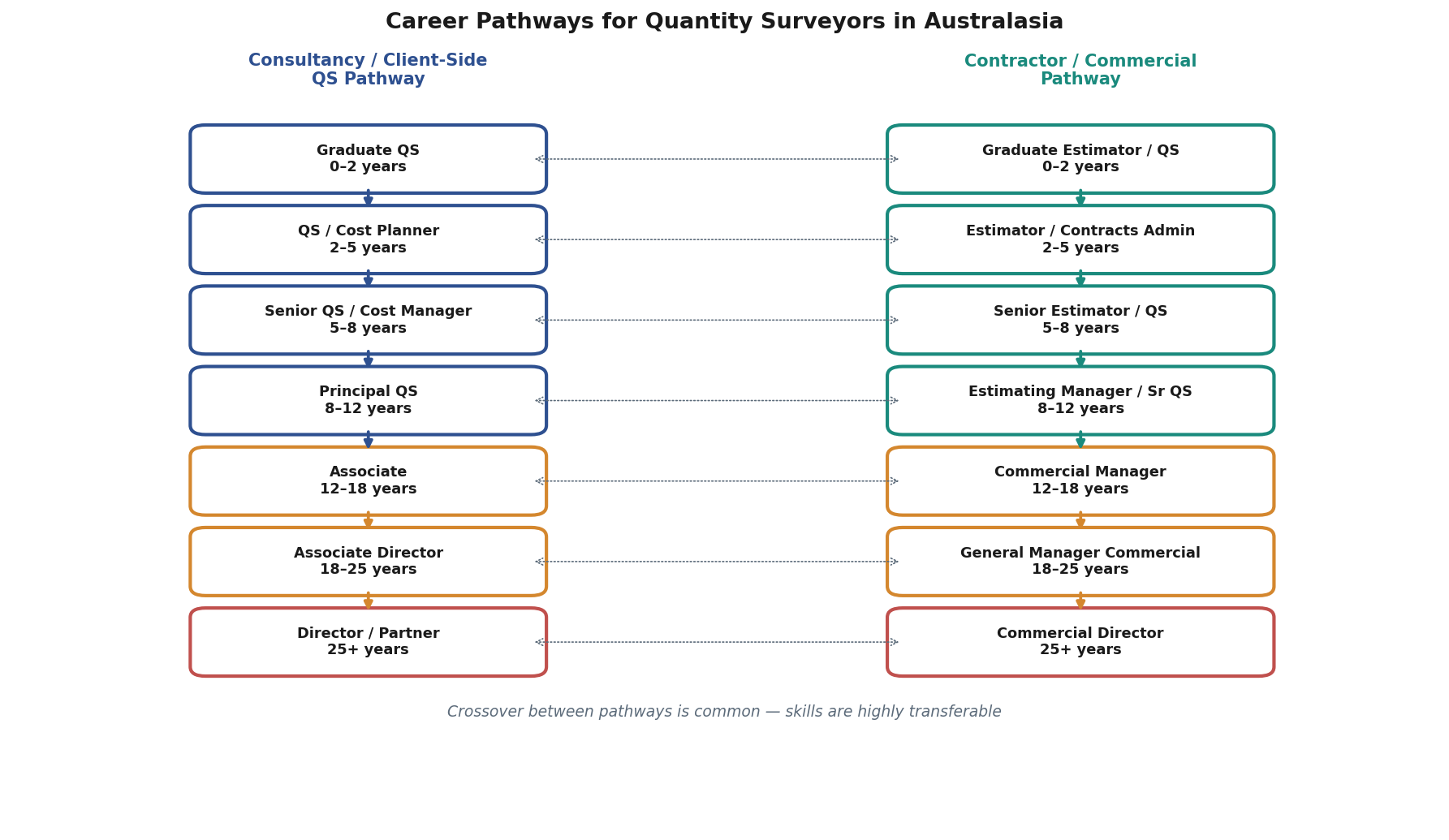
A QS typically works client/consultancy-side providing independent cost advice. A Commercial Manager works contractor-side managing commercial performance. The underlying skills are the same.
What skills are Australian employers looking for?
Core QS skills plus BIM, CostX, Bluebeam, Power BI, sustainability, commercial acumen, and experience with alliance contracting and collaborative procurement.
Is Australia a good destination for international Quantity Surveyors?
Yes. Active recruitment of international QS professionals. Skills shortage lists. Strong salaries, quality of life, and substantial construction pipeline.
Is New Zealand a good destination for international Quantity Surveyors?
Yes. Skills shortages. Well-recognised qualifications. Exceptional quality of life. Lower salaries than Australia but lower cost of living outside Auckland.
How will AI affect Quantity Surveying in Australasia?
AI will automate take-off, enhance estimating, and enable predictive modelling. Commercial judgement, negotiation, and client advisory require human expertise. AI will make the QS more productive, not redundant.
Australasia Quantity Surveying Knowledge Hub
This article is the pillar page for ProQS.site’s Australasian Quantity Surveying and Cost Management content network. Future dedicated hubs are planned for: Australia, New South Wales, Victoria, Queensland, Western Australia, South Australia, ACT, New Zealand, Auckland, Wellington, Christchurch, Papua New Guinea, Fiji, and the Pacific Islands.
Cross-Links
- Quantity Surveying in the Middle East
- Quantity Surveying in Africa
- Quantity Surveying in the Americas
- Quantity Surveying in Asia
- Quantity Surveying in Europe
- Post-Contract Cost Management
- NRM 1 and Cost Planning
- Early Warning Under NEC4
- Bonds, Guarantees and Warranties
- Role of the Employer’s Agent
- Key Performance Indicators in Construction