Quantity Surveying in Africa — Complete Guide
Introduction: Quantity Surveying Across Africa
Africa’s construction market is valued at approximately $258 billion in 2026 and growing at over 7% annually — making it one of the fastest-expanding construction markets in the world. From Egypt’s $58 billion New Administrative Capital to Nigeria’s Dangote Refinery, from Kenya’s standard gauge railway to South Africa’s Gautrain expansion, the continent’s infrastructure ambitions are creating unprecedented demand for quantity surveyors, cost consultants, and commercial managers.
Quantity surveying — the professional management of construction costs from inception to completion — is practised across Africa in forms that reflect the continent’s extraordinary diversity. In South Africa, the profession has over a century of formal history, with statutory registration, accredited universities, and a mature professional infrastructure that rivals the UK. In Nigeria, the QS profession has grown rapidly since independence, regulated by the Nigerian Institute of Quantity Surveyors (NIQS) and the Quantity Surveyors Registration Board (QSRBN). In Kenya, Tanzania, and Ghana, the profession is well established and expanding. In Francophone and Lusophone Africa, quantity surveying takes different forms — the French économiste de la construction and métreur traditions differ from the Anglo-Saxon QS model, though the core function of managing construction costs is universal.
The relationship between quantity surveying, cost management, commercial management, and construction economics varies across the continent. In Southern Africa, “quantity surveyor” remains the dominant professional title. In East and West Africa, “cost consultant” and “commercial manager” are increasingly used, particularly by international firms. In North Africa, the profession aligns more closely with French or Egyptian engineering traditions. What unites them all is the fundamental need to manage construction costs effectively — a need that is growing as Africa’s infrastructure investment accelerates.
Africa’s construction growth is driven by urbanisation (the continent will add 900 million urban residents by 2050), population growth (projected to reach 2.5 billion by 2050), infrastructure deficits (the African Development Bank estimates a $68–108 billion annual infrastructure financing gap), natural resource extraction (mining, oil, and gas), energy development (solar, wind, hydroelectric, and gas), housing demand (an estimated 56 million housing-unit deficit), and international investment (including Chinese Belt and Road, Japanese, European, and Gulf state financing). Each of these drivers creates work for quantity surveyors.
The Origins of Quantity Surveying in Africa
Traditional African construction — from the Great Zimbabwe stone walls to the Hausa architecture of northern Nigeria, from Egyptian engineering to the coral-stone buildings of the Swahili coast — involved sophisticated cost and resource management practices long before European colonial influence. Master builders managed materials, labour, and budgets through oral traditions and practical experience.
The modern quantity surveying profession, however, arrived in Africa through British colonial influence. The first formal QS practices were established in the Cape Colony (South Africa) in the late 19th century, following the profession’s development in the United Kingdom. The Association of South African Quantity Surveyors (ASAQS) was founded in 1908 — making it one of the oldest professional QS bodies outside the UK — and the profession grew alongside South Africa’s mining and urban development.
British colonial administration brought QS practices to other parts of the continent during the early to mid-20th century. Public works departments in Kenya, Nigeria, Ghana (then the Gold Coast), Tanzania (then Tanganyika), Uganda, Zimbabwe (then Rhodesia), and Zambia (then Northern Rhodesia) employed quantity surveyors to manage government construction projects. British standard methods of measurement, bills of quantities, and competitive tendering procedures were adopted across Anglophone Africa.
The post-independence era (1960s onwards) saw African countries establish their own professional institutions. The Nigerian Institute of Quantity Surveyors (NIQS) was founded in 1969. The Institute of Quantity Surveyors of Kenya (IQSK) was established in the 1970s. Similar bodies emerged across the continent. Universities began offering quantity surveying programmes, reducing dependence on UK-trained professionals.
The establishment of the Africa Association of Quantity Surveyors (AAQS) — the continental umbrella body — marked a milestone in pan-African professional cooperation. AAQS now includes member institutions from South Africa, Nigeria, Kenya, Ghana, Botswana, Namibia, Uganda, Rwanda, Mozambique, Mauritius, Lesotho, and others.
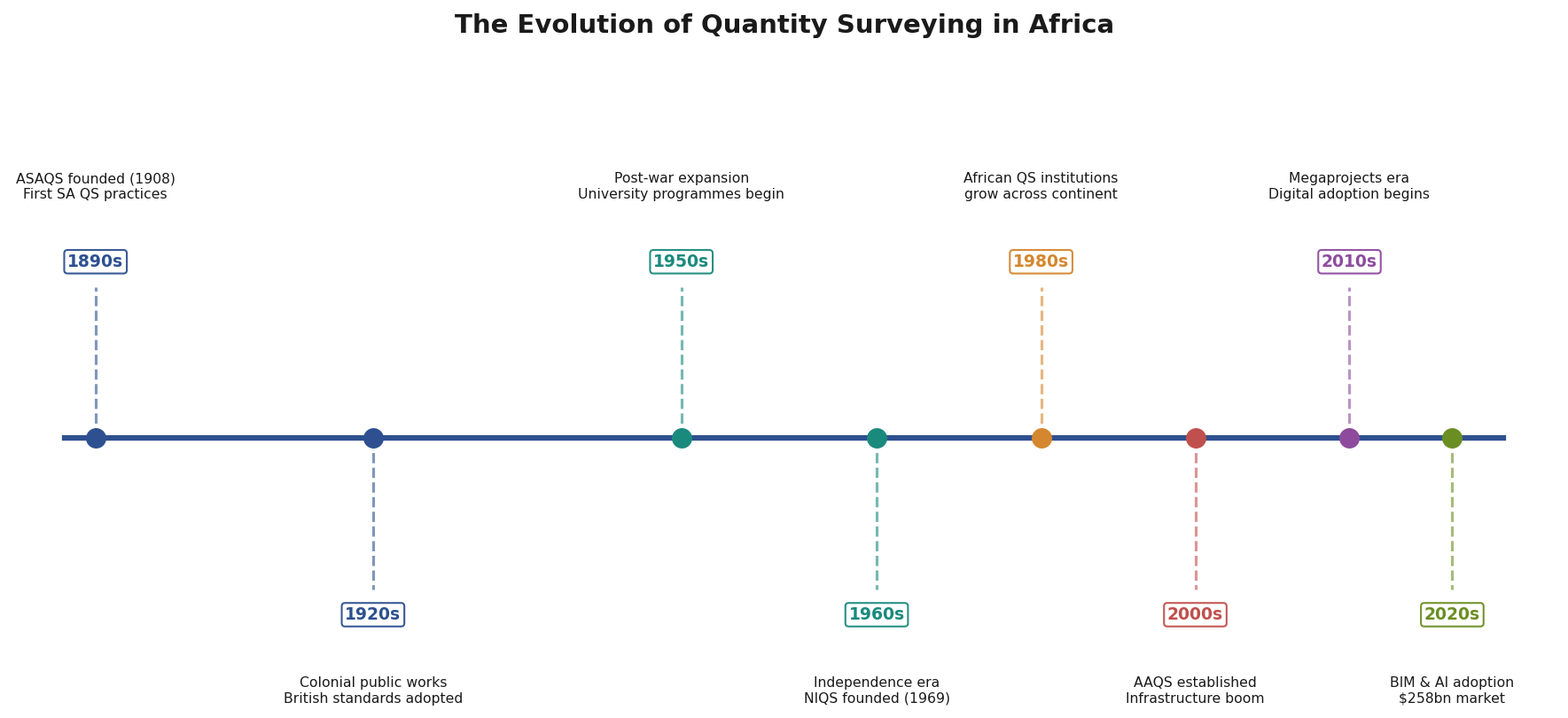
Evolution of the Profession
| Period | Development | Impact on QS Profession |
|---|---|---|
| Pre-1900 | Colonial public works, mining infrastructure | First British QS practices in Cape Colony. Mining and railway construction drive demand. |
| 1900–1950 | ASAQS founded (1908). Colonial expansion | Professional standards formalised in South Africa. QS practices spread to East and West Africa through colonial public works departments. |
| 1960s–1970s | Independence era across Africa | National QS institutions founded (NIQS 1969). Universities introduce QS programmes. FIDIC adoption grows on development-funded projects. |
| 1980s–1990s | Structural adjustment, infrastructure investment | International consultancies establish African offices. World Bank and AfDB projects drive demand for FIDIC-literate QS professionals. |
| 2000s | Commodities boom, Chinese investment | AAQS established. Mining and oil & gas drive demand. Infrastructure megaprojects begin. Belt and Road Initiative brings Chinese-funded projects. |
| 2010s–present | Megaprojects, urbanisation, digital transformation | $258bn market. BIM adoption. NEC growing. Data centres, renewables, and smart cities create new demand. AI and digital tools emerging. |
The Development of Quantity Surveying by Region
Southern Africa
South Africa has the most mature QS profession on the continent, with statutory regulation through SACQSP, a professional association (ASAQS) dating to 1908, and multiple RICS-accredited university programmes. Zimbabwe and Zambia have established QS professions inherited from the colonial era, though economic challenges have affected growth. Botswana and Namibia have small but professional QS markets, often serviced by South African firms. Mozambique (Lusophone) and Angola follow Portuguese engineering traditions with growing QS adoption on international projects. Malawi, Lesotho, and Eswatini have emerging QS markets, typically supported by South African professionals and ASAQS/SACQSP frameworks.
East Africa
Kenya is the regional QS hub, with IQSK, BORAQS registration, and strong demand driven by infrastructure (Nairobi Expressway, Standard Gauge Railway, Konza Technopolis). Tanzania is growing rapidly — the Standard Gauge Railway (SGR), Julius Nyerere Hydropower project, and mining infrastructure are creating significant QS demand. Uganda has a developing QS market with road and energy projects. Rwanda has ambitious infrastructure plans and a growing QS profession. Ethiopia — Africa’s second most populous country — has massive construction activity (Grand Ethiopian Renaissance Dam, industrial parks, housing programmes) but a QS profession still developing alongside traditional engineering cost management. South Sudan is at the earliest stage of QS development, with opportunities primarily on humanitarian and donor-funded projects.
West Africa
Nigeria is the dominant QS market in the region, with NIQS (founded 1969), statutory regulation through QSRBN, and multiple university programmes. The Dangote Refinery, Lagos Rail Mass Transit, Lekki Deep Sea Port, and substantial commercial development drive demand. Ghana has a well-established QS profession with the Ghana Institution of Surveyors (GhIS) and KNUST providing education. Senegal and Côte d’Ivoire follow French professional traditions — the économiste de la construction role is closest to the QS function, with growing adoption of international QS practices on major projects. Liberia and Sierra Leone have emerging QS markets, primarily on reconstruction and donor-funded projects.
North Africa
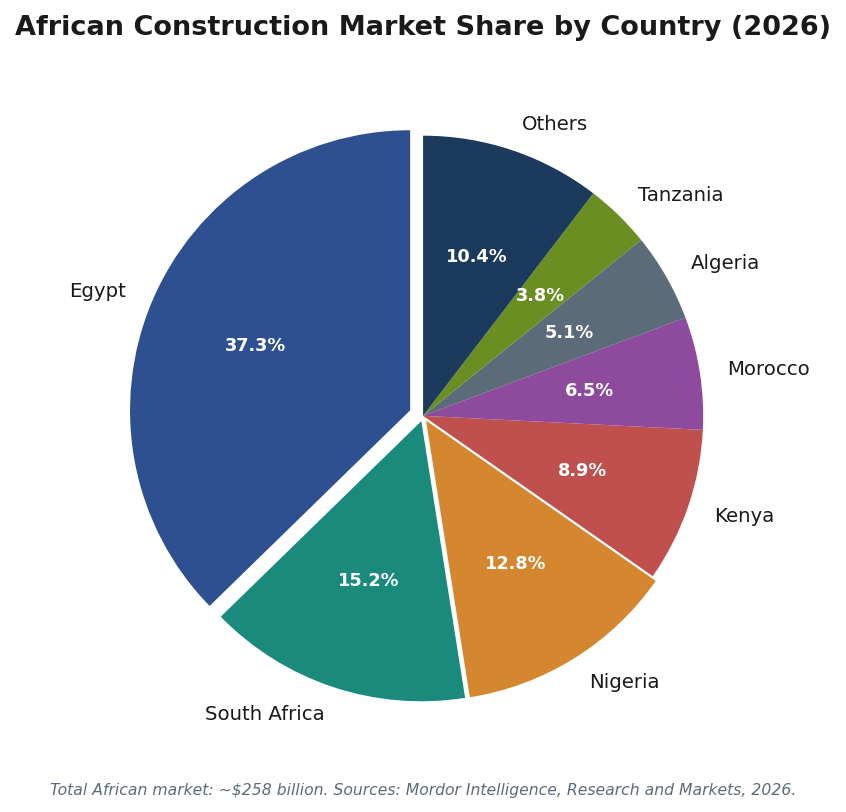
Egypt has the largest construction market in Africa (37% of the continent), driven by the New Administrative Capital ($58 billion), Suez Canal developments, and Cairo Metro expansion. The QS profession operates within the Egyptian engineering tradition, with cost management functions typically performed by cost engineers. Morocco has a growing construction sector with French-influenced professional structures. Algeria, Tunisia, and Libya have construction markets shaped by French colonial traditions and Arabic-language professional practices, with FIDIC used on international projects.
Central Africa
Cameroon (bilingual French/English) has an emerging QS profession. DRC and Republic of Congo have significant mining and oil & gas construction, with QS services typically provided by international firms. Gabon and Equatorial Guinea have oil-driven construction markets with Francophone professional structures.
Country-by-Country Quantity Surveying Guide
South Africa
Professional body: Association of South African Quantity Surveyors (ASAQS, founded 1908). Statutory regulator: South African Council for the Quantity Surveying Profession (SACQSP). Registration: Professional Quantity Surveyor (PrQS) — statutory requirement to practise.
Education: BSc Quantity Surveying (4 years) from accredited universities (Pretoria, Wits, UCT, UJ, UFS, UKZN, Nelson Mandela, DUT, CPUT). Programmes accredited by SACQSP and, in most cases, RICS.
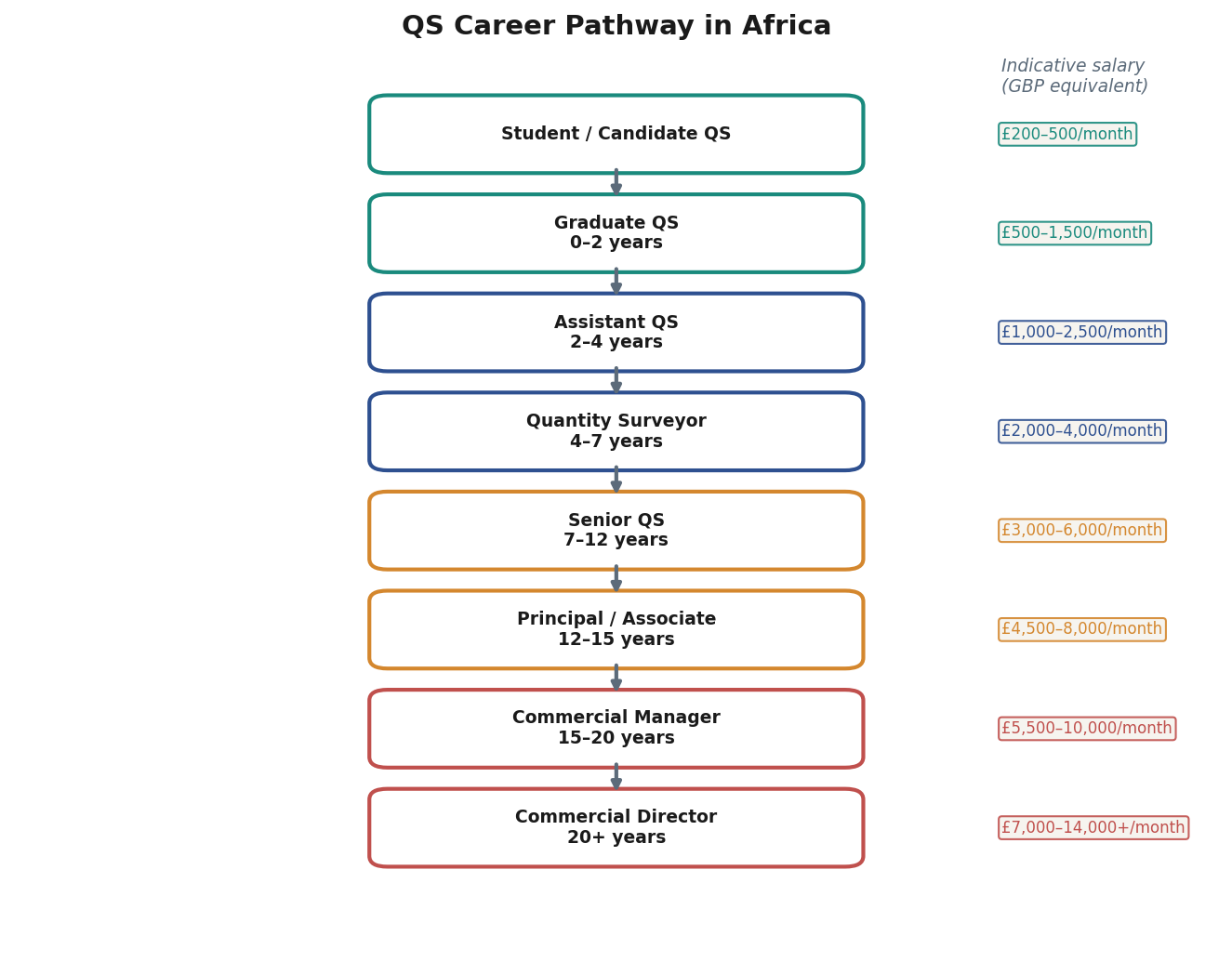
Career pathway: BSc → Candidate QS (minimum 2 years supervised experience) → Assessment of Professional Competence (APC) → PrQS registration → MRICS (optional but increasingly standard).
Contracts: JBCC (building works), GCC (government engineering), NEC (infrastructure — used on Gautrain, SANRAL projects), FIDIC (international/donor-funded). NEC adoption is growing.
Major sectors: Mining infrastructure, residential, commercial, government buildings, transport (Gautrain expansion, SANRAL roads), energy (renewables, Koeberg nuclear), water infrastructure, data centres.
Salary range: Graduate QS R180,000–R360,000/year; Senior QS R550,000–R900,000/year; Commercial Director R1,000,000–R2,000,000+/year.
Major employers: Turner & Townsend (acquired Profica), AECOM, Mace, RLB, Zutari, MLC QS, QualConsul, Quanticost, plus numerous local practices.
Nigeria
Professional body: Nigerian Institute of Quantity Surveyors (NIQS, founded 1969). Statutory regulator: Quantity Surveyors Registration Board of Nigeria (QSRBN). Registration: Registered Quantity Surveyor (RQS).
Education: BSc/BTech Quantity Surveying (5 years) from accredited universities (University of Lagos, OAU Ife, FUTA, UNILAG, Covenant University, and others).
Contracts: FIDIC (dominant on international and government projects), JCT (legacy from colonial era — less common now), NEC (emerging on infrastructure), bespoke government forms.
Major sectors: Oil and gas (Niger Delta), commercial (Lagos, Abuja), residential, infrastructure (Lagos Rail, Lekki Port, road programmes), industrial (Dangote facilities), telecoms/data centres.
Salary range: Graduate QS ₦1,200,000–₦3,600,000/year; Senior QS ₦5,000,000–₦12,000,000/year; Commercial Director ₦15,000,000–₦30,000,000+/year.
Challenges: Currency volatility (naira depreciation), payment delays, informal construction sector, limited reliable cost data for benchmarking.
Kenya
Professional body: Institute of Quantity Surveyors of Kenya (IQSK). Statutory regulator: Board of Registration of Architects and Quantity Surveyors (BORAQS). Registration: Registered Quantity Surveyor.
Education: BSc Quantity Surveying / Building Economics from University of Nairobi, JKUAT, or Technical University of Kenya (4–5 years).
Contracts: FIDIC (dominant, especially on donor-funded and infrastructure projects), JBCC (adapted from South Africa, used by private developers), NEC (emerging on UK-linked projects).
Major sectors: Infrastructure (Nairobi Expressway, Mombasa–Nairobi SGR, Konza Technopolis), commercial (Nairobi CBD), residential, healthcare, education, geothermal energy.
Salary range: Graduate QS KES 40,000–80,000/month; Senior QS KES 150,000–350,000/month; Commercial Director KES 400,000–800,000+/month.
Demand: Kenya is the fastest-growing QS market in Africa (8.9% CAGR), driven by Vision 2030 infrastructure and East African regional hub status.
Ghana
Professional body: Ghana Institution of Surveyors (GhIS). Education: KNUST (Kumasi) offers BSc QS — the leading programme in the country. Contracts: FIDIC dominant on government and donor-funded projects; modified JCT forms used in the private sector.
Major sectors: Mining (gold — Newmont, AngloGold Ashanti), oil and gas (Jubilee Field), commercial, residential, infrastructure (roads, ports).
Salary range: Graduate QS GHS 2,500–5,000/month; Senior QS GHS 8,000–18,000/month; Commercial Director GHS 20,000–40,000+/month.
Egypt
Egypt has the largest construction market in Africa, valued at over $96 billion (37% of the continental total). The New Administrative Capital ($58 billion), Cairo Metro expansion, Suez Canal Economic Zone, and El Alamein new city are among the largest construction programmes on the continent.
Professional structure: Cost management is typically practised by cost engineers rather than quantity surveyors in the UK sense. The Egyptian Engineers’ Syndicate regulates engineering professionals. RICS is recognised on international projects.
Contracts: FIDIC (dominant on international projects), Egyptian Civil Code provisions for domestic projects, EPC for industrial and energy.
Salary range: Graduate cost engineer EGP 8,000–15,000/month; Senior EGP 25,000–50,000/month; Commercial Director EGP 60,000–120,000+/month.
Tanzania
Professional body: Architects and Quantity Surveyors Registration Board (AQRB). Education: Ardhi University (Dar es Salaam) offers BSc Quantity Surveying.
Major sectors: Standard Gauge Railway (Lot 6 commenced 2026, €2.5 billion), Julius Nyerere Hydropower project (2,115 MW), mining (gold, tanzanite), gas pipeline infrastructure, commercial (Dar es Salaam).
Salary range: Graduate QS TZS 800,000–1,500,000/month; Senior QS TZS 3,000,000–6,000,000/month.
Uganda
Professional body: Surveyors Registration Board. Major sectors: Oil and gas (Lake Albert basin — TotalEnergies EACOP pipeline), roads, hydropower, commercial development.
Zambia
Professional body: Zambia Institute of Quantity Surveyors. Major sectors: Copper mining infrastructure, roads, energy, commercial and residential development in Lusaka.
Zimbabwe
Professional body: Quantity Surveying Council of Zimbabwe. Challenges: Economic instability, currency issues, and skills emigration have affected the profession. Many Zimbabwean QS professionals work in South Africa, Botswana, and the Middle East.
Botswana
Professional body: Botswana chapter of ASAQS (AAQS member). Major sectors: Diamond mining infrastructure (Debswana), government buildings, commercial development. Small but well-regulated market with strong demand relative to population.
Rwanda
Professional body: Institute of Quantity Surveyors of Rwanda (AAQS member). Major sectors: Kigali Convention Centre, Bugesera International Airport, road infrastructure, smart city developments.
Morocco
Morocco’s construction sector is growing, driven by the Tanger Med port expansion, Mohammed VI High-Speed Railway, renewable energy (Noor Ouarzazate solar complex — one of the world’s largest), tourism infrastructure, and the 2030 FIFA World Cup (co-hosted with Spain and Portugal). The QS profession follows French économiste de la construction traditions. FIDIC is used on international projects.
Professional Institutions
| Institution | Country | Founded | Membership Grade | AAQS Member |
|---|---|---|---|---|
| ASAQS | South Africa | 1908 | Student → Graduate → Professional (PrQS via SACQSP) | Yes |
| NIQS | Nigeria | 1969 | Probationer → Associate → Fellow (via QSRBN) | Yes |
| IQSK | Kenya | 1970s | Graduate → Corporate → Fellow (via BORAQS) | Yes |
| GhIS | Ghana | — | Graduate → Professional → Fellow | Yes |
| RICS (Sub-Saharan Africa) | Pan-African | — | AssocRICS → MRICS → FRICS | — |
| SACQSP | South Africa (statutory) | — | Candidate QS → PrQS | — |
| AAQS | Pan-African (continental) | — | Institutional membership | Umbrella body |
| QSRBN | Nigeria (statutory) | — | Registered QS (RQS) | — |
| BORAQS | Kenya (statutory) | — | Registered QS | — |
Education and University Pathways
| Country | University | Qualification | Duration | Recognition |
|---|---|---|---|---|
| South Africa | University of Pretoria | BSc QS + BScHons QS | 3 + 1 years | SACQSP, RICS |
| South Africa | University of the Witwatersrand | BSc(Hons) QS | 4 years | SACQSP, RICS |
| South Africa | University of Cape Town | BSc Construction Studies + PgDip | 3 + 1 years | SACQSP, RICS |
| South Africa | University of Johannesburg | BSc QS | 4 years | SACQSP |
| South Africa | University of the Free State | BSc QS | 4 years | SACQSP |
| Nigeria | University of Lagos | BSc QS | 5 years | QSRBN |
| Nigeria | Obafemi Awolowo University (OAU) | BSc QS | 5 years | QSRBN |
| Kenya | University of Nairobi | BSc Building Economics | 4 years | BORAQS |
| Kenya | JKUAT | BSc Construction Management | 4 years | BORAQS |
| Ghana | KNUST (Kumasi) | BSc QS & Construction Economics | 4 years | GhIS |
| Tanzania | Ardhi University | BSc QS | 4 years | AQRB |
| Egypt | Cairo University | BSc Civil / Construction Engineering | 5 years | Egyptian Engineers’ Syndicate |
For professionals without a QS degree, conversion routes exist through RICS-accredited postgraduate programmes (including distance learning from CEM and South African universities), the RICS Senior Professional Assessment, or national professional body examinations. Several international consultancies in Africa run structured graduate development programmes supporting candidates through to chartership.
Career Pathway
Salaries and Compensation
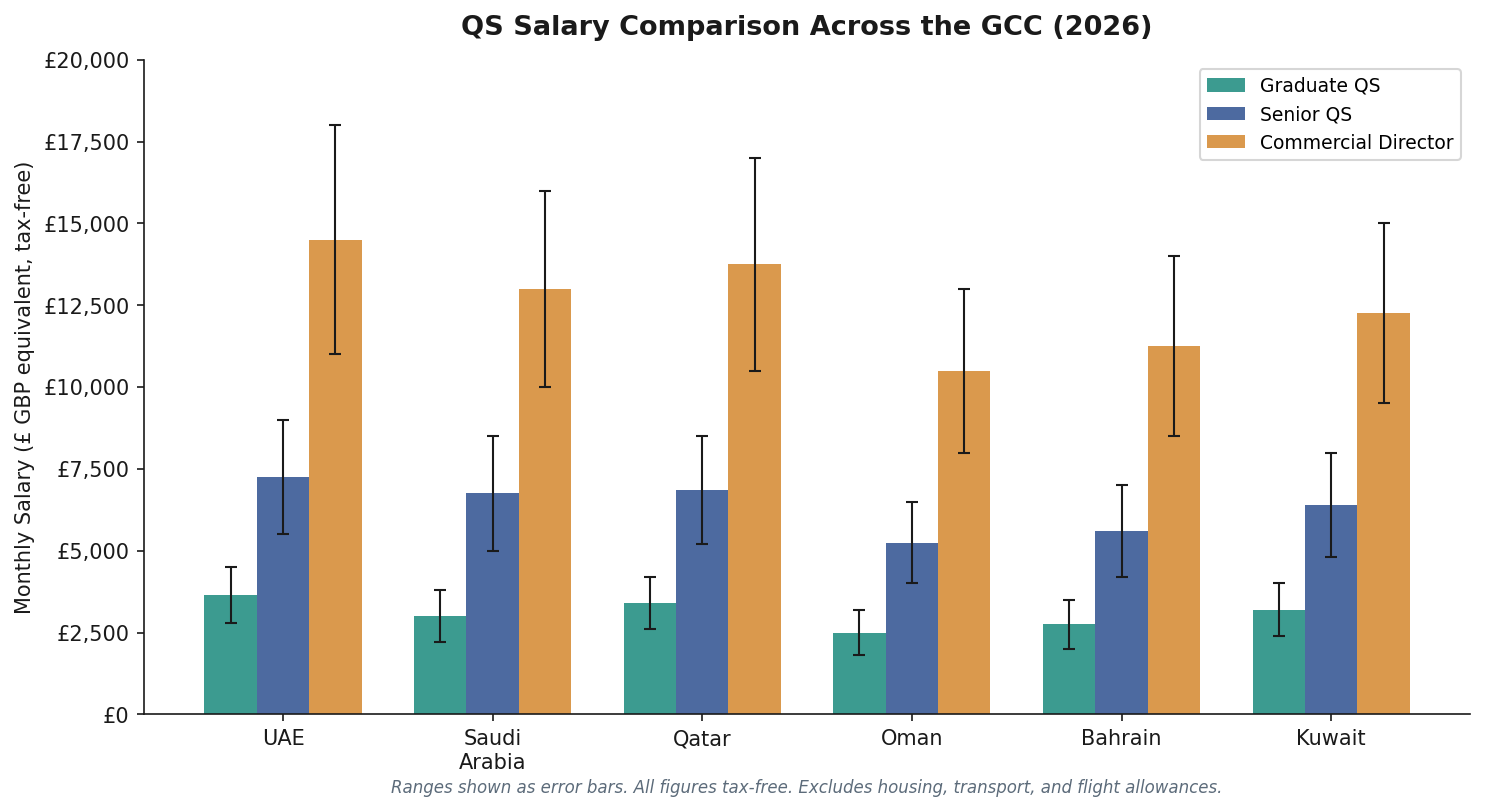
| Country | Graduate QS (monthly) | Senior QS (monthly) | Commercial Director (monthly) | Currency |
|---|---|---|---|---|
| South Africa | R15,000–R30,000 | R45,000–R75,000 | R85,000–R170,000+ | ZAR |
| Nigeria | ₦100,000–₦300,000 | ₦400,000–₦1,000,000 | ₦1,200,000–₦2,500,000+ | NGN |
| Kenya | KES 40,000–80,000 | KES 150,000–350,000 | KES 400,000–800,000+ | KES |
| Ghana | GHS 2,500–5,000 | GHS 8,000–18,000 | GHS 20,000–40,000+ | GHS |
| Egypt | EGP 8,000–15,000 | EGP 25,000–50,000 | EGP 60,000–120,000+ | EGP |
| Tanzania | TZS 800,000–1,500,000 | TZS 3,000,000–6,000,000 | TZS 8,000,000–15,000,000+ | TZS |
| Uganda | UGX 1,500,000–3,000,000 | UGX 5,000,000–10,000,000 | UGX 12,000,000–25,000,000+ | UGX |
| Botswana | BWP 8,000–14,000 | BWP 20,000–40,000 | BWP 50,000–90,000+ | BWP |
Expatriate packages on major infrastructure and mining projects in Africa typically include: housing (company-provided or allowance — often the most valuable component), flights (annual return to home country for employee and dependants), medical insurance, hardship allowance (for remote or challenging locations), per diems, R&R leave cycles (common in mining and oil and gas — e.g. 8 weeks on, 4 weeks off), and company vehicle or transport allowance. These packages can significantly exceed the base salary figures shown above.
Major African Construction Markets
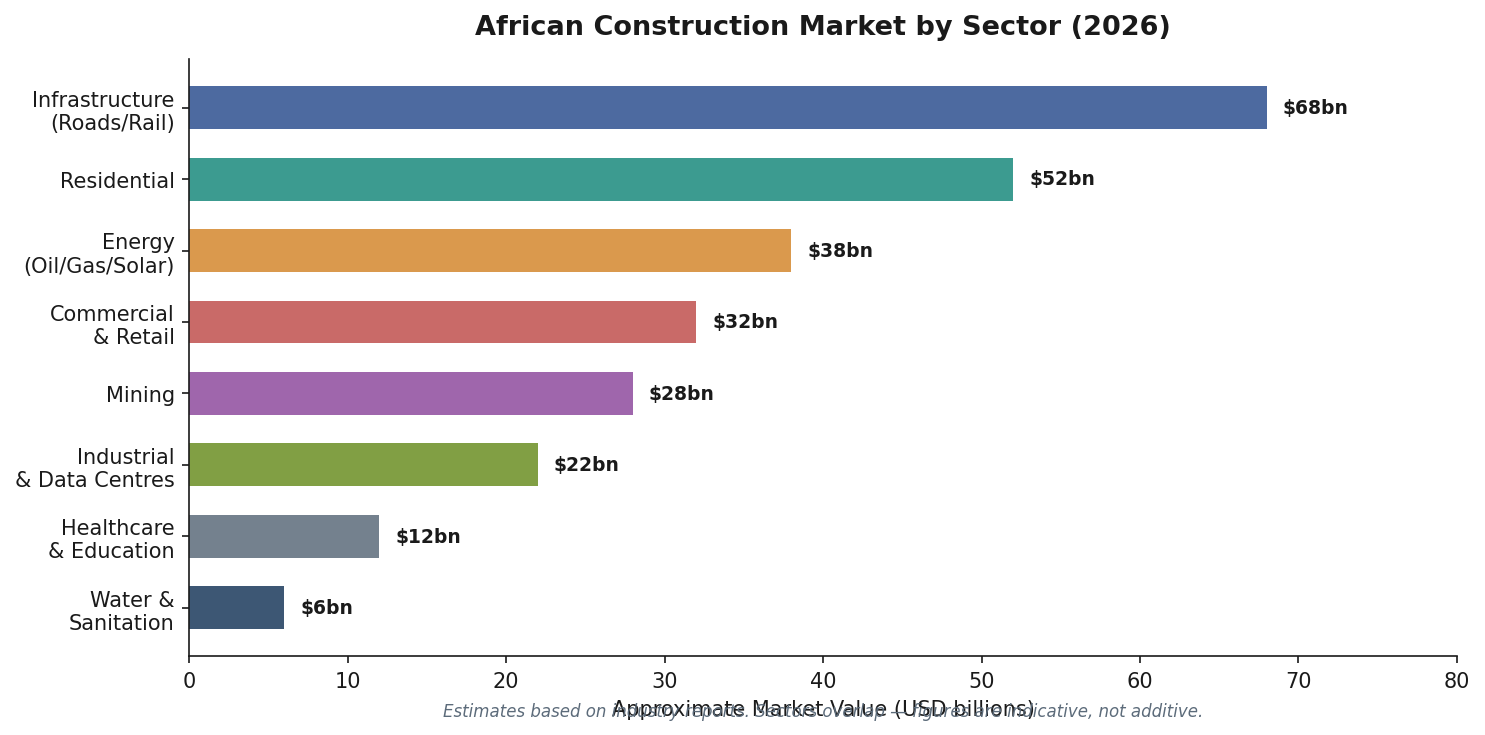
Africa’s Major Infrastructure and Construction Projects
| Project | Country | Estimated Value | Sector | Status (2026) |
|---|---|---|---|---|
| New Administrative Capital | Egypt | $58 billion | New city | Operational — government relocated. Iconic Tower (393m) complete. |
| Grand Ethiopian Renaissance Dam | Ethiopia | $5 billion | Hydropower (5,150 MW) | Inaugurated. Four turbines operational (1,550 MW). Scaling to full capacity. |
| Dangote Refinery | Nigeria | $19 billion | Oil refinery (700,000 bpd) | Operational. World’s largest single-train refinery. Upgraded to 700k bpd. |
| Konza Technopolis | Kenya | $14.5 billion | Smart city / tech hub | Under construction — Phase 1 infrastructure. |
| Tanzania Standard Gauge Railway | Tanzania | $11 billion (all lots) | Rail | Lots 1–5 complete/operational. Lot 6 (€2.5bn) commenced Aug 2026. |
| Lagos–Calabar Coastal Railway | Nigeria | $10 billion | Rail (1,400 km) | Under construction. |
| Gautrain Expansion | South Africa | R120 billion ($6.5 billion) | Rail / metro | New PPP concession being finalised. Expansion planning. |
| Cairo Metro Line 4 | Egypt | $3 billion | Metro | Under construction. Phase 1 opening planned H1 2028. |
| Lekki Deep Sea Port | Nigeria | $1.5 billion | Port | Operational — Nigeria’s deepest port. Expansion underway. |
| Noor Ouarzazate Solar Complex | Morocco | $2.5 billion | Renewable energy | Operational — one of the world’s largest concentrated solar plants. |
| Mombasa–Nairobi SGR | Kenya | $3.8 billion | Rail | Operational since 2017. Extensions planned. |
| Nairobi Expressway | Kenya | $668 million | Highway | Operational since 2022. |
Major QS and Construction Consultancy Firms
International Consultancies
| Firm | HQ | African Operations | Graduate Programmes |
|---|---|---|---|
| Turner & Townsend | Leeds, UK | South Africa (Profica acquisition), Kenya, Nigeria, Ghana. Three regional hubs: Southern, East, and West Africa. | Yes — RICS APC support |
| AECOM | Dallas, USA | South Africa, Kenya, Nigeria, Egypt, Morocco. Infrastructure, buildings, mining. | Yes |
| Mace | London, UK | South Africa, Kenya. Cost consultancy and project management. | Yes — RICS APC support |
| AtkinsRéalis | Montréal, Canada | South Africa, Kenya, Nigeria, Morocco, Egypt. | Yes |
| Rider Levett Bucknall | London / Sydney | South Africa. Cost management, quantity surveying. | Yes |
| Gleeds | London, UK | South Africa, Kenya, Nigeria. | Yes |
| Arcadis | Amsterdam, Netherlands | South Africa, Kenya. | Yes |
| WSP | Montréal, Canada | South Africa, Botswana, Mozambique, Tanzania, Kenya. | Yes |
African-Based Consultancies
| Firm | HQ | Specialisms | Markets |
|---|---|---|---|
| Zutari | Johannesburg, South Africa | Infrastructure engineering, cost management, advisory | Southern and East Africa |
| GIBB Africa | Johannesburg / Nairobi | Technical audits, cost estimates, project management | Southern, East, West Africa |
| MLC Quantity Surveyors | Johannesburg, South Africa | Quantity surveying, cost management | South Africa |
| QualConsul QS | Johannesburg, South Africa | Quantity surveying, commercial management | South Africa, Southern Africa |
| Broll | Johannesburg, South Africa | Property services, project management | Southern and East Africa |
Major Contractors and Developers
| Contractor | HQ | African Markets | QS/Commercial Roles |
|---|---|---|---|
| WBHO | Johannesburg, South Africa | South Africa, Botswana, Mozambique, Zambia | Large QS teams. Building, civil, roads. JBCC and NEC. |
| Murray & Roberts | Johannesburg, South Africa | South Africa, Sub-Saharan Africa | Mining infrastructure, energy, water. Strong commercial teams. |
| Julius Berger | Wiesbaden, Germany / Abuja, Nigeria | Nigeria (dominant), West Africa | Largest contractor in Nigeria. Roads, bridges, buildings. Active QS recruitment. |
| China State Construction Engineering | Beijing, China | Egypt, Kenya, Tanzania, Algeria | Mega-infrastructure. Cost engineering roles (Chinese and international staff). |
| Raubex / Raubex Building | Johannesburg, South Africa | South Africa, Botswana | Roads, infrastructure, building. QS and commercial management roles. |
| Stefanutti Stocks | Johannesburg, South Africa | South Africa, Mozambique, Swaziland | Building, civil, marine, mining infrastructure. |
| Orascom Construction | Cairo, Egypt | Egypt, Algeria, Sub-Saharan Africa | Infrastructure, industrial, commercial. Egypt’s largest contractor. |
Contracts and Procurement in Africa
| Contract | Countries / Markets | Typical Use | QS Role |
|---|---|---|---|
| FIDIC Red Book | All Africa — dominant on international projects | Measured (re-measurement). World Bank, AfDB, donor-funded infrastructure. | BOQ, IPC, variations, claims, final account. |
| FIDIC Yellow Book | All Africa — D&B projects | Plant and design-build. Commercial, industrial, some infrastructure. | Employer’s requirements, change control, cost monitoring. |
| FIDIC Silver Book | Oil & gas, mining, energy (continent-wide) | EPC / turnkey. Contractor takes all risk. | Cost engineering, risk assessment, change management. |
| JBCC | South Africa, Botswana, adapted in Kenya | Building works — commercial, residential, institutional. | Traditional QS role. BOQ, valuations, final account. |
| GCC (General Conditions of Contract) | South Africa — government engineering projects | Government infrastructure, civil works. | Re-measurement, payment certification, contract administration. |
| NEC4 | South Africa (Gautrain, SANRAL), growing in East Africa | Infrastructure, transport. Collaborative approach. | Defined Cost, disallowed cost, compensation events, early warning. |
| EPC / EPCM | Mining, oil & gas, energy (continent-wide) | Turnkey / management contracting. High-value industrial. | Cost engineering, earned value, change management. |
| PPP / Concession | South Africa, Kenya, Nigeria, Egypt | Toll roads, airports, ports. Whole-life cost modelling. | Financial modelling, lifecycle costing, FM pricing. |
Quantity Surveying Skills Required in Africa
The African QS market demands both traditional and modern skills. Core competencies include measurement (taking off from drawings and increasingly from BIM models), cost planning, estimating, bills of quantities, tendering, procurement, cost reporting, cash flow forecasting, risk management, value management, contract administration, claims management, and post-contract cost management through to final account.
Digital skills are increasingly important: CostX for digital measurement, Bluebeam for document management, AutoCAD and Revit/BIM for quantity extraction, Power BI for commercial dashboards, Excel (advanced — still the most used tool in African QS practice), CEMAR for NEC contract management, SAP and Oracle for ERP systems on large projects, Primavera P6 for planning and delay analysis, and emerging AI tools for cost estimation and document review.
Digital Transformation of Quantity Surveying
BIM adoption is growing but uneven across Africa. South Africa leads — BIM is mandated on major public projects and most large consultancies have BIM-integrated QS workflows. Kenya, Nigeria, and Egypt are adopting BIM on large-scale projects, particularly where international consultancies and development finance institutions are involved. However, much of the continent is still in early adoption, and traditional 2D measurement from paper drawings remains common.
5D BIM (cost-linked models), digital twins, AI-assisted estimating, automated quantity take-off, and cloud-based collaboration are all emerging. The opportunity for African QS professionals is significant — those who master digital tools can compete globally while serving local markets where the same tools are only beginning to penetrate.
Working as an International QS in Africa
Qualifications: RICS chartership (MRICS) is the most transferable international qualification. Local registration may also be required (e.g. SACQSP registration in South Africa, QSRBN in Nigeria). NEC and FIDIC experience are highly valued.
CV requirements: Include a full project list with values, contract forms used, and specific QS responsibilities. Highlight FIDIC and donor-funded project experience. Africa-specific experience (even from a single project) is a significant advantage.
Visa and work permits: Most African countries require employer-sponsored work permits. Processing times vary from weeks (South Africa, Kenya) to months (Nigeria, Tanzania). Some countries have bilateral agreements that simplify the process for Commonwealth citizens.
Tax: Varies significantly. South Africa has a progressive income tax system (up to 45%). Nigeria has a graduated tax (up to 24%). Kenya has PAYE (up to 30%). Expatriate tax treatment varies — some countries offer tax incentives for skilled professionals on infrastructure projects.
Health, safety, and security: International employers typically provide private medical insurance, security briefings, and evacuation cover. Malaria prophylaxis is required in many regions. Security considerations vary significantly by country and project location — employer risk assessments are standard for remote projects.
African QS vs UK QS
| Area | UK | Africa |
|---|---|---|
| Education | BSc QS (3 years) + APC | BSc QS (4–5 years) + national registration |
| Professional qualification | MRICS (voluntary but standard) | National registration (statutory in SA, Nigeria, Kenya) + MRICS (optional but valued) |
| Contracts | JCT, NEC dominant | FIDIC dominant (international); JBCC, GCC, NEC (South Africa); bespoke (some markets) |
| Procurement | D&B, traditional, two-stage | Traditional (measured BOQ), EPC, D&B growing, PPP on infrastructure |
| Measurement | NRM 1 & NRM 2 | Varies: SA uses own standards (ASAQS); others use SMM-based or FIDIC-aligned approaches |
| Cost reporting | Monthly cost reports, CVR, EVM | Similar in SA and on international projects; more basic on smaller domestic projects |
| Claims | Relatively low claims intensity | High claims intensity on FIDIC projects; delay analysis essential |
| Technology | High BIM adoption, digital measurement | Growing in SA; early adoption elsewhere; traditional methods still common |
| Career progression | Structured — APC at ~4 years | Structured in SA; developing elsewhere; faster progression common in high-growth markets |
Challenges Facing Quantity Surveying in Africa
The African QS profession faces significant challenges alongside its opportunities. Skills shortages affect every market — there are not enough qualified quantity surveyors to meet demand, particularly in East and West Africa. Infrastructure funding gaps (estimated at $68–108 billion annually by the African Development Bank) limit the volume of projects. Currency volatility — particularly affecting the Nigerian naira, Egyptian pound, and several East African currencies — creates pricing uncertainty and complicates cost management. Material price volatility and import dependency (many construction materials are imported) add cost risk.
Payment delays are a persistent challenge, particularly on government-funded projects. Limited reliable cost data for benchmarking and estimating — compared to the UK’s BCIS database — means QS professionals often rely on project-specific records and professional judgment. Informal construction (a large proportion of African construction occurs outside the formal, professionally managed sector) limits the profession’s reach. Limited digital adoption in many markets means traditional manual processes persist.
Despite these challenges, the trajectory is positive. Professional institutions are growing, university programmes are expanding, international firms are investing, and digital tools are increasingly accessible.
The Future of Quantity Surveying in Africa
The outlook for quantity surveying in Africa over the next 10–20 years is exceptionally strong. Africa’s population is projected to reach 2.5 billion by 2050 — creating unprecedented demand for housing (an estimated 56-million-unit deficit), infrastructure (roads, rail, ports, airports, water systems), energy (solar, wind, gas, hydroelectric, nuclear), healthcare, education, and commercial development.
The African Continental Free Trade Area (AfCFTA) — the world’s largest free trade area by number of countries — will boost cross-border investment and construction. Data centres are among the fastest-growing construction sectors, with hyperscale facilities planned across South Africa, Kenya, Nigeria, and Egypt. Renewable energy (Africa has extraordinary solar and wind resources) will drive billions of dollars of construction investment. Mining for critical minerals (lithium, cobalt, copper, rare earths) essential for the global energy transition will create infrastructure demand across DRC, Zambia, Tanzania, and others.
The QS who combines traditional measurement and contractual skills with digital fluency, FIDIC expertise, and commercial leadership will be extraordinarily well positioned for the African market of the next two decades.
The Future QS Professional
The African Quantity Surveyor of 2035 will need a skills framework spanning four domains: Technical (measurement, cost planning, estimating, contract management — with digital tools as standard); Commercial (risk management, procurement strategy, negotiation, claims, commercial leadership); Digital (BIM, AI-assisted estimating, data analytics, Power BI dashboards, digital twins); and Leadership (communication, strategic thinking, client management, cross-cultural fluency, and the ability to operate across multiple African markets and contract forms).
Career Opportunities by Country — Ranking
| Rank | Country | Strength | Notes |
|---|---|---|---|
| 1 | South Africa | Most mature profession, highest salaries, strongest professional infrastructure | Moderate growth. Established market. |
| 2 | Kenya | Fastest-growing QS market (8.9% CAGR). East African hub. | Strong infrastructure pipeline. International firm presence. |
| 3 | Nigeria | Largest West African market. Oil and gas, infrastructure, commercial. | Currency volatility a challenge. High demand. |
| 4 | Egypt | Largest construction market in Africa (37% share). Megaprojects. | QS practised as cost engineering. Massive scale. |
| 5 | Tanzania | SGR, mining, hydropower. Growing rapidly. | Early-stage profession with strong growth potential. |
| 6 | Ghana | Mining, oil and gas, commercial. Stable market. | Well-established profession. KNUST produces quality graduates. |
| 7 | Botswana | Small but well-regulated. Strong salaries relative to cost of living. | Diamond mining infrastructure. Government building programmes. |
| 8 | Morocco | 2030 FIFA World Cup. Renewables. Rail. Tourism. | French-tradition market. Growing international QS adoption. |
This ranking is indicative and based on a composite assessment of construction activity, infrastructure investment, salary potential, demand for QS professionals, international opportunities, professional development infrastructure, and long-term prospects. It is not absolute and will change as markets evolve.
Frequently Asked Questions
How do I become a Quantity Surveyor in Africa?
Complete an accredited BSc Quantity Surveying or Construction Economics degree (typically 4 years), gain professional experience (2–5 years depending on the country), register with your national professional body (e.g. SACQSP in South Africa, QSRBN in Nigeria, BORAQS in Kenya), and pursue chartership through RICS or your local institution.
Which African country has the highest demand for QS professionals?
South Africa has the most established QS market, but Nigeria, Kenya, and Egypt are experiencing the fastest growth in demand. Saudi Arabia’s giga-projects have also drawn African QS professionals to the Middle East, creating domestic shortages — particularly in Nigeria and Kenya.
Is RICS recognised in Africa?
Yes. RICS is recognised across Africa, particularly in South Africa, Nigeria, Kenya, Ghana, and Tanzania. RICS has a Sub-Saharan Africa board and conducts APC assessments regionally. MRICS is widely regarded as the gold standard international qualification.
Can a UK Quantity Surveyor work in Africa?
Yes. UK-qualified QS professionals — particularly MRICS holders — are valued across Africa, especially on internationally funded infrastructure projects. A work permit is required in most countries. FIDIC and NEC experience are particularly attractive to employers.
Which African country pays Quantity Surveyors the most?
South Africa and Botswana generally offer the highest QS salaries in local purchasing-power terms. However, expatriate packages on major infrastructure projects in Nigeria, Kenya, Tanzania, and Mozambique can exceed South African salaries when housing, flights, and per diems are included.
Is Quantity Surveying a good career in Nigeria?
Yes. Nigeria has the largest construction market in West Africa and growing demand for qualified QS professionals. The Nigerian Institute of Quantity Surveyors (NIQS) and the Quantity Surveyors Registration Board of Nigeria (QSRBN) regulate the profession. Salaries are rising, particularly on oil and gas, infrastructure, and commercial projects.
Is Quantity Surveying a good career in South Africa?
Yes. South Africa has the most mature QS profession in Africa, with SACQSP registration, ASAQS membership, and strong RICS recognition. Registered Professional Quantity Surveyors (PrQS) command premium salaries and are in consistent demand across building, infrastructure, and mining sectors.
What qualifications do I need to become a QS in Kenya?
A BSc in Quantity Surveying or Building Economics from a recognised university, followed by registration with the Board of Registration of Architects and Quantity Surveyors (BORAQS). Membership of the Institute of Quantity Surveyors of Kenya (IQSK) is also standard. RICS chartership is increasingly pursued.
Which universities offer Quantity Surveying in Africa?
Leading universities include the University of Pretoria, University of the Witwatersrand, and University of Cape Town (South Africa); University of Lagos and Obafemi Awolowo University (Nigeria); University of Nairobi and JKUAT (Kenya); KNUST (Ghana); and Cairo University (Egypt). Many programmes are accredited by SACQSP, RICS, or national professional bodies.
What contracts do African Quantity Surveyors use?
FIDIC is the dominant contract form for internationally funded and infrastructure projects across Africa. In South Africa, JBCC (building) and GCC/NEC (engineering and infrastructure) are standard. NEC is growing on donor-funded projects. EPC contracts are common in oil and gas and mining sectors.
Is FIDIC important in Africa?
FIDIC is essential. It is the standard contract form for World Bank, African Development Bank, and most donor-funded infrastructure projects across the continent. QS professionals working in Africa must be proficient in FIDIC — particularly the Red Book, Yellow Book, and Silver Book.
Is NEC used in Africa?
Yes, increasingly. NEC is well established in South Africa (used on Gautrain and major infrastructure) and growing in East Africa. It is favoured by some development finance institutions and UK-linked projects. However, FIDIC remains dominant continent-wide.
Can I work in Africa with an RICS qualification?
Yes. RICS is recognised across Africa and is often a requirement or strong preference for senior QS roles, particularly with international consultancies and on internationally funded projects. Some countries also require local registration (e.g. SACQSP in South Africa, QSRBN in Nigeria).
Do Quantity Surveyors need to speak French or Arabic?
For Francophone West and Central Africa (Senegal, Côte d’Ivoire, Cameroon, DRC), French is essential. For North Africa (Egypt, Morocco, Algeria, Tunisia), Arabic and French are valuable. English is the working language in Southern, East, and Anglophone West Africa.
What is the difference between a QS and a Commercial Manager?
A Quantity Surveyor focuses on measurement, cost planning, and contract administration. A Commercial Manager takes a broader role encompassing procurement strategy, risk management, CVR, and business-level commercial decision-making. In Africa, the Commercial Manager title is increasingly used at senior level, particularly by international contractors.
What are the best QS firms in Africa?
Major international firms with significant African operations include Turner & Townsend, AECOM, Mace, AtkinsRéalis, RLB, Gleeds, and Arcadis. Leading African-based firms include Zutari, MLC Quantity Surveyors, QualConsul, Quanticost, and numerous national practices in South Africa, Nigeria, Kenya, and Ghana.
What skills do African employers want from Quantity Surveyors?
Core QS skills (measurement, cost planning, contract administration) plus FIDIC proficiency, claims management, commercial reporting, and digital skills (CostX, Power BI, BIM, Primavera). On infrastructure projects, experience with donor-funded procurement and NEC is highly valued.
How can an African QS work internationally?
Obtain RICS chartership (MRICS) — it is the most internationally transferable QS qualification. Build experience on FIDIC and NEC contracts. Gain exposure to international consultancies. The Middle East, UK, and Australia are the most common international destinations for African QS professionals.
What is the AAQS?
The Africa Association of Quantity Surveyors (AAQS) is the continental body representing national QS institutions across Africa. Members include ASAQS (South Africa), NIQS (Nigeria), IQSK (Kenya), GhIS (Ghana), and institutions from Botswana, Namibia, Uganda, Rwanda, Mozambique, Mauritius, and others.
What is SACQSP?
The South African Council for the Quantity Surveying Profession is the statutory body that regulates the QS profession in South Africa. Registration as a Professional Quantity Surveyor (PrQS) is required to practise. SACQSP accredits university programmes and conducts professional assessments.
Are there QS graduate programmes in Africa?
Yes. International consultancies (Turner & Townsend, AECOM, AtkinsRéalis, Mace) and major African firms offer structured graduate programmes, particularly in South Africa, Kenya, and Nigeria. These typically include RICS or local professional body support and mentorship.
What is the construction market size in Africa?
The African construction market is valued at approximately $258 billion in 2026, forecast to reach $432 billion by 2033 at a CAGR of 7.1%. Egypt leads with 37% market share, followed by South Africa, Nigeria, and Kenya.
Is BIM used in African construction?
BIM adoption is growing but varies significantly by country. South Africa leads with BIM mandates on major public projects. Kenya, Nigeria, and Egypt are adopting BIM on large-scale projects. However, much of the continent is still in early adoption, and traditional 2D measurement remains common.
What challenges do Quantity Surveyors face in Africa?
Key challenges include payment delays, currency volatility, limited reliable cost data, skills shortages, informal construction sectors, material price volatility, import dependency, and varying levels of digital infrastructure. Despite these challenges, the profession is growing strongly.
What is the future of Quantity Surveying in Africa?
Extremely positive. Africa’s population is projected to reach 2.5 billion by 2050, driving massive demand for housing, infrastructure, energy, and industrial construction. The African Continental Free Trade Area (AfCFTA) will boost cross-border investment. Demand for professional cost management will increase significantly across the continent.
African Quantity Surveying Knowledge Hub
This article is the pillar page for ProQS.site’s African Quantity Surveying content network. Future dedicated country guides are planned for: South Africa, Nigeria, Kenya, Ghana, Egypt, Tanzania, Zambia, Zimbabwe, Morocco, Uganda, Botswana, and Rwanda — each covering history, education, professional bodies, qualifications, career pathways, salaries, major firms, major projects, contracts, jobs, professional development, and future outlook.
Cross-Links
For related topics, see these ProQS articles:
- Quantity Surveying in the Middle East
- Post-Contract Cost Management
- NRM 1 and Cost Planning
- Early Warning Under NEC4
- Bonds, Guarantees and Warranties
- Role of the Employer’s Agent
- Key Performance Indicators in Construction