Quantity Surveying in the Middle East — Complete Guide
Introduction
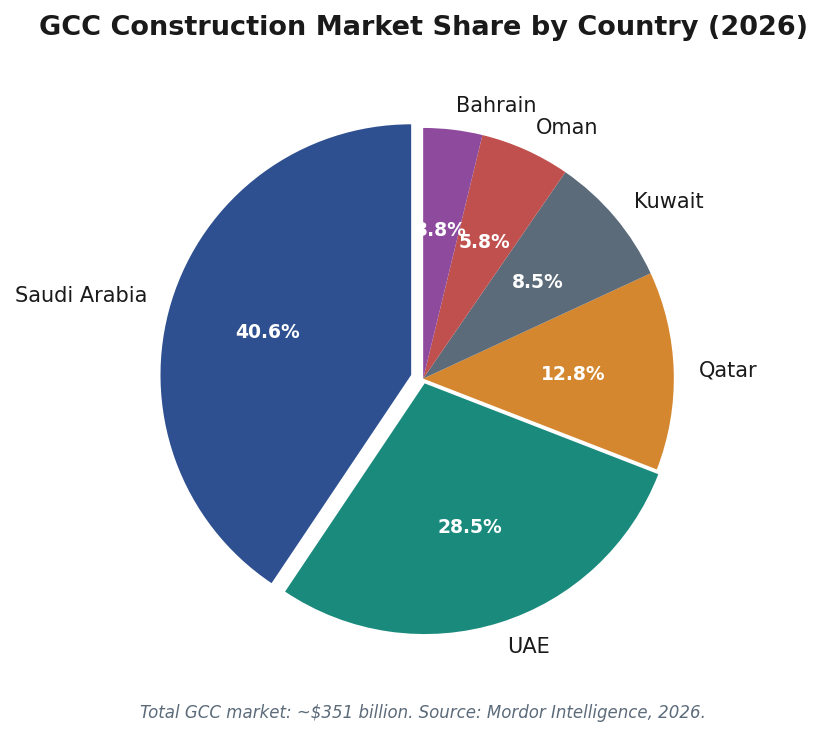
The Middle East is one of the world’s largest and most dynamic construction markets. With over $350 billion in active construction across the six Gulf Cooperation Council (GCC) states, the region offers quantity surveyors career opportunities, project scale, and earning potential that few other markets can match.
The profession as it is practised in the GCC today owes much to British commercial management traditions — brought to the region by international consultancies during the oil boom of the 1960s and 1970s — but it has evolved into something distinct. The dominance of FIDIC contracts, the scale of megaprojects like NEOM and the Dubai Metro, the tax-free salary model, and the multicultural working environment all create a professional landscape that differs significantly from the UK, Australia, or any other traditional QS market.
This guide covers everything a quantity surveyor needs to know about the Middle East: the history of the profession in the region, country-by-country market analysis, salary data, the largest employers, procurement methods, professional institutions, career pathways, technology trends, and practical advice for relocating as an expat QS. Whether you are a graduate considering your first international move, a senior QS weighing up a relocation, or an employer looking to understand the market, this is your definitive reference.
The Origins of Quantity Surveying in the Middle East
Before the discovery of oil, construction in the Arabian Peninsula was governed by traditional methods passed down through generations. Buildings were constructed from local materials — coral stone, mud brick, palm fronds, and gypsum — and costs were managed informally through master builders and merchants. There was no formal quantity surveying profession.
The transformation began in the 1930s and 1940s with the granting of oil concessions. As revenues grew, Gulf states embarked on modernisation programmes that required international engineering expertise. British firms — already established across the colonial and post-colonial world — were among the first to bring professional quantity surveying practices to the region.
During the 1950s and 1960s, firms like Widnell & Trollope (later Davis Langdon, now AECOM), Gardiner & Theobald, and other UK-based practices established offices in Bahrain, Kuwait, and the Trucial States (now the UAE). These firms introduced bills of quantities, formal tendering procedures, and cost planning — the building blocks of the profession as it is known today.
The 1973 oil crisis and subsequent surge in oil revenues accelerated the transformation. Gulf states invested heavily in infrastructure — hospitals, airports, universities, roads, ports, and housing. The volume of work attracted international contractors and consultancies from across the world, and with them came the FIDIC suite of contracts, which became the dominant contractual framework across the region.
By the 1990s and 2000s, the Middle East had moved beyond basic infrastructure into megaproject territory. The Burj Khalifa, Palm Jumeirah, Doha’s West Bay, and Riyadh’s King Abdullah Financial District represented a new scale of ambition. Quantity surveyors were no longer just measuring and valuing — they were managing commercial risk on some of the largest and most complex projects on earth.
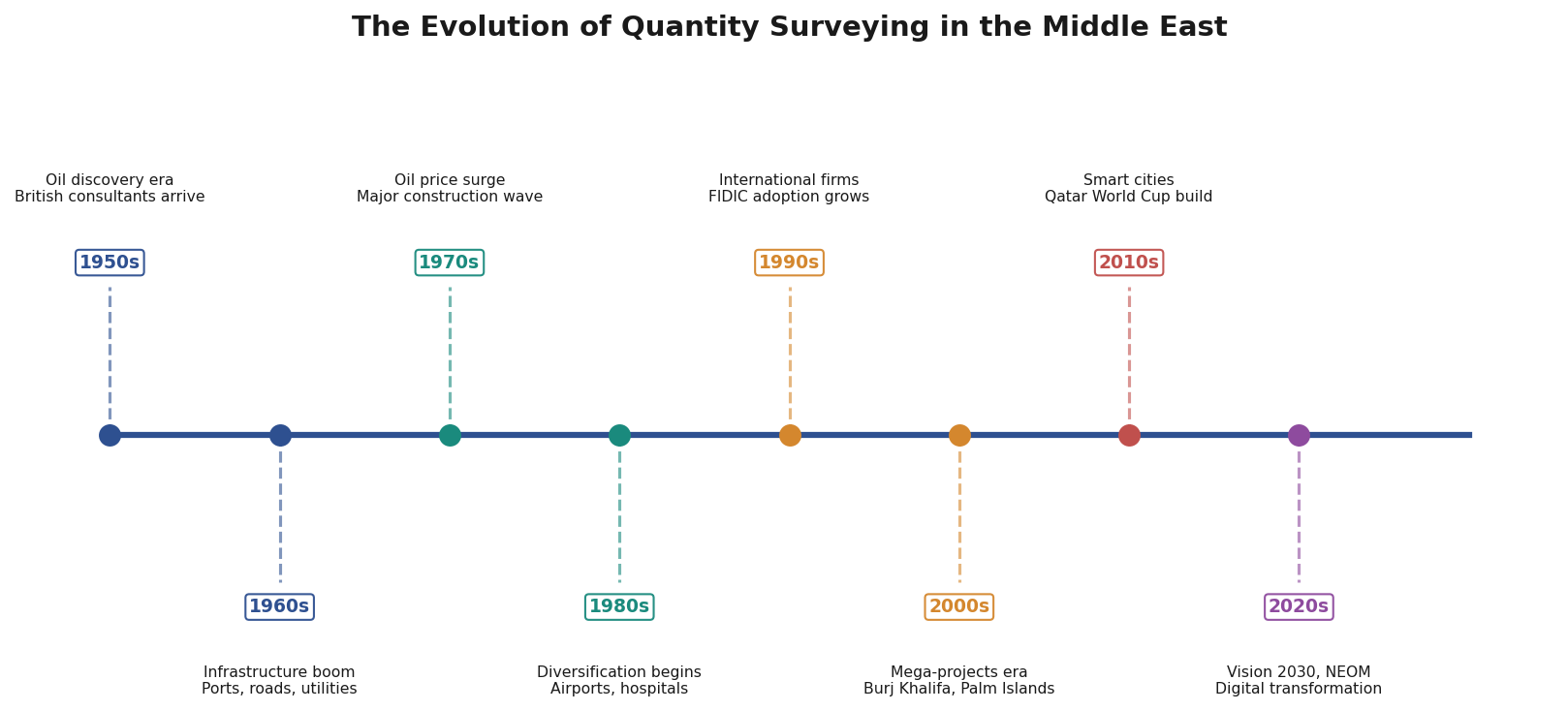
Evolution of the Profession
| Period | Development | Impact on QS Profession |
|---|---|---|
| 1950s–1970s | Oil boom and first wave of infrastructure | British QS firms establish regional offices. BOQ-based tendering introduced. FIDIC contracts adopted. |
| 1980s | Infrastructure expansion and diversification | Airports, hospitals, universities. QS role expands into project controls and claims management. |
| 1990s | International consultancies scale up | Global firms open permanent ME offices. RICS presence grows. Professional standards formalised. |
| 2000s | Mega-developments and real estate boom | Burj Khalifa, Palm Islands, Lusail. QS demand surges. EPC and D&B contracts dominate. Claims culture intensifies. |
| 2010s | Smart cities and mega-events | Qatar FIFA World Cup, Expo 2020 Dubai. BIM adoption. NEC introduced on select projects. Commercial manager role emerges. |
| 2020s | Vision 2030, sustainability, digital transformation | NEOM, The Line, Qiddiya. Saudi Arabia becomes the dominant market. AI, digital twins, Power BI dashboards. Net zero targets emerge. |
Quantity Surveying by Country
United Arab Emirates
The UAE remains the most mature QS market in the GCC. Dubai and Abu Dhabi together account for the bulk of activity, with a construction market worth approximately $100 billion. The UAE’s strength lies in its diversified economy, established legal framework, and concentration of international consultancies and contractors.
Major sectors: Commercial towers, hospitality, residential, metro/rail, airports, data centres, renewable energy.
Procurement: FIDIC Red Book and Yellow Book dominate. Design and Build is the most common route for private sector work. Government clients (e.g. RTA, Aldar, Mubadala) increasingly use amended FIDIC or bespoke contracts. NEC has been used on select projects but remains niche.
Key projects (2026): Dubai Metro Blue Line ($5.6 billion), Expo City Dubai legacy development, Al Maktoum International Airport expansion, Etihad Rail, Masdar City Phase 2.
Salary range: Graduate QS AED 10,000–16,000/month; Senior QS AED 20,000–33,000/month; Commercial Director AED 40,000–65,000/month. All tax-free.
Visa: Employment visa sponsored by employer. Golden Visa available for highly skilled professionals. Processing typically 2–4 weeks.
RICS: Fully recognised. Large RICS member community. APC assessments conducted regionally.
Saudi Arabia
Saudi Arabia is now the largest construction market in the Middle East, accounting for over 40% of GCC construction activity. Vision 2030 has transformed the kingdom from a secondary QS market into the primary destination for quantity surveyors worldwide. The pipeline is extraordinary: NEOM, The Line, Qiddiya, the Red Sea project, King Salman International Airport ($30 billion), the Riyadh Metro, and Diriyah Gate.
Major sectors: Giga-projects, airports, rail, defence, healthcare, education, entertainment, renewable energy, data centres.
Procurement: FIDIC Red Book is the standard for public sector work, often heavily amended in the employer’s favour. EPC (turnkey) contracts are common for industrial and infrastructure projects. NEC is gaining interest but adoption remains limited. Saudi Binladin Group and other local contractors use bespoke forms.
Salary range: Graduate QS SAR 8,000–14,000/month; Senior QS SAR 18,000–32,000/month; Commercial Director SAR 38,000–60,000/month. Tax-free.
Visa: Employment visa (iqama) sponsored by employer. Premium Residency available for high earners. Saudisation (Nitaqat) quotas apply — employers must maintain a minimum percentage of Saudi nationals, which can affect hiring patterns for expatriates.
RICS: Recognised and growing. RICS has a dedicated Saudi Arabia advisory board. APC pathway supported by major consultancies including Mace, Turner & Townsend, and AtkinsRéalis.
Qatar
Qatar’s construction market slowed after the FIFA World Cup 2022 delivery phase but remains active, with a pipeline estimated at over $100 billion including Lusail City completion, Hamad International Airport expansion, and new metro extensions. The market is smaller than the UAE or Saudi Arabia but offers high salaries and excellent project quality.
Major sectors: Infrastructure, LNG facilities, stadiums legacy, residential, healthcare, education.
Procurement: FIDIC dominates (Red and Yellow Books). Qatar Foundation and Ashghal (Public Works Authority) are the major government clients. Bespoke employer-amended FIDIC is common.
Salary range: Graduate QS QAR 10,000–15,000/month; Senior QS QAR 20,000–32,000/month; Commercial Director QAR 38,000–65,000/month. Tax-free.
Visa: Employer-sponsored work visa. Permanent residency available for select professionals.
Oman
Oman’s construction market is smaller but growing, with investment in tourism (Oman Vision 2040), port infrastructure (Duqm Special Economic Zone), and renewable energy. The market offers a more relaxed working environment compared to the UAE or Saudi Arabia, with lower cost of living.
Salary range: Graduate QS OMR 700–1,200/month; Senior QS OMR 1,500–2,500/month; Commercial Director OMR 3,000–5,000/month. Tax-free.
Procurement: FIDIC-based. Government tender board manages public sector procurement.
Bahrain
Bahrain was historically one of the first GCC states to adopt formal QS practices. The market is compact but has a steady pipeline of residential, commercial, and infrastructure projects. Bahrain’s lower cost of living and proximity to Saudi Arabia (via the King Fahd Causeway) make it attractive for professionals servicing both markets.
Salary range: Graduate QS BHD 600–1,000/month; Senior QS BHD 1,200–2,200/month; Commercial Director BHD 2,500–4,500/month. Tax-free.
Kuwait
Kuwait has a significant infrastructure pipeline including the Kuwait Metro, Silk City (Madinat al-Hareer), and healthcare facilities. The market is heavily government-driven, with the Kuwait Authority for Partnership Projects (KAPP) managing PPP schemes. Procurement is predominantly FIDIC-based with heavy employer amendments.
Salary range: Graduate QS KWD 700–1,100/month; Senior QS KWD 1,500–2,500/month; Commercial Director KWD 3,000–5,000/month. Tax-free.

Major Construction Sectors
| Sector | Key Markets | QS Opportunities |
|---|---|---|
| Airports | Saudi Arabia, UAE, Qatar | King Salman ($30bn), Al Maktoum, Hamad expansion. Complex M&E, high-value contracts. |
| Rail & Metro | UAE, Saudi Arabia, Kuwait | Dubai Metro Blue Line ($5.6bn), Riyadh Metro, Etihad Rail, Kuwait Metro. NEC increasingly used. |
| Highways | All GCC | Expressway programmes, interchanges, bridges. FIDIC Red Book standard. |
| Data Centres | UAE, Saudi Arabia | Fastest-growing sector. Specialist M&E QS skills in high demand. Hyperscale facilities. |
| Healthcare | Saudi Arabia, UAE, Qatar | Hospital programmes, medical cities. Complex specifications and compliance requirements. |
| Education | Saudi Arabia, UAE | University campuses, schools programmes. D&B and traditional procurement. |
| Defence | Saudi Arabia, UAE, Oman | Military facilities, naval bases, air bases. Security clearance often required. High-value programmes. |
| Oil & Gas | All GCC, especially Qatar, Saudi | ARAMCO, ADNOC, QatarEnergy. EPC contracts. Strong demand for cost engineers. |
| Renewable Energy | Saudi Arabia, UAE, Oman | Solar farms, green hydrogen, wind. Growing rapidly under net-zero commitments. |
| Commercial & Hospitality | UAE, Saudi Arabia, Bahrain | Office towers, hotels, entertainment venues. D&B and FIDIC Yellow Book. |
| Residential | All GCC | High-rise, villas, masterplanned communities. Volume work with strong measurement focus. |
| Stadiums & Entertainment | Saudi Arabia, Qatar | FIFA 2034 venues, Qiddiya theme parks. High-profile, fast-track delivery. |
The Largest Projects
| Project | Country | Estimated Value | Sector | Status (2026) |
|---|---|---|---|---|
| NEOM | Saudi Arabia | $500 billion (overall) | Mixed-use megacity | Under construction (restructured) |
| Qiddiya | Saudi Arabia | $32 billion | Entertainment & sports | Under construction |
| King Salman International Airport | Saudi Arabia | $30 billion | Aviation | Under construction (commenced Sep 2025) |
| Lusail City | Qatar | $45 billion | New city | Advanced / phased completion |
| Red Sea Global | Saudi Arabia | $10 billion+ | Tourism & hospitality | Phase 1 operational, Phase 2 underway |
| Dubai Metro Blue Line | UAE | $5.6 billion | Rail / metro | Under construction (20% complete) |
| Expo City Dubai | UAE | $8 billion | Mixed-use legacy | Operational / expanding |
| Diriyah Gate | Saudi Arabia | $20 billion | Heritage / tourism | Under construction |
| Etihad Rail | UAE | $11 billion | Rail / freight | Operational (Stage 2 complete) |
| Hamad International Airport Expansion | Qatar | $6 billion | Aviation | Under construction |
Procurement and Contracts
The Middle East’s contractual landscape is dominated by FIDIC (Fédération Internationale des Ingénieurs-Conseils). Unlike the UK, where JCT and NEC are the standard forms, FIDIC has been the default suite across the GCC for over 50 years. However, the way FIDIC is used in the region differs significantly from its intended balanced risk allocation — employer-side amendments are extensive, and many contracts bear little resemblance to the unamended FIDIC text.
| Contract Form | Middle East Usage | UK Equivalent | QS Notes |
|---|---|---|---|
| FIDIC Red Book | Dominant — public & private sector | JCT SBC (with quantities) | Re-measurement based. QS manages BOQ, IPC, variations, and final account. |
| FIDIC Yellow Book | Common — D&B projects | JCT DB | Lump sum with employer’s requirements. QS manages contractor’s proposals and change control. |
| FIDIC Silver Book | EPC / turnkey projects | No direct UK equivalent | Contractor takes all risk. Common in oil & gas, industrial, and power. Cost engineering focus. |
| NEC4 | Limited but growing | NEC4 (same) | Used on select rail and infrastructure projects. Collaborative approach less familiar to regional market. |
| Bespoke / Employer Forms | Common — major developers | N/A | ARAMCO, Emaar, Aldar, NEOM all use proprietary contracts. Heavy employer risk transfer. |
| PPP / Concession | Growing — especially Kuwait, Saudi | PFI / PF2 | Whole-life cost modelling. QS role in financial close and FM pricing. |
| Target Cost | Emerging — NEC Option C | NEC Option C | Pain/gain mechanism. Requires strong QS scrutiny of Defined Cost and disallowed cost. |
A key difference from the UK is the claims culture. In the Middle East, claims under FIDIC Sub-Clause 20.1 (notice requirements) are a major part of the QS’s workload. Contractors routinely submit extensive prolongation, disruption, and variation claims, and the QS — whether acting for the employer or the contractor — must be proficient in delay analysis (often using Primavera P6), quantum assessment, and contractual drafting.
Professional Institutions
| Institution | Full Name | ME Recognition | Notes |
|---|---|---|---|
| RICS | Royal Institution of Chartered Surveyors | Widely recognised across all GCC states | MRICS is the gold standard. Regional APC assessments. MENA World Regional Board. Largest international professional body for QS in the region. |
| CIQS | Canadian Institute of Quantity Surveyors | Recognised, particularly with Canadian firms | PQS designation. Less common than RICS in the ME but valued in cost management roles. |
| CICES | Chartered Institute of Civil Engineering Surveyors | Recognised for infrastructure / civil works | Relevant for rail, highways, and utilities. TechCICES and CICES chartership pathways. |
| AIQS | Australian Institute of Quantity Surveyors | Recognised, particularly with Australian firms | MAIQS designation. Reciprocal arrangement with RICS. Australian QS well represented in ME. |
| Local engineering councils | Saudi Council of Engineers, UAE MOHR | Required for practise registration in some states | Saudi Arabia requires SCE registration for engineering professionals. UAE requires MOHR classification. QS may or may not fall under these depending on the jurisdiction. |
Education Pathways
| Institution | Location | Relevant Programmes | RICS Accredited |
|---|---|---|---|
| Heriot-Watt University Dubai | Dubai, UAE | BSc Quantity Surveying, MSc Construction Project Management | Yes |
| University of Reading (Henley) | Malaysia campus (ME accessible) | BSc Quantity Surveying | Yes |
| UCL Qatar | Doha, Qatar | MSc Project and Enterprise Management | — |
| UOWD (University of Wollongong Dubai) | Dubai, UAE | Master of Engineering Management | — |
| RICS Distance Learning (various) | Online / global | Postgraduate Diploma in QS, MSc programmes | Yes |
| College of Estate Management (CEM) | Online / UK-based | BSc Quantity Surveying (distance), MSc QS | Yes |
For professionals without a QS degree, conversion routes exist through RICS-accredited postgraduate programmes (CEM and others offer distance learning) or via the RICS Senior Professional Assessment for experienced practitioners. Several major consultancies in the ME — including Turner & Townsend, AtkinsRéalis, and Mace — run structured RICS graduate development programmes that support APC candidates through to chartership.
Career Pathways

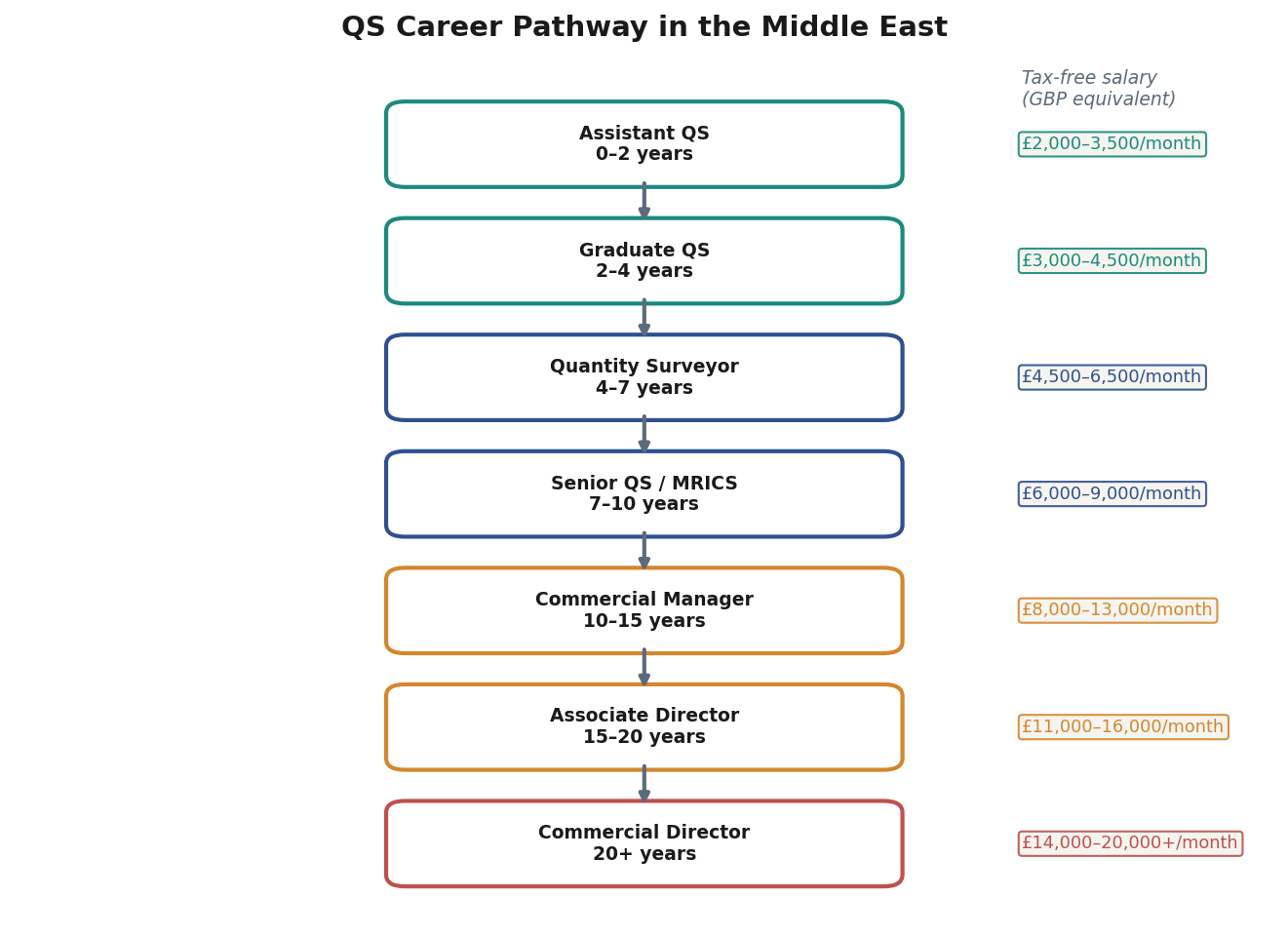
| Level | Typical Experience | Key Responsibilities | Chartership |
|---|---|---|---|
| Assistant QS | 0–2 years | Measurement, taking off, assisting with valuations and cost reports | Working towards APC |
| Graduate QS | 2–4 years | Preparing cost plans, managing subcontract packages, interim valuations | APC in progress |
| Quantity Surveyor | 4–7 years | Running own projects, cost management, contract administration, claims | MRICS achieved |
| Senior QS | 7–10 years | Leading project teams, client management, commercial strategy, mentoring juniors | MRICS / FRICS |
| Commercial Manager | 10–15 years | Multi-project commercial oversight, CVR, procurement strategy, risk management | MRICS / FRICS |
| Associate Director | 15–20 years | Business development, client relationships, team leadership, P&L responsibility | FRICS |
| Commercial Director | 20+ years | Board-level commercial strategy, major project bids, dispute resolution, expert witness | FRICS |
Salary Guide

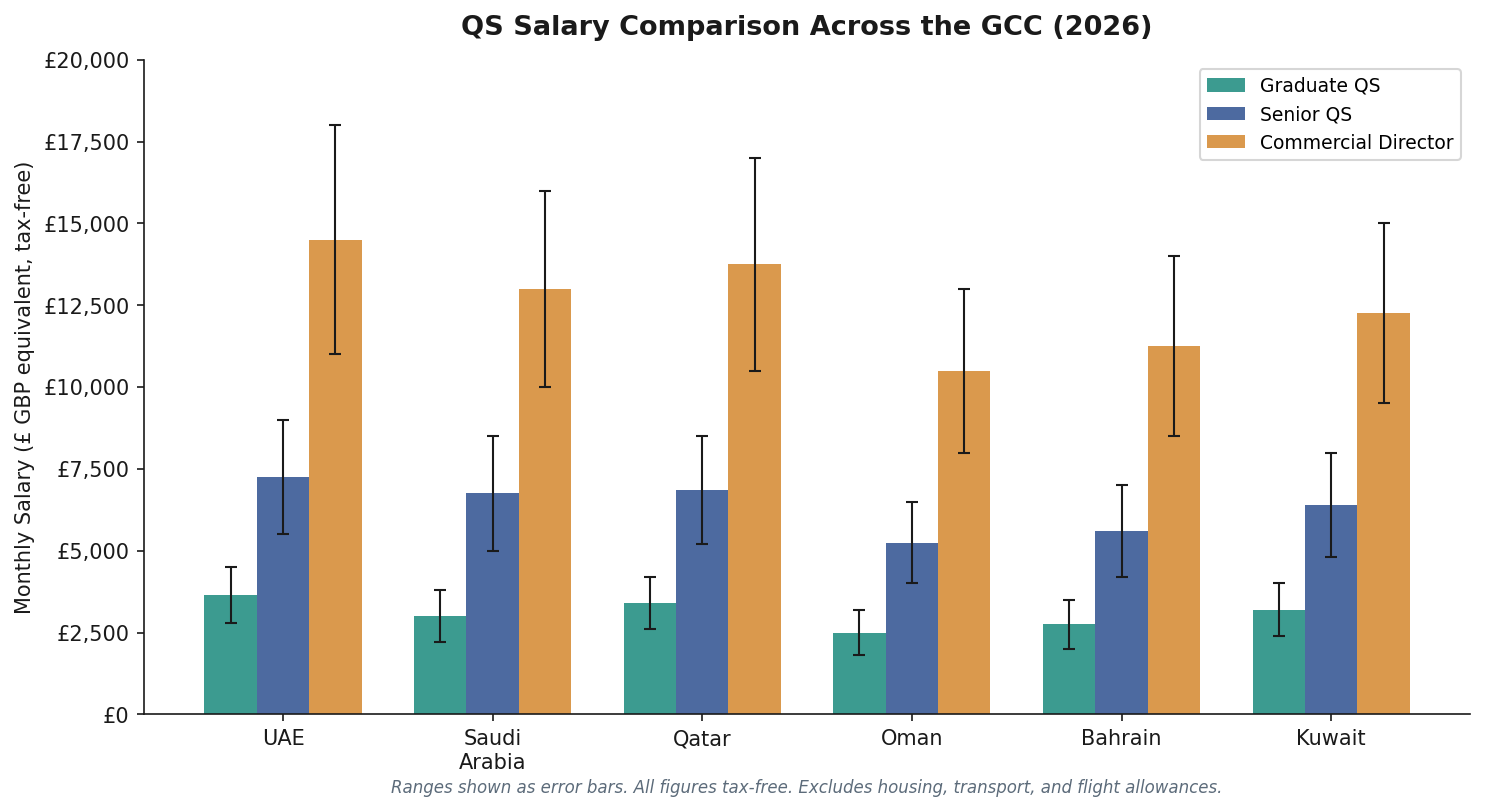
| Country | Graduate QS (monthly) | Senior QS (monthly) | Commercial Director (monthly) | Tax |
|---|---|---|---|---|
| UAE | AED 10,000–16,000 | AED 20,000–33,000 | AED 40,000–65,000 | 0% income tax |
| Saudi Arabia | SAR 8,000–14,000 | SAR 18,000–32,000 | SAR 38,000–60,000 | 0% income tax |
| Qatar | QAR 10,000–15,000 | QAR 20,000–32,000 | QAR 38,000–65,000 | 0% income tax |
| Oman | OMR 700–1,200 | OMR 1,500–2,500 | OMR 3,000–5,000 | 0% income tax |
| Bahrain | BHD 600–1,000 | BHD 1,200–2,200 | BHD 2,500–4,500 | 0% income tax |
| Kuwait | KWD 700–1,100 | KWD 1,500–2,500 | KWD 3,000–5,000 | 0% income tax |
Typical benefits package (in addition to base salary): housing allowance or company-provided accommodation (typically 25–35% of salary value), annual return flights for employee and dependants, private medical insurance, company car or transport allowance, end-of-service gratuity (typically 21 days’ salary per year for the first five years, 30 days per year thereafter), and 30 days’ annual leave. These benefits mean the total package value is typically 30–50% above the stated base salary.
The Biggest Employers
Consultancies
| Firm | HQ | ME Presence | Graduate Schemes |
|---|---|---|---|
| Turner & Townsend | Leeds, UK | Dubai, Abu Dhabi, Riyadh, Jeddah, Doha | Yes — RICS APC programme |
| AECOM | Dallas, USA | Dubai, Abu Dhabi, Riyadh, Muscat, Doha | Yes — structured graduate programme |
| Arcadis | Amsterdam, Netherlands | Dubai, Riyadh, Doha | Yes |
| Mace | London, UK | Dubai, Riyadh, NEOM | Yes — RICS APC support |
| AtkinsRéalis | Montréal, Canada | Dubai, Abu Dhabi, Riyadh, Doha, Muscat | Yes — RICS graduate programme |
| Rider Levett Bucknall (RLB) | London, UK / Sydney, Australia | Dubai, Abu Dhabi, Doha | Yes |
| Gleeds | London, UK | Dubai, Abu Dhabi, Riyadh | Yes |
| Faithful+Gould | London, UK (part of AtkinsRéalis) | Dubai, Abu Dhabi, Riyadh, Doha | Yes |
| Currie & Brown | London, UK | Dubai, Riyadh | Yes |
Contractors
| Contractor | HQ | ME Markets | QS Recruitment |
|---|---|---|---|
| Bechtel | Reston, USA | Saudi Arabia, UAE, Qatar | Cost engineers, controls specialists. NEOM, KSIA. |
| CCC (Consolidated Contractors) | Athens, Greece | All GCC | Large QS teams. Infrastructure, oil & gas, buildings. |
| ALEC Engineering | Dubai, UAE | UAE, Saudi Arabia | Strong commercial teams. High-rise, hospitality. |
| Saudi Binladin Group | Jeddah, Saudi Arabia | Saudi Arabia | One of the largest ME contractors. KSIA contracts ($7.2bn). Major QS employer. |
| El Seif Engineering | Riyadh, Saudi Arabia | Saudi Arabia | Major Saudi contractor. Healthcare, education, government buildings. |
| Al Naboodah Construction | Dubai, UAE | UAE | Commercial, residential, infrastructure. Active QS recruitment. |
Skills Employers Want
The Middle East QS market demands a broader skillset than the UK market. In addition to core QS competencies (measurement, cost planning, contract administration, and post-contract cost management), employers in the region look for proficiency in FIDIC contract administration, claims preparation and defence, delay analysis (Primavera P6), and commercial reporting.
Technology skills are increasingly important. CostX for digital measurement, CEMAR for NEC contract management, Oracle Primavera and SAP for project controls, Power BI for commercial dashboards, and BIM (particularly Revit and Navisworks for quantity extraction) are all valued. Candidates who can demonstrate proficiency in these tools alongside traditional QS skills will find themselves in the strongest position.
Technology Transforming QS in the Middle East
The Middle East — particularly the UAE and Saudi Arabia — is embracing construction technology faster than many established markets. Government mandates for BIM (mandatory on Dubai Municipality projects over AED 50 million since 2015, and increasingly required in Saudi Arabia) have accelerated digital adoption.
AI and machine learning are being applied to cost estimation, risk analysis, and document review. Digital twins — real-time digital replicas of physical assets — are being deployed on megaprojects like NEOM and the Dubai Metro to track construction progress and predict cost outcomes. Drone surveying and reality capture (lidar scanning) are increasingly used for progress measurement and quantity verification on large-scale infrastructure projects. Automated applications for payment — where interim payment certificates are generated from BIM models linked to cost data — represent the next frontier for the QS profession.
Challenges in the Region
The Middle East offers extraordinary opportunities, but it comes with challenges that any QS considering relocation should understand.
Payment culture: Late payment is endemic across parts of the GCC. Contractors routinely wait 90–180 days for interim payments, and subcontractors further down the supply chain can wait even longer. The QS must manage cash flow carefully and understand the contractual remedies available (including FIDIC Sub-Clause 14.8 for delayed payment).
Claims intensity: The adversarial claims culture in the region means QS professionals spend a significant proportion of their time on claims preparation, defence, and negotiation. Delay analysis, quantum assessment, and contractual notice requirements (particularly FIDIC Sub-Clause 20.1 time bars) are critical skills.
Labour regulations: Nationalisation programmes (Saudisation/Nitaqat in Saudi Arabia, Emiratisation in the UAE, Omanisation in Oman) require employers to maintain minimum percentages of national employees. This affects hiring patterns and can create uncertainty for expatriate professionals.
Fast-track projects: The pace of delivery in the Middle East — particularly on Saudi giga-projects — is extraordinary. Design and construction often run concurrently, creating significant commercial risk. The QS must manage provisional sums, unquantified variations, and incomplete design information as a matter of routine.
Currency and cost of living: Most GCC currencies are pegged to the US dollar. While this provides stability, exchange rate movements against GBP or other home currencies can affect the real value of savings. The cost of living in Dubai and Riyadh has risen significantly since 2020.
Working as an Expat QS
Relocating to the Middle East as a quantity surveyor is one of the best career moves available in the profession. The combination of tax-free salaries, high-value projects, international experience, and career acceleration makes the region uniquely attractive. Here is practical guidance for making the move.
CV expectations: Middle East employers expect a detailed CV (not a two-page UK-style summary). Include a full project list with values, your specific role, contract forms used, and key achievements. FIDIC and claims experience should be highlighted prominently. RICS membership (or progress towards it) is a significant advantage.
Interview process: Interviews are typically conducted via video call for initial rounds, with a face-to-face or final video interview with senior management. Technical questions focus on FIDIC knowledge, claims experience, and commercial acumen. Be prepared to discuss specific projects in detail.
Salary negotiation: Negotiate the full package, not just the base salary. Housing allowance, flights, medical insurance, and end-of-service gratuity are all negotiable. Ask for the offer in writing with all elements itemised. In Saudi Arabia, clarify whether housing is provided or an allowance is given — the difference can be significant.
Cultural awareness: The working week in the GCC is typically Sunday to Thursday (Friday and Saturday are the weekend). During Ramadan, working hours are reduced. Business culture values personal relationships and face-to-face interaction. Learning basic Arabic greetings is appreciated but not required — English is the working language of the construction industry across the GCC.
Networking: RICS regional events, CIOB Middle East chapter meetings, LinkedIn groups, and industry conferences (Cityscape, The Big 5) are all valuable networking opportunities. The Middle East QS community is relatively close-knit, and personal referrals are often the most effective route to senior positions.
The Future of Quantity Surveying in the Middle East
The medium-term outlook for quantity surveyors in the Middle East is exceptionally strong. Saudi Vision 2030 alone represents a pipeline of over $1.3 trillion in planned projects, and while some giga-projects have been rescoped (notably The Line within NEOM), the overall direction of investment is clear. The UAE’s 2031 strategy continues to drive infrastructure and diversification investment. Qatar’s post-World Cup legacy programme, Oman’s Vision 2040, and Kuwait’s New Kuwait 2035 all sustain demand.
The profession itself is evolving. Data centres and renewable energy are the fastest-growing sectors, and QS professionals with expertise in these areas will command premium salaries. AI-assisted commercial management — including automated cost estimation, predictive analytics for cost overruns, and machine learning for claims analysis — is moving from concept to practice. The QS who combines traditional measurement and contractual skills with digital fluency will be best positioned for the next decade.
Net zero targets are also reshaping the profession. Saudi Arabia, the UAE, and Oman have all committed to net-zero carbon emissions by 2050–2060, and this will drive demand for whole-life cost modelling, embodied carbon measurement, and green building certification — all areas where the QS can add value.
Cross-Links
For related topics, see these ProQS articles:
- Post-Contract Cost Management
- NRM 1 and Cost Planning
- Early Warning Under NEC4
- Bonds, Guarantees and Warranties
- Role of the Employer’s Agent
- Key Performance Indicators in Construction
External References
- RICS — Middle East & Africa World Regional Board
- Mordor Intelligence — GCC Construction Industry Market Report
- King & Spalding — Outlook and Opportunities in GCC Projects 2026
- BCLP — NEC Contracts in the Kingdom of Saudi Arabia
- Gulf News — Saudi Arabia’s Vision 2030 Projects Reach $1.3 Trillion
Frequently Asked Questions
Is RICS recognised in Saudi Arabia?
Yes. RICS is fully recognised in Saudi Arabia and has a dedicated Saudi Arabia Advisory Board. Most major consultancies in the kingdom — including Turner & Townsend, Mace, and AtkinsRéalis — support RICS APC candidates. MRICS is widely regarded as the gold standard qualification for quantity surveyors in the region.
Is NEC used in Dubai?
NEC has been used on select projects in the UAE, particularly in rail and infrastructure, but it remains niche. FIDIC (Red Book and Yellow Book) dominates the Dubai market. QS professionals with NEC experience are valued for specific projects, but FIDIC knowledge is the essential baseline.
Can UK quantity surveyors work in Qatar?
Yes. UK-qualified quantity surveyors — particularly MRICS holders — are highly sought after in Qatar. An employer-sponsored work visa is required. English is the working language of the construction industry, and UK QS qualifications are fully recognised.
Which GCC country pays the highest QS salary?
The UAE and Qatar generally offer the highest base salaries for quantity surveyors, particularly at senior level. However, Saudi Arabia is increasingly competitive, especially for giga-project roles where packages can exceed UAE equivalents. The total package (including housing, flights, and gratuity) should be compared, not just the base salary.
Is Arabic required to work as a QS in the Middle East?
No. English is the working language of the construction industry across the GCC. Arabic is useful for daily life and is appreciated by local colleagues, but it is not a requirement for QS roles. All contracts, correspondence, and commercial documentation are typically in English (sometimes with Arabic translations for government clients).
What visa do I need to work in the UAE?
An employment visa sponsored by your employer. The employer handles the visa application process, which typically takes two to four weeks. A Golden Visa (long-term residency) is available for highly skilled professionals earning above a threshold salary or holding specialist qualifications.
What is the cost of living in Dubai compared to London?
Dubai is generally 10–20% cheaper than London overall, though housing costs in prime areas can be comparable. The key difference is the zero income tax — a QS earning AED 25,000/month in Dubai takes home 100% of their salary, whereas an equivalent UK salary would be subject to income tax and National Insurance at a combined marginal rate of 40%+ for higher earners.
Do I need FIDIC experience to work in the Middle East?
FIDIC experience is strongly preferred and is often listed as essential in job descriptions. If you have UK experience under JCT or NEC, many of the core QS skills transfer directly, but you should invest time in understanding FIDIC — particularly the Red Book, Yellow Book, and the claims notification requirements under Sub-Clause 20.1.
What is the working week in the GCC?
The standard working week is Sunday to Thursday, with Friday and Saturday as the weekend. Working hours are typically 8am to 5pm or 6pm. During Ramadan, working hours are usually reduced by two hours per day for all employees.
Are there graduate QS opportunities in the Middle East?
Yes. Major consultancies including Turner & Townsend, AECOM, AtkinsRéalis, and Faithful+Gould all run graduate development programmes in the Middle East. These typically include RICS APC support and structured training. However, most employers prefer graduates with at least one to two years of home-market experience before relocating.
What contract forms are used on Saudi giga-projects?
Saudi giga-projects (NEOM, Qiddiya, Red Sea, Diriyah Gate) typically use bespoke employer contracts or heavily amended FIDIC. NEOM has its own contract suite. ARAMCO uses its own standard forms. QS professionals working on these projects need strong contractual acumen and the ability to navigate non-standard contract provisions.
Is the Middle East QS market still growing?
Yes. The GCC construction market is valued at approximately $351 billion in 2026 and is forecast to reach $454 billion by 2031, growing at a compound annual rate of 5.3%. Saudi Arabia leads with over 40% of market activity. Demand for qualified quantity surveyors significantly exceeds supply in Saudi Arabia and the UAE.
What is Saudisation and how does it affect QS recruitment?
Saudisation (Nitaqat) is Saudi Arabia’s nationalisation programme requiring employers to maintain a minimum percentage of Saudi national employees. The quotas vary by sector and company size. While this primarily affects mid-level positions, expat QS professionals in senior and specialist roles remain in strong demand. Employers must balance their workforce to meet Nitaqat requirements.
Can I achieve RICS chartership while working in the Middle East?
Yes. RICS conducts APC assessments in the region, and many major employers provide structured APC support programmes, counsellors, and supervisors. The Middle East is one of the most active regions for RICS assessments globally.
What is the typical notice period in the GCC?
Typically one to three months, depending on the contract of employment and seniority. Senior positions often have three-month notice periods. Early termination may require compensation in lieu of notice.
Do I get an end-of-service gratuity?
Yes. Under UAE, Saudi, and other GCC labour laws, employees are entitled to an end-of-service gratuity payment on leaving their employer. In the UAE, this is typically 21 days’ basic salary per year for the first five years and 30 days per year thereafter. The gratuity is payable on top of any other contractual benefits.
What is the claims culture like in the Middle East?
Intensive. Claims under FIDIC contracts — particularly prolongation, disruption, and variation claims — are a major part of the QS’s workload. Contractors invest heavily in claims preparation, and employers require strong QS teams to assess and defend against claims. Delay analysis (using Primavera P6) and quantum assessment are essential skills.
Which sector offers the best QS salary in the Middle East?
Oil and gas, data centres, and aviation/airports typically offer the highest salaries for quantity surveyors, reflecting the specialist nature of the work and the scale of the projects. Defence is also well-paid but may require specific security clearances.
Can I bring my family to the Middle East?
Yes. Most employment visas allow sponsorship of dependants (spouse and children). The employer typically provides or contributes to family medical insurance and annual flights. International schools are widely available but can be expensive — some employers offer education allowances as part of the package.
What are the best recruitment agencies for QS roles in the Middle East?
Specialist agencies include Hays, Michael Page, Robert Half, Stafford Lawrence, Brewer Morris, Cobalt Recruitment, and GulfTalent. LinkedIn is also a primary recruitment channel. Many senior positions are filled through personal networks and direct approaches, so building a regional network is important.