Quantity Surveying in Asia
Introduction: Quantity Surveying Across Asia
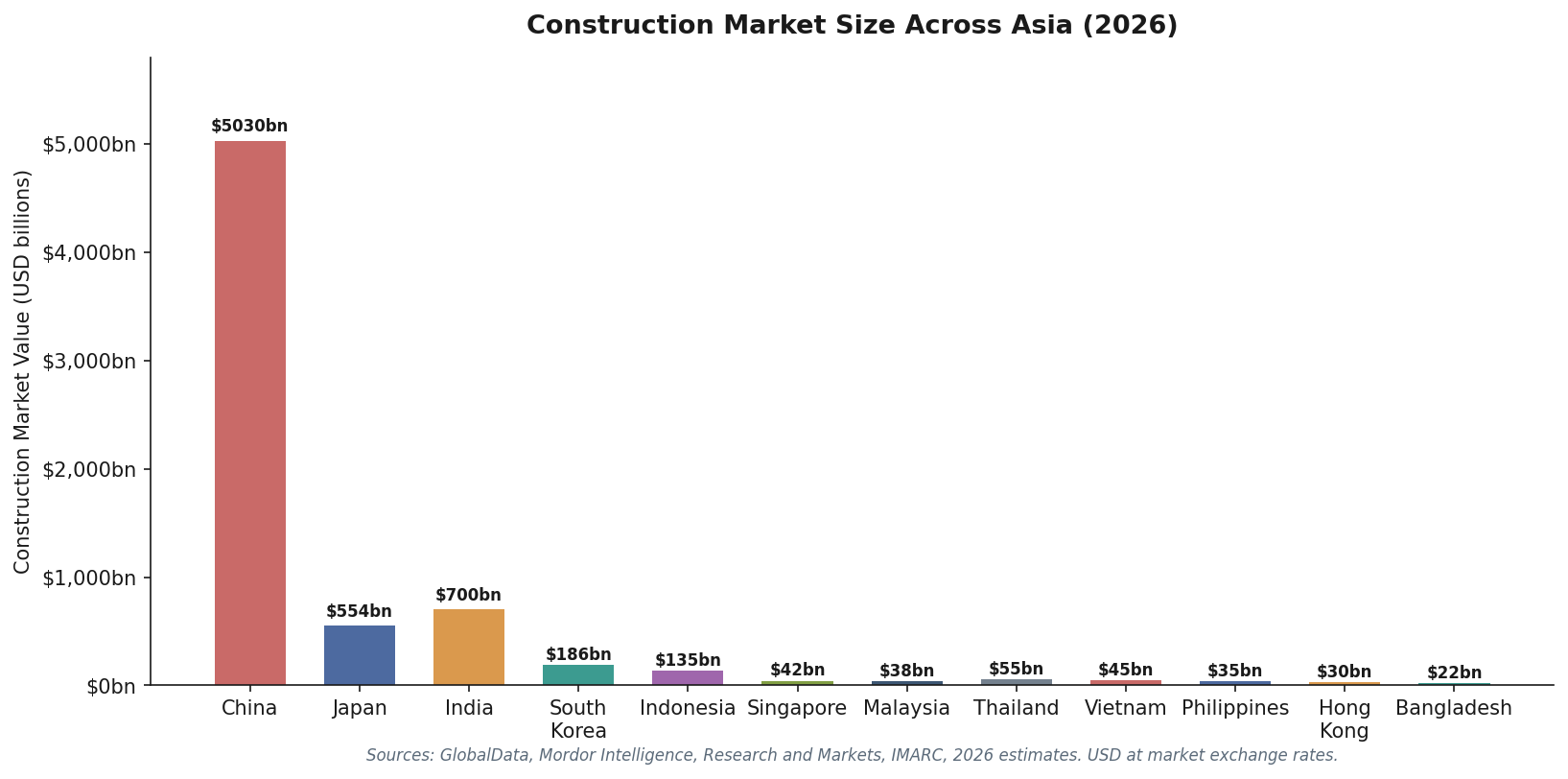
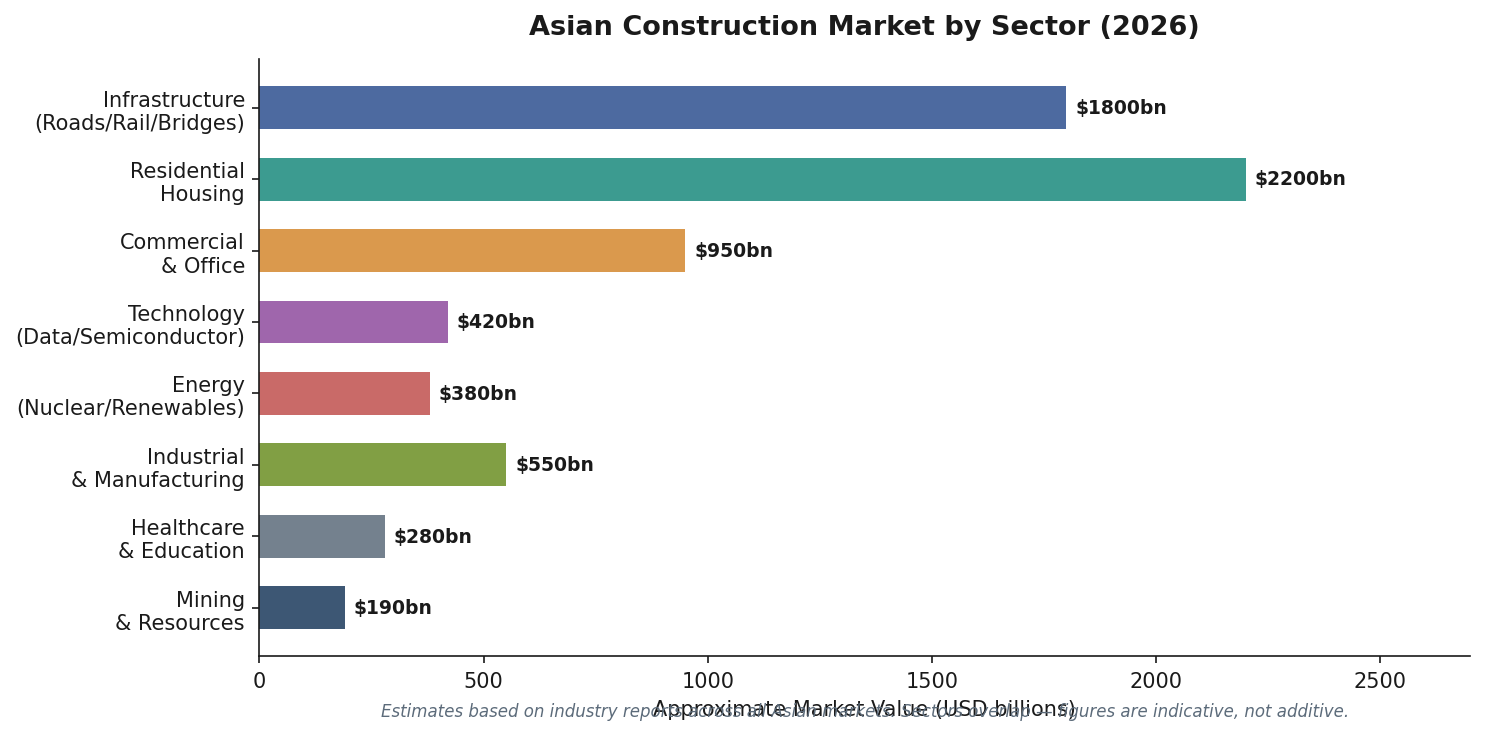
Asia is the world’s largest construction market. China alone accounts for over $5 trillion in annual construction output — more than double the United States. Add India ($700 billion), Japan ($554 billion), South Korea ($186 billion), Indonesia, Singapore, Malaysia, Thailand, Vietnam, the Philippines, Hong Kong, Bangladesh, and the rest of the continent, and Asia’s combined construction market exceeds $7 trillion annually.
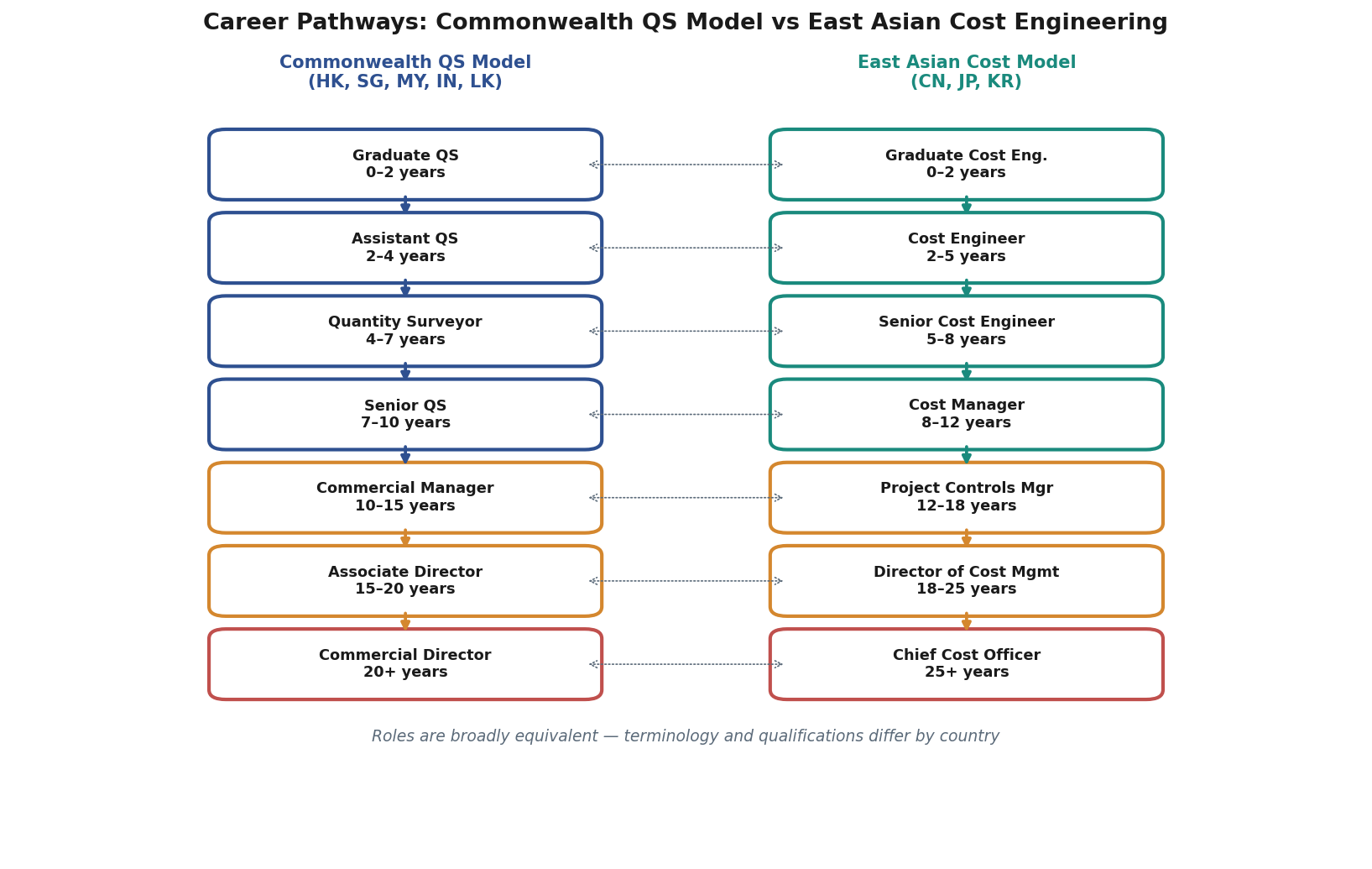
Yet the profession that manages construction costs varies enormously across this vast region. In countries with British and Commonwealth heritage — Singapore, Malaysia, Hong Kong, India, Sri Lanka, Pakistan, Bangladesh — the Quantity Surveyor title is established, regulated, and well understood. Professional institutions, university programmes, and registration systems mirror the UK model. In China, the equivalent function is performed by Cost Engineers (造价工程师), regulated through a national examination system. In Japan and South Korea, cost management is embedded within the engineering and general contracting traditions, without a separate QS profession in the British sense. In Southeast Asia, the profession ranges from fully established (Singapore, Malaysia) to emerging (Vietnam, Cambodia, Myanmar).
This guide explains the profession across Asia — its origins, development, terminology, qualifications, institutions, career pathways, salaries, contracts, major employers, construction markets, and future. Asia is not a single construction market. The professional structures, contract forms, procurement practices, and career opportunities differ fundamentally between South Asia, Southeast Asia, East Asia, and Central Asia.
Defining the Asian Region
This article covers the Asian continent excluding the Middle East (which has its own dedicated ProQS regional guide). The region is organised geographically:
South Asia: India, Pakistan, Bangladesh, Sri Lanka, Nepal, Bhutan, Maldives. Southeast Asia: Singapore, Malaysia, Indonesia, Thailand, Vietnam, Philippines, Cambodia, Laos, Myanmar, Brunei, Timor-Leste. East Asia: China, Japan, South Korea, Taiwan, Hong Kong, Mongolia. Central Asia: Kazakhstan, Uzbekistan, Turkmenistan, Kyrgyzstan, Tajikistan. Western Asia (non-Middle East): Turkey, Georgia, Armenia, Azerbaijan.
The Relationship Between Professional Titles
| Discipline | Focus | Where Used in Asia |
|---|---|---|
| Quantity Surveying | Full lifecycle cost management — measurement, cost planning, procurement, contract admin, valuations, final account | Singapore, Malaysia, Hong Kong, India, Sri Lanka, Pakistan, Bangladesh |
| Cost Engineering | Engineering-based cost management, project controls, earned value, scheduling | China (造价工程师), Japan, South Korea, Central Asia |
| Cost Management | Client-side cost planning, benchmarking, cost control, change management | International consultancies across Asia |
| Estimating | Quantity take-off, unit pricing, bid preparation | Japan, South Korea (contractor-side), all markets |
| Commercial Management | Contractor-side cost, procurement, subcontracts, claims, CVR | International contractors across Asia |
| Project Controls | Integrated cost, schedule, risk, and performance management | Oil & gas, mining, energy, infrastructure — Asia-wide |
The Origins of Quantity Surveying in Asia
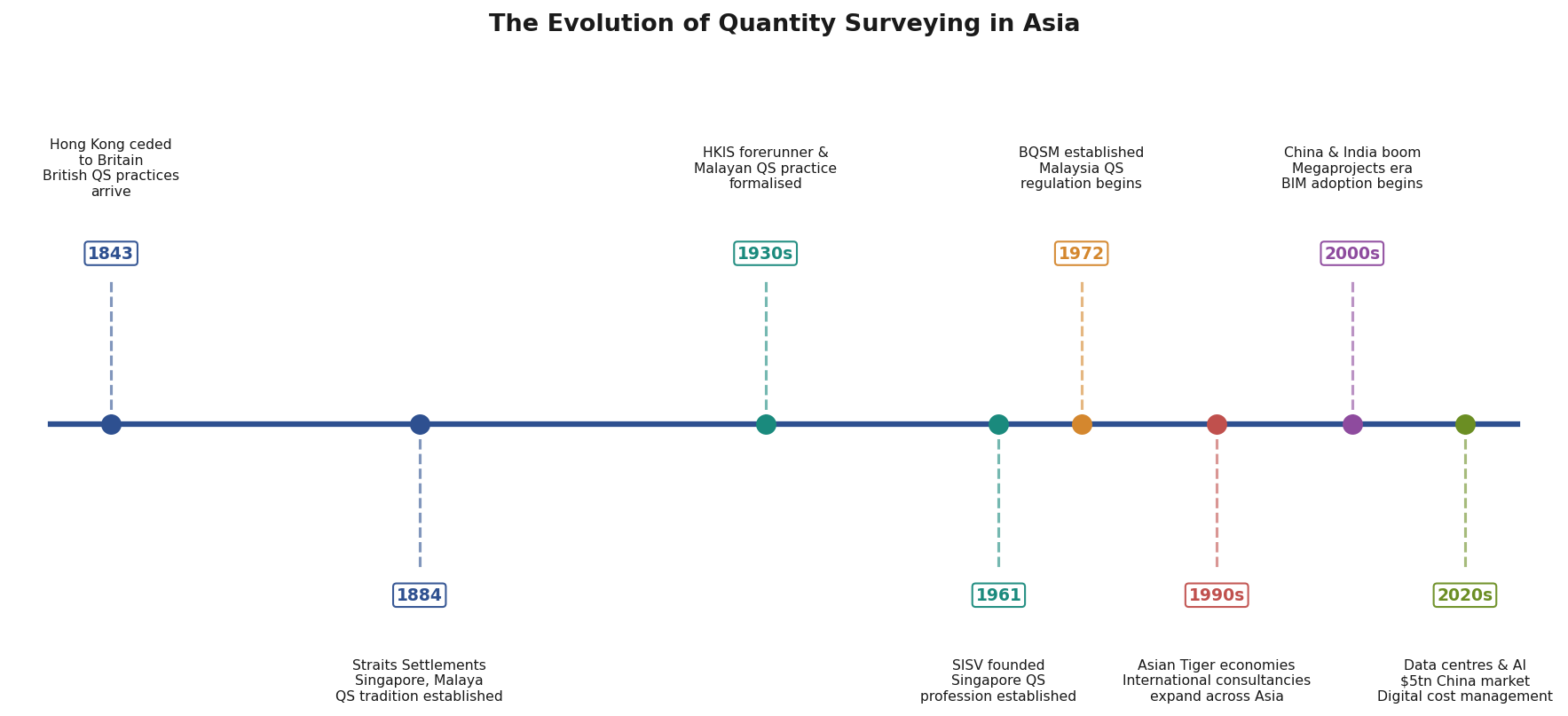
The British Quantity Surveying tradition arrived in Asia through colonialism. Hong Kong (ceded to Britain in 1843), the Straits Settlements (Singapore, Penang, Malacca), British Malaya, British India, Ceylon (Sri Lanka), and British Burma all adopted British public works procurement — bills of quantities, competitive tendering, and independent cost advice.
The earliest professional QS practices in Asia were established in Hong Kong and Singapore in the late 19th century, where British government public works departments employed quantity surveyors to manage construction costs for colonial infrastructure. The tradition spread through British India, Ceylon, and the Malay States.
In East Asia, construction cost management developed through different channels. Japan developed sophisticated construction pricing systems through its major general contractors (zenekon — 大手ゼネコン), with estimating and cost control embedded within the contractor rather than performed by an independent profession. China developed the cost engineer (造价工程师) system through its engineering tradition, formalised through national examination after economic reform. South Korea followed the Japanese contractor-led model, with cost management embedded within the chaebol construction divisions.
Evolution of the Profession
| Period | Development | Impact on QS / Cost Profession |
|---|---|---|
| 1843–1950s | British colonial period. Hong Kong, Singapore, Malaya, India, Ceylon under British administration. | British QS practices established. Public works departments employ quantity surveyors. BOQ-based tendering introduced. |
| 1950s–1970s | Post-independence nation building. SISV founded (1961). BQSM established (1972). HKIS forerunner active. | National QS institutions founded. Universities introduce QS programmes. Professional regulation begins. |
| 1980s–1990s | Asian Tiger economies boom. Rapid urbanisation. International consultancies expand. | Hong Kong and Singapore become major QS markets. International firms establish permanent Asian offices. RICS presence grows. |
| 2000s | China and India boom. Asian megaprojects era. BIM adoption begins. | China’s cost engineer system formalised. India’s QS profession grows rapidly. RICS India established. Digital measurement transforms practice. |
| 2010s–present | Data centres, AI infrastructure, semiconductor fabs, energy transition, smart cities. | $7tn+ Asian construction market. AI-assisted estimating. BIM mandates (Singapore, Hong Kong). India’s infrastructure supercycle. |
India
India has the fastest-growing major construction market in Asia, valued at approximately $700 billion in 2026 and growing at over 6% annually. The FY2026–27 Union Budget allocated INR 12.2 trillion ($136 billion) for capital expenditure. A pipeline of 852 PPP projects valued at INR 17 trillion ($190 billion) was introduced in January 2026. A new high-speed road network valued at INR 11.2 trillion ($125 billion) is planned for completion by 2033.
Quantity Surveying in India has grown from a niche profession to one of the country’s most in-demand built environment roles. RICS India has a major presence, with offices in New Delhi and Mumbai, and conducts APC assessments locally. The Indian construction industry historically embedded cost management within civil engineering, but the QS profession is now firmly established — particularly at international consultancies.
Major sectors: Metro systems (Delhi, Mumbai, Bengaluru, Chennai, Kolkata, Hyderabad — over 20 cities building or planning metro networks), high-speed rail (Mumbai–Ahmedabad HSR, seven new corridors planned), airports (Navi Mumbai, Jewar/Noida, expansions), highways (Bharatmala Pariyojana — 83,677 km), data centres (Mumbai, Chennai, Hyderabad — India is one of Asia’s fastest-growing data centre markets), residential (affordable housing — Pradhan Mantri Awas Yojana), commercial (Bengaluru, Mumbai, Hyderabad tech parks), energy (nuclear, solar — India targets 500GW renewable by 2030), and industrial (semiconductor fabs, manufacturing under Make in India).
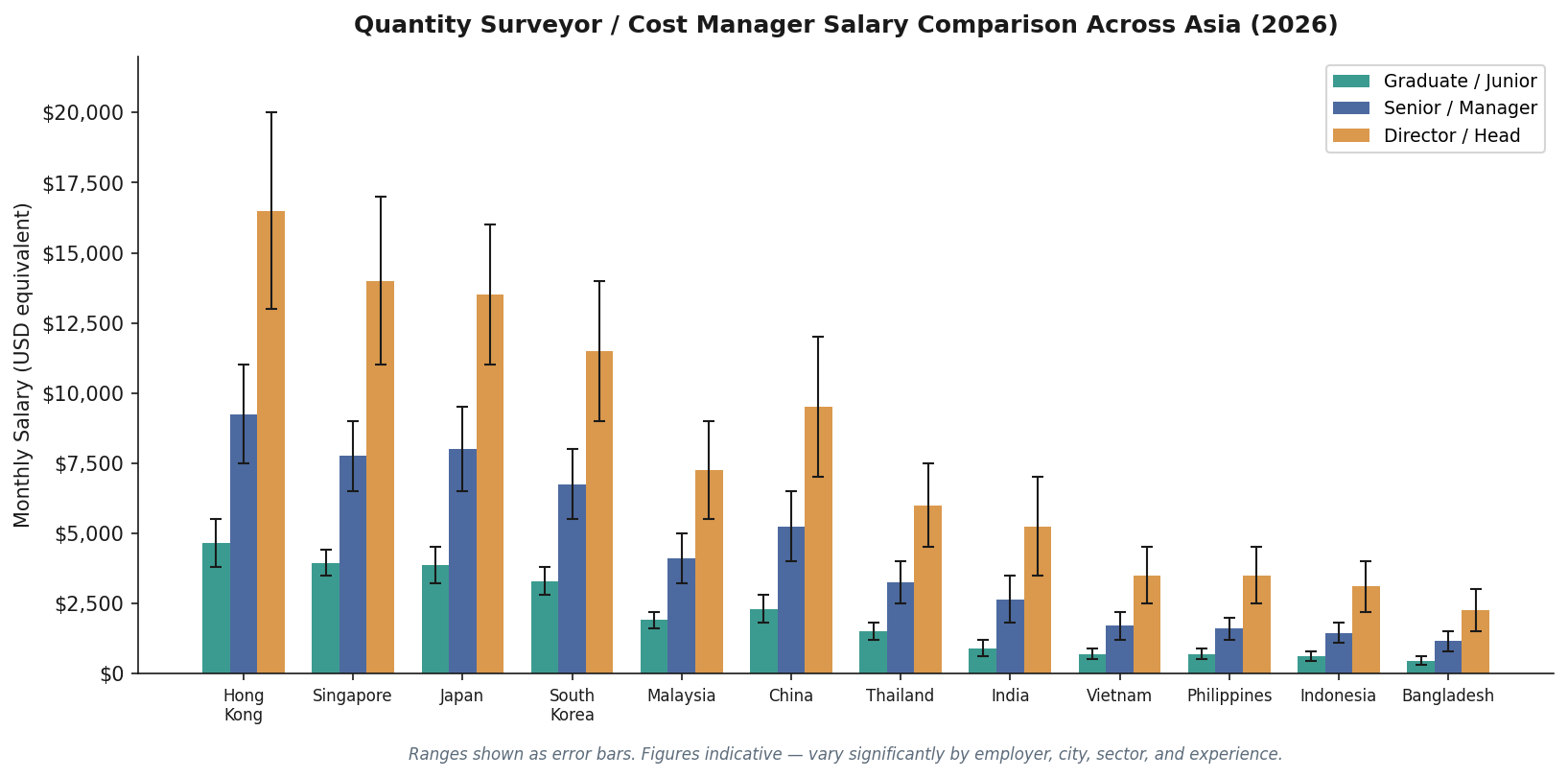
Salary ranges (2026): Graduate QS INR 25,000–50,000/month; Senior QS INR 80,000–150,000/month; Director (international consultancy) INR 200,000–500,000+/month.
Singapore
Singapore has one of Asia’s most mature and regulated QS professions. The Singapore Institute of Surveyors and Valuers (SISV), founded in 1961, has a dedicated Quantity Surveying Division and awards the Accredited Professional Quantity Surveyor (APQS) designation. SISV has a mutual recognition agreement with RICS and reciprocity agreements with AIQS, HKIS, and other international bodies.
The construction market is valued at approximately $42 billion in 2026. Singapore has mandated BIM on public projects since 2015 — one of the most advanced BIM environments in the world. The Building and Construction Authority (BCA) regulates the industry.
Contract forms: SIA (Singapore Institute of Architects) contracts are standard for building works. PSSCOC (Public Sector Standard Conditions of Contract) for government projects. FIDIC on some infrastructure. NEC on select projects.
Salary ranges (2026): Graduate QS SGD 3,500–4,500/month; Senior QS SGD 6,500–9,000/month; Director SGD 11,000–17,000+/month.
Major sectors: Data centres (one of Asia’s key data centre hubs), MRT (Mass Rapid Transit — Cross Island Line, Jurong Region Line), public housing (HDB programme), healthcare (new hospitals), commercial (CBD redevelopment), Changi Airport Terminal 5 (one of Asia’s largest airport projects), and Tuas Mega Port.
Malaysia
Malaysia has a well-established QS profession regulated by the Board of Quantity Surveyors Malaysia (BQSM). Registration with BQSM is required to use the Registered Quantity Surveyor title. Candidates must hold a BQSM-recognised degree and complete supervised professional experience before sitting the BQSM assessment. The Royal Institution of Surveyors Malaysia (RISM) is the professional body.
The construction market is valued at approximately $38 billion in 2026. Malaysia has strong QS university programmes — Universiti Malaya, Universiti Teknologi Malaysia (UTM), and Universiti Teknologi MARA (UiTM) all offer RICS-accredited QS degrees.
Contract forms: PAM (Pertubuhan Akitek Malaysia) contracts for building works. CIDB standard forms. FIDIC on infrastructure. JKR (Public Works Department) contracts for government projects.
Salary ranges (2026): Graduate QS RM 2,800–4,000/month; Senior QS RM 6,000–10,000/month; Director RM 12,000–20,000+/month.
Major sectors: Infrastructure (East Coast Rail Link, MRT3 Kuala Lumpur, Pan Borneo Highway), data centres (Johor — Malaysia is emerging as a major Southeast Asian data centre hub), residential, commercial, oil and gas (PETRONAS), and manufacturing.
Singapore vs Malaysia Comparison
| Area | Singapore | Malaysia |
|---|---|---|
| Professional body | SISV | RISM / BQSM (statutory) |
| Qualification | APQS (SISV), MRICS | Registered QS (BQSM), MRICS |
| Registration | BCA registration | BQSM registration (statutory) |
| Contracts | SIA, PSSCOC, FIDIC | PAM, CIDB, JKR, FIDIC |
| Major sectors | Data centres, MRT, public housing, airports | Rail, data centres, oil & gas, highways |
| Graduate salary | SGD 3,500–4,500/month | RM 2,800–4,000/month |
| Language | English | English / Bahasa Malaysia |
Hong Kong
Hong Kong has one of Asia’s most established QS professions, shaped by over 150 years of British influence. The Hong Kong Institute of Surveyors (HKIS), founded in 1984, has a dedicated Quantity Surveying Division. HKIS has mutual recognition with RICS. The profession is well regulated, well paid, and deeply embedded in Hong Kong’s construction industry.
The construction market is valued at approximately $30 billion in 2026. Hong Kong’s Government has adopted NEC on some infrastructure projects alongside traditional government standard forms and FIDIC.
Salary ranges (2026): Graduate QS HKD 18,000–25,000/month; Senior QS HKD 40,000–70,000/month; Director HKD 80,000–130,000+/month.
Major sectors: Rail (MTR expansions), airport (Three Runway System completed, SKYCITY development), Northern Metropolis (major development area), public housing, commercial, healthcare, and data centres.
China
China has the world’s largest construction market — valued at over $5 trillion in 2026. The Quantity Surveyor title is not widely used. The equivalent function is performed by Cost Engineers (造价工程师, zàojià gōngchéngshī), regulated by the Ministry of Housing and Urban-Rural Development (MOHURD) through a national examination system.
The Registered Cost Engineer (注册造价工程师) examination is China’s primary cost management qualification. It is a rigorous national examination covering construction pricing, valuation, contract management, and cost control. International consultancies operating in China (Turner & Townsend, AECOM, Arcadis, RLB) use the Cost Manager and Quantity Surveyor titles.
How the Chinese system compares with British QS: The core function — managing construction costs — is the same. Chinese cost engineers perform cost planning, estimating, contract management, and final account functions. The key differences are the regulatory framework (state examination vs RICS APC), measurement standards (Chinese national standards vs NRM/SMM), and the role of state-owned enterprises in procurement.
Major sectors: Infrastructure (world’s largest high-speed rail network — over 45,000 km), airports, metro systems (over 50 cities with metro networks), data centres, semiconductor fabs, residential, commercial, energy (nuclear, solar, wind, hydro), and Belt and Road Initiative international projects.
Japan
Japan has the third-largest construction market in Asia, valued at approximately $554 billion in 2026. The British QS model does not exist in Japan. Cost management is embedded within the major general contractors (zenekon — 大手ゼネコン) — Obayashi, Shimizu, Kajima, Takenaka, and Taisei. These contractors perform estimating, cost control, and project management internally.
The Japanese Society of Civil Engineers (JSCE) and the Architectural Institute of Japan (AIJ) are the primary professional bodies. Construction pricing follows the MLIT (Ministry of Land, Infrastructure, Transport and Tourism) standard unit price system.
Key feature: The Japanese construction industry is characterised by long-term relationships between clients and contractors, negotiated rather than competitive procurement, and engineering-led project delivery. International consultancies with Tokyo offices (Turner & Townsend, AECOM, Mace) provide cost management services to international clients and on projects with international funding.
Major sectors: Infrastructure (Shinkansen extensions, maglev — Chuo Shinkansen), disaster resilience (earthquake and tsunami-resistant infrastructure), semiconductor fabs (TSMC Kumamoto, Rapidus Hokkaido), data centres, Osaka Expo 2025 legacy, Tokyo redevelopment, nuclear decommissioning and new build, and renewable energy.
South Korea
South Korea’s construction market is valued at approximately $186 billion in 2026, growing at 5.5% CAGR. Like Japan, South Korea does not have a separate QS profession in the British sense. Cost management is embedded within the chaebol construction divisions — Samsung C&T, Hyundai Engineering & Construction, Daewoo E&C (now DL E&C), GS E&C, and POSCO E&C.
The Korea Institute of Construction Engineering and Management (KICEM) and Korean Institute of Quantity Surveyors (KIQS) are relevant professional bodies. The Korean construction system emphasises engineering-led delivery and modular construction.
Major sectors: Semiconductor (Samsung, SK Hynix — world-leading chip fabrication), nuclear energy (Korean APR-1400 reactor programme — exported to UAE), data centres, smart cities (Songdo, Sejong City), KTX high-speed rail extensions, and defence construction.
Southeast Asia
Indonesia is Southeast Asia’s largest construction market and one of the most dynamic. The relocation of the capital from Jakarta to Nusantara (IKN — Ibu Kota Nusantara) is one of the world’s largest current development programmes. Additional major sectors include Jakarta MRT and LRT, Surabaya development, industrial zones, data centres, and energy (geothermal, LNG). The QS profession is less formalised than in Singapore or Malaysia, with cost management practised within the engineering tradition. FIDIC is widely used on internationally funded projects.
Vietnam is one of Asia’s fastest-growing construction markets, driven by manufacturing investment (semiconductor, electronics), logistics infrastructure, and urbanisation. The approved $67 billion Hanoi–Ho Chi Minh City high-speed railway is a transformative project. Ho Chi Minh City Metro Line 1 is operational. Data centres are attracting massive investment. The QS profession is emerging, with international consultancies providing cost management services.
Thailand has a construction market valued at approximately $55 billion. Major projects include the Eastern Economic Corridor (EEC), Bangkok BTS and MRT extensions, high-speed rail (Bangkok–Nakhon Ratchasima, part of the China–Laos–Thailand link), and a $70 billion semiconductor roadmap over 25 years. FIDIC is widely used.
Philippines is forecast to grow at 7.5% CAGR through 2031 — one of the highest rates in Southeast Asia. The “Build Better More” programme drives infrastructure investment. Metro Manila Subway, Clark Airport expansion, and regional infrastructure are major projects. The QS profession is practised but less formalised than in Singapore or Malaysia.
South Asia (Beyond India)
Pakistan has a growing construction sector driven by CPEC (China–Pakistan Economic Corridor) infrastructure, housing, and energy projects. The Pakistan Institute of Quantity Surveyors (PIQS) is the professional body. FIDIC is widely used on CPEC and internationally funded projects.
Bangladesh has a rapidly growing construction market driven by urbanisation, infrastructure (Dhaka Metro — MRT Line 6 operational, Padma Bridge completed), garment industry construction, and energy. The QS profession is emerging, with civil engineering the primary entry route.
Sri Lanka has a well-established QS profession with strong British heritage. The Institute of Quantity Surveyors Sri Lanka (IQSSL) is the professional body. The University of Moratuwa offers a RICS-accredited QS programme — one of the strongest in South Asia. Sri Lankan QS professionals are valued internationally, particularly in the Middle East.
Central Asia
Kazakhstan is Central Asia’s largest construction market, driven by oil and gas (Tengiz, Kashagan), mining, and Astana development. Cost engineering follows the Russian/Soviet tradition. FIDIC is used on internationally funded projects. Uzbekistan is growing rapidly, with Tashkent metro extensions, industrial zones, and energy projects. Turkmenistan, Kyrgyzstan, and Tajikistan have smaller construction markets, with cost management embedded within engineering traditions. International financing institutions (ADB, EBRD, World Bank) drive FIDIC adoption on infrastructure projects across the region.
Major Construction Markets
Professional Institutions
| Institution | Country | Qualification | RICS Recognition |
|---|---|---|---|
| HKIS | Hong Kong | MHKIS, FHKIS (QSD) | Mutual recognition agreement |
| SISV | Singapore | APQS, MSISV, FSISV | Mutual recognition agreement |
| BQSM | Malaysia (statutory) | Registered QS | RICS recognised |
| RISM | Malaysia | MRISM, FRISM | RICS recognised |
| RICS India | India | MRICS, FRICS | Direct RICS presence |
| IQSSL | Sri Lanka | MIQSSL, FIQSSL | RICS recognised |
| MOHURD | China (regulatory) | Registered Cost Engineer (注册造价工程师) | Separate system |
| KIQS | South Korea | — | Limited |
| PIQS | Pakistan | Member PIQS | RICS recognised |
Education Pathways
| Country | University | Qualification | Duration | Recognition |
|---|---|---|---|---|
| Singapore | National University of Singapore | BSc Project & Facilities Management | 4 years | SISV, RICS |
| Singapore | Singapore University of Social Sciences | BSc Quantity Surveying | Part-time | SISV |
| Malaysia | Universiti Malaya | BSc Quantity Surveying | 4 years | BQSM, RISM, RICS |
| Malaysia | Universiti Teknologi Malaysia (UTM) | BSc Quantity Surveying | 4 years | BQSM, RISM, RICS |
| Hong Kong | Hong Kong Polytechnic University | BSc Surveying | 4 years | HKIS, RICS |
| India | CEPT University, Ahmedabad | MSc Construction Management | 2 years | RICS |
| India | NICMAR (National Institute of Construction Management) | PGP in QS | 2 years | RICS |
| Sri Lanka | University of Moratuwa | BSc Quantity Surveying | 4 years | IQSSL, RICS |
| China | Tsinghua University | BSc / MSc Civil Engineering (Cost specialisation) | 4–5 years | MOHURD |
| Indonesia | Universitas Indonesia | BSc Civil Engineering | 4 years | National |
| Pakistan | NED University of Engineering, Karachi | BE Civil / QS programmes | 4 years | PIQS |
| Bangladesh | BUET (Bangladesh University of Eng. & Tech.) | BSc Civil Engineering | 4 years | National |
Career Pathways
Salaries and Compensation
| Country | Graduate (monthly) | Senior (monthly) | Director (monthly) | Currency |
|---|---|---|---|---|
| Hong Kong | HKD 18,000–25,000 | HKD 40,000–70,000 | HKD 80,000–130,000+ | HKD |
| Singapore | SGD 3,500–4,500 | SGD 6,500–9,000 | SGD 11,000–17,000+ | SGD |
| Japan | ¥350,000–480,000 | ¥600,000–850,000 | ¥1,000,000–1,500,000+ | JPY |
| South Korea | ₩3,200,000–4,500,000 | ₩5,500,000–8,000,000 | ₩9,000,000–14,000,000+ | KRW |
| Malaysia | RM 2,800–4,000 | RM 6,000–10,000 | RM 12,000–20,000+ | MYR |
| China | ¥8,000–15,000 | ¥18,000–35,000 | ¥40,000–80,000+ | CNY |
| India | ₹25,000–50,000 | ₹80,000–150,000 | ₹200,000–500,000+ | INR |
| Thailand | ฿25,000–40,000 | ฿55,000–90,000 | ฿100,000–180,000+ | THB |
| Vietnam | VND 12,000,000–22,000,000 | VND 30,000,000–55,000,000 | VND 60,000,000–110,000,000+ | VND |
| Philippines | ₱25,000–45,000 | ₱60,000–100,000 | ₱120,000–220,000+ | PHP |
| Indonesia | IDR 7,000,000–13,000,000 | IDR 18,000,000–30,000,000 | IDR 35,000,000–65,000,000+ | IDR |
| Bangladesh | BDT 25,000–50,000 | BDT 70,000–130,000 | BDT 150,000–280,000+ | BDT |
Major Construction Sectors
Major Projects in Asia
| Project | Country | Est. Value | Sector |
|---|---|---|---|
| Mumbai–Ahmedabad HSR | India | $17 billion | High-speed rail (508 km) |
| Hanoi–HCMC HSR | Vietnam | $67 billion | High-speed rail (1,541 km) |
| Nusantara (IKN) | Indonesia | $35 billion | New capital city |
| TSMC Kumamoto Fab | Japan | $20 billion+ | Semiconductor |
| Changi Airport Terminal 5 | Singapore | SGD 10 billion+ | Aviation |
| Cross Island Line | Singapore | SGD 30 billion+ | Metro (50 km) |
| East Coast Rail Link | Malaysia | RM 50 billion | Rail (665 km) |
| Northern Metropolis | Hong Kong | HKD 300 billion+ | New development area |
| Delhi–Varanasi HSR | India | $30 billion+ | High-speed rail (planned) |
| Samsung Pyeongtaek Campus | South Korea | $200 billion+ (cumulative) | Semiconductor (largest chip complex) |
| SE Asia Data Centre Boom | Singapore, Malaysia, Indonesia, Thailand | $50 billion+ (pipeline) | Data centres / AI infrastructure |
| Manila Metro Subway | Philippines | $7 billion | Metro |
Major Cost Consultancy and Construction Firms
| Firm | HQ | Asian Presence | Graduate Programmes |
|---|---|---|---|
| Turner & Townsend | Leeds, UK (70% CBRE) | Singapore, Hong Kong, Tokyo, Mumbai, New Delhi, Shanghai, Kuala Lumpur, Bangkok | Yes — RICS APC support |
| AECOM | Dallas, USA | Hong Kong, Singapore, India, China, Philippines, Indonesia, Vietnam | Yes |
| Arcadis | Amsterdam, Netherlands | Singapore, Hong Kong, China, India, Philippines, Thailand, Vietnam | Yes |
| Rider Levett Bucknall | London / Sydney | Hong Kong, Singapore, China, Japan, India, Indonesia, Philippines, Vietnam | Yes |
| Mace | London, UK | Singapore, Hong Kong, India, Tokyo | Yes — RICS APC support |
| AtkinsRéalis | Montréal, Canada | Singapore, Hong Kong, India, China, Malaysia | Yes |
| Gleeds | London, UK | Shanghai, Beijing, Singapore, Hong Kong | Yes |
| Currie & Brown | London, UK | Hong Kong, Singapore, India | Yes |
| Linesight | Dublin, Ireland | Singapore, India. Data centres specialist. | Yes |
| WT Partnership | Sydney, Australia | Singapore, Hong Kong, Malaysia. Regional Asian QS firm. | Yes |
Contracts and Procurement
| Contract Form | Main Markets | Typical Use | QS / Cost Manager Role |
|---|---|---|---|
| FIDIC Red Book | Asia-wide (infrastructure, donor-funded) | Re-measurement. ADB, World Bank, JICA funded projects. | BOQ, IPC, variations, claims, final account. |
| FIDIC Yellow Book | Asia-wide (D&B) | Design-build. Common in commercial, industrial. | Employer’s requirements, change control, cost management. |
| SIA Conditions | Singapore | Standard form for building works. | Traditional QS role. BOQ, valuations, final account. |
| HK Government Forms | Hong Kong | Government projects. Building and civil forms. | Traditional QS. BOQ-based. Extensive measurement. |
| PAM / CIDB | Malaysia | Building and construction. PAM for private, CIDB for government. | Traditional QS. Registered QS required. |
| NEC4 | Hong Kong (growing), Singapore (select) | Some government infrastructure. Limited but growing. | Defined Cost, compensation events, early warning. |
| EPC / EPCM | Asia-wide (energy, mining, industrial) | Turnkey / management. Oil & gas, mining, power, semiconductor. | Cost engineering, earned value, project controls. |
| Chinese Standard Forms | China | Domestic projects. Government-regulated pricing. | Cost engineer role. National pricing standards. |
Country Comparison
| Country | QS Model | Professional Body | Main Contracts | Demand |
|---|---|---|---|---|
| India | British / Commonwealth | RICS India | FIDIC, Indian govt. forms | Very high (fastest growing) |
| Singapore | British / Commonwealth | SISV | SIA, PSSCOC, FIDIC | High |
| Malaysia | British / Commonwealth | BQSM, RISM | PAM, CIDB, JKR | High |
| Hong Kong | British / Commonwealth | HKIS | HK Govt, FIDIC, NEC | High |
| China | Cost Engineering | MOHURD (regulatory) | Chinese standard, FIDIC | High (largest market) |
| Japan | Contractor-led | JSCE, AIJ | Japanese forms | Moderate (intl. consultancies) |
| South Korea | Contractor-led | KIQS, KICEM | Korean forms, FIDIC | Moderate |
| Indonesia | Engineering-led | — | FIDIC, domestic | Growing |
| Vietnam | Emerging | — | FIDIC, domestic | Growing rapidly |
| Philippines | Emerging | — | FIDIC, domestic | Growing (7.5% CAGR) |
| Sri Lanka | British / Commonwealth | IQSSL | FIDIC, domestic | Moderate |
Working in Asia as a UK Quantity Surveyor
What transfers directly: Cost planning, measurement, contract administration, claims management, commercial reporting, and RICS chartership. The core QS skill set is highly valued across Asia, particularly in Singapore, Hong Kong, Malaysia, and India.
What you need to learn: Local contract forms (SIA, PAM, HK Government, Indian contracts), local measurement standards, local registration requirements (BQSM in Malaysia, BCA in Singapore, HKIS in Hong Kong), and cultural working practices.
RICS recognition: RICS is widely recognised across Asia, with mutual recognition agreements with SISV (Singapore) and HKIS (Hong Kong). RICS-accredited programmes are available in Singapore, Malaysia, Hong Kong, India, and Sri Lanka. MRICS is the most portable international QS qualification.
Visa and work permits: Singapore requires an Employment Pass. Hong Kong requires a work visa. Malaysia requires an Employment Pass. India requires an employment visa. Japan requires a work visa. China requires a Z visa. Each country has distinct immigration requirements.
Language and Cultural Skills
English is the working language in Singapore, Hong Kong, India, Malaysia, Sri Lanka, Pakistan, and the Philippines. Mandarin is essential for domestic projects in China. Japanese is essential for Japan. Korean is essential for South Korea. Bahasa Indonesia/Malay, Thai, and Vietnamese are important for domestic projects in their respective countries. International projects often operate in English regardless of location.
Digital Quantity Surveying in Asia
Asia includes both global leaders and emerging adopters in construction technology. Singapore mandated BIM on public projects in 2015 and is one of the world’s most digitally advanced construction markets. Hong Kong, South Korea, Japan, and China have advanced BIM adoption. 5D BIM (cost-linked models) is growing across the region. CostX, Bluebeam, Autodesk Construction Cloud, Primavera P6, and Power BI are widely used by international consultancies. AI-assisted estimating and automated quantity take-off are emerging, particularly in Singapore, Japan, and South Korea.
Challenges Facing Cost Professionals in Asia
Key challenges include diverse professional standards across countries, language barriers, variable payment practices, different contract forms requiring country-specific knowledge, lack of reliable cost data in some emerging markets, rapid pace of construction requiring fast-track cost management, currency volatility, political and regulatory risk in some countries, and the need to continuously upskill in digital tools and AI.
The Future of Quantity Surveying in Asia
The outlook for cost management professionals in Asia is exceptionally strong. India plans to invest over $1.4 trillion in infrastructure through 2030. China continues to invest in high-speed rail, energy, and technology infrastructure despite moderating growth. Southeast Asia’s data centre boom — driven by Nvidia, Microsoft, Amazon, Google, ByteDance, and others — is creating billions of dollars in new construction. Vietnam’s $67 billion high-speed rail project and Indonesia’s new capital city are transformative programmes. Semiconductor manufacturing investment across Japan, South Korea, India, and Southeast Asia is creating a new category of specialist construction.
The cost professional who combines traditional QS/estimating skills with digital fluency (BIM, AI, data analytics), FIDIC expertise, and Asian market knowledge will be in extraordinary demand across the continent.
Best Asian Markets for Quantity Surveyors — Ranking
| Rank | Country | Strength | Notes |
|---|---|---|---|
| 1 | Singapore | Most mature QS market. RICS/SISV mutual recognition. BIM mandate. High salaries. English-speaking. | Small market but very high quality. Data centres, MRT, airport. |
| 2 | Hong Kong | Strong British heritage. HKIS. High salaries. Established profession. | Northern Metropolis. NEC growing. Bilingual (English/Cantonese). |
| 3 | India | Fastest growing. RICS India. Massive infrastructure pipeline. English-speaking. | Lower salaries but extraordinary growth. $700bn market. |
| 4 | Malaysia | BQSM regulation. RICS-accredited universities. Established profession. | Data centres (Johor). ECRL. Oil & gas. Competitive salaries. |
| 5 | China | World’s largest market. Enormous infrastructure. International consultancies active. | Mandarin essential. Cost Engineer system. Growth moderating. |
| 6 | Japan | $554bn market. Semiconductor fabs. Disaster resilience. High technology. | Japanese essential. Contractor-led model. High salaries. |
| 7 | South Korea | Semiconductor (Samsung, SK Hynix). Nuclear exports. Smart cities. | Korean essential. Chaebol-dominated industry. |
| 8 | Vietnam | $67bn HSR. Manufacturing boom. Data centres. Rapid growth. | Emerging QS market. Vietnamese useful. FIDIC on international projects. |
| 9 | Indonesia | Largest SE Asian market. New capital (Nusantara). Data centres. | QS profession less formalised. Bahasa Indonesia useful. |
| 10 | Philippines | 7.5% CAGR. Metro Manila Subway. English-speaking. | Growing market. Infrastructure programme. |
This ranking is indicative and based on a composite assessment of professional maturity, construction activity, salary potential, demand for cost professionals, qualification recognition, and long-term pipeline. It is not absolute.
Frequently Asked Questions
Is Quantity Surveying popular in Asia?
Yes. Quantity Surveying is well established across much of Asia, particularly in countries with British/Commonwealth heritage — Singapore, Malaysia, Hong Kong, India, Sri Lanka, Bangladesh, and Pakistan. In East Asia (China, Japan, South Korea), the equivalent function is performed by cost engineers and estimators.
Which Asian country has the largest QS profession?
India has the largest and fastest-growing QS profession in Asia. Singapore, Malaysia, and Hong Kong have the most established QS professions in terms of professional regulation and institutional maturity.
Is Quantity Surveying a good career in India?
Yes. India’s construction market is growing at over 6% annually, with massive infrastructure investment. International consultancies are expanding rapidly. RICS India has a significant presence. Demand for qualified cost management professionals far exceeds supply.
Is RICS recognised in Asia?
Yes. RICS is widely recognised across Asia, particularly in Singapore, Hong Kong, Malaysia, India, and Sri Lanka. RICS has mutual recognition agreements with SISV (Singapore) and HKIS (Hong Kong). MRICS is the most widely recognised international QS qualification in Asia.
Is RICS recognised in Singapore?
Yes. RICS and SISV have a Mutual Recognition Agreement. RICS is widely recognised by employers, particularly international consultancies.
Can a UK QS work in Singapore?
Yes. MRICS-qualified Quantity Surveyors are well recognised in Singapore. An Employment Pass is required. English is the working language.
Can a UK QS work in Hong Kong?
Yes. Hong Kong has a strong British QS tradition. RICS and HKIS have mutual recognition arrangements. A work visa is required. English is widely used.
What is a Quantity Surveyor called in China?
The closest equivalent is the Cost Engineer (造价工程师, zàojià gōngchéngshī). Cost Engineers are regulated by MOHURD through a national examination system. International consultancies in China also use the Cost Manager and Quantity Surveyor titles.
What is a Cost Engineer?
A Cost Engineer applies engineering principles to cost management, project controls, earned value, and scheduling. In China, the Registered Cost Engineer is a nationally regulated profession. AACE International’s CCP certification is also recognised.
What is the difference between a QS and a Cost Engineer?
The core function is the same. The QS tradition emphasises measurement, bills of quantities, contract administration, and independent cost advice. Cost Engineering emphasises engineering-based cost management, project controls, earned value, and scheduling. The roles increasingly overlap at senior levels.
What contracts do Asian Quantity Surveyors use?
FIDIC is the most widely used international contract form across Asia. Singapore uses SIA contracts. Hong Kong uses government standard forms and FIDIC. Malaysia uses PAM and CIDB contracts. Japan and South Korea use domestic contract forms. NEC is used on select projects in Hong Kong and Singapore.
Is NEC used in Asia?
NEC has limited but growing use. Hong Kong has adopted NEC on some government infrastructure projects. Singapore has used NEC on select projects. NEC is not widely adopted across the rest of Asia.
Is FIDIC widely used in Asia?
Yes. FIDIC is the most widely used international contract form in Asia, particularly on projects funded by the ADB, World Bank, and JICA.
Which country pays Quantity Surveyors the most in Asia?
Hong Kong and Singapore offer the highest QS salaries in Asia. Japan also offers competitive salaries. India and Southeast Asia offer lower absolute salaries but significantly lower costs of living.
What is the salary of a QS in Singapore?
Graduate QS professionals earn approximately SGD 3,500–4,500/month. Senior QS/Cost Managers earn SGD 6,500–9,000/month. Directors earn SGD 11,000–17,000+/month (2026 figures).
What is the salary of a QS in India?
Graduate QS professionals earn approximately INR 25,000–50,000/month. Senior QS/Cost Managers earn INR 80,000–150,000/month. Directors at international consultancies earn INR 200,000–500,000+/month (2026 figures).
Which universities offer Quantity Surveying in Asia?
Leading universities include NUS (Singapore), Universiti Malaya, UTM, Hong Kong Polytechnic University, CEPT University (India), NICMAR (India), University of Moratuwa (Sri Lanka), and many others. RICS-accredited programmes are available in Singapore, Malaysia, Hong Kong, India, and Sri Lanka.
Do I need local registration to work as a QS in Asia?
Requirements vary. Singapore requires BCA registration. Malaysia requires BQSM registration. Hong Kong requires HKIS membership for certain government work. India does not have statutory QS registration. China requires the Registered Cost Engineer examination.
Do I need to speak the local language?
English is the working language in Singapore, Hong Kong, India, Malaysia, Sri Lanka, Pakistan, and the Philippines. Mandarin, Japanese, Korean, and local languages are essential for domestic projects in their respective countries.
Which Asian country has the greatest construction growth?
India is forecast to have the highest growth rate (over 6% annually). Vietnam, the Philippines, Indonesia, and Bangladesh are also growing rapidly.
Which firms employ Quantity Surveyors in Asia?
Turner & Townsend, AECOM, Arcadis, Mace, AtkinsRéalis, WSP, RLB, Gleeds, Currie & Brown, Linesight, WT Partnership, and many others.
Can an Asian QS work in the UK?
Yes. MRICS holders from any country can practise in the UK. Graduates from RICS-accredited Asian universities have a direct pathway to chartership. A Skilled Worker visa is required.
Can an Asian QS obtain RICS chartership?
Yes. RICS APC assessments are conducted in Singapore, Hong Kong, Kuala Lumpur, Mumbai, and other Asian cities. Candidates from RICS-accredited programmes can enrol directly.
How important is BIM in Asia?
BIM adoption is advanced in Singapore (mandate since 2015), Hong Kong, South Korea, Japan, and China. 5D BIM is growing. Malaysia, India, and Thailand are increasing adoption.
Will AI replace Quantity Surveyors in Asia?
AI will transform, not replace, the QS profession. AI-assisted quantity take-off, automated benchmarking, and predictive cost modelling are already in use. The commercial judgement, negotiation, and client advisory skills of an experienced QS remain irreplaceable.
What is the HKIS?
The Hong Kong Institute of Surveyors (HKIS) is the professional body for surveyors in Hong Kong, including Quantity Surveyors. Founded in 1984, HKIS has a dedicated QS Division and mutual recognition with RICS.
What is the SISV?
The Singapore Institute of Surveyors and Valuers (SISV) is Singapore’s professional body for surveyors, including QS. SISV awards the APQS designation and has mutual recognition with RICS, AIQS, HKIS, and others.
What is the BQSM?
The Board of Quantity Surveyors Malaysia (BQSM) is the statutory body regulating the QS profession in Malaysia. BQSM registration is required to use the Registered Quantity Surveyor title.
What is the future of Quantity Surveying in Asia?
Exceptionally strong. India’s infrastructure supercycle, Southeast Asia’s data centre boom, semiconductor manufacturing across Japan, South Korea, and India, and continued Chinese infrastructure investment are driving unprecedented demand for cost management professionals.
What challenges do cost professionals face in Asia?
Diverse professional standards, language barriers, variable payment practices, different contract forms, lack of reliable cost data in some markets, rapid construction pace, currency volatility, and the need to continuously upskill in digital tools and AI.
Asia Quantity Surveying Knowledge Hub
This article is the pillar page for ProQS.site’s Asia Quantity Surveying and Cost Management content network. Future dedicated country guides are planned for: India, Singapore, Malaysia, Hong Kong, China, Japan, South Korea, Indonesia, Thailand, Vietnam, Philippines, Bangladesh, Pakistan, Sri Lanka, and Kazakhstan.
Cross-Links
- Quantity Surveying in the Middle East
- Quantity Surveying in Africa
- Quantity Surveying in the Americas
- Post-Contract Cost Management
- NRM 1 and Cost Planning
- Early Warning Under NEC4
- Bonds, Guarantees and Warranties
- Role of the Employer’s Agent
- Key Performance Indicators in Construction