Quantity Surveying in the Americas — Complete Guide
Introduction: Quantity Surveying and Cost Management Across the Americas
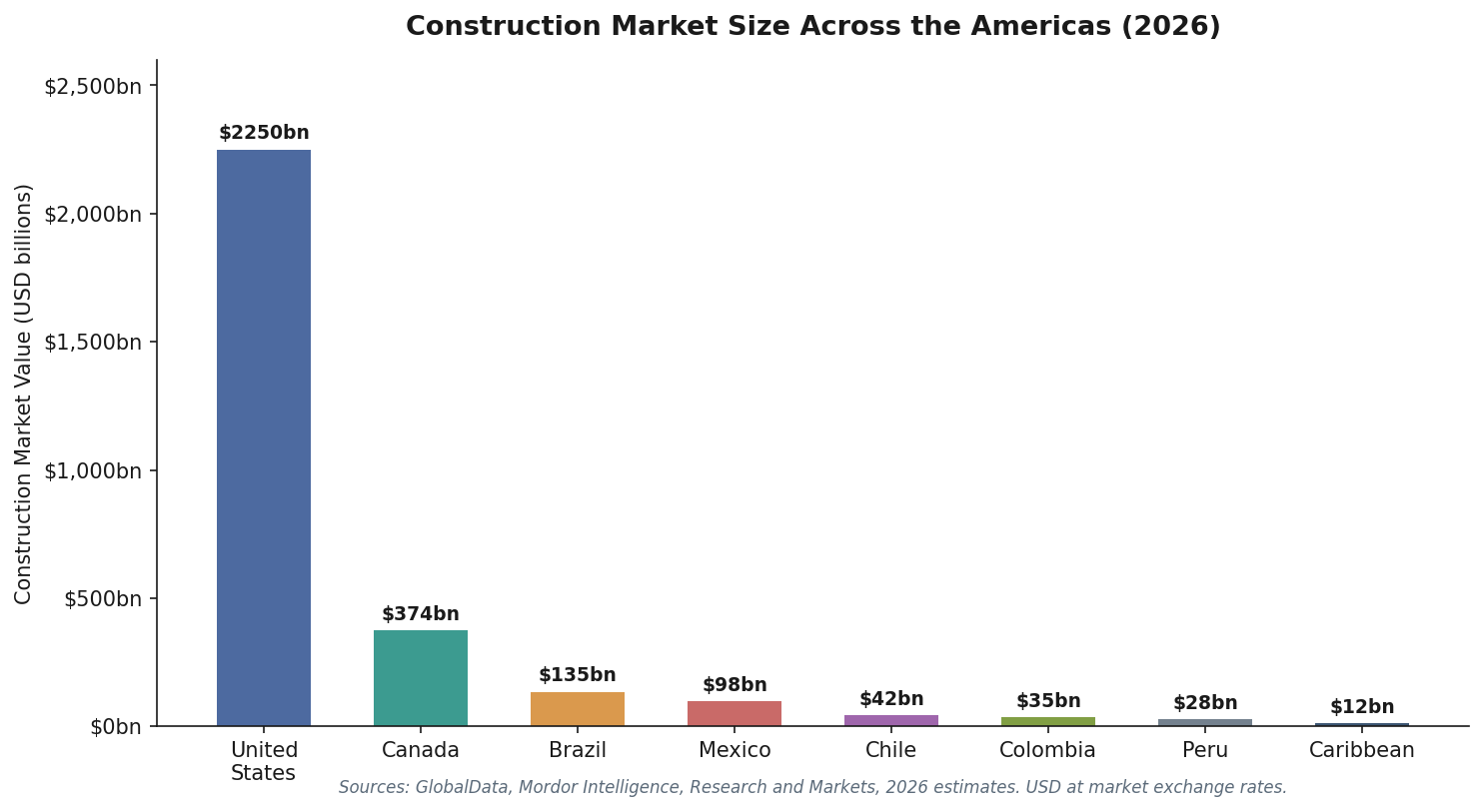
The Americas represent the world’s largest construction market — the United States alone accounts for over $2.25 trillion in annual construction spending, making it the single biggest national construction market on the planet. Add Canada ($374 billion), Brazil ($135 billion), Mexico ($98 billion), Chile, Colombia, Peru, the Caribbean, and the rest of Latin America, and the combined Americas construction market exceeds $3 trillion annually.
Yet the profession that manages construction costs goes by different names across the hemisphere. In the United Kingdom, the professional who plans, manages, and controls construction costs is a Quantity Surveyor. In the United States, the same function is performed by professionals called Cost Estimators, Cost Managers, Cost Consultants, Cost Engineers, Preconstruction Managers, or Commercial Managers — the term “Quantity Surveyor” is rarely used domestically. In Canada, the QS title survives — the Canadian Institute of Quantity Surveyors (CIQS) has regulated the profession since 1959. In the Caribbean, particularly the English-speaking islands (Jamaica, Trinidad and Tobago, Barbados, Guyana), the British QS tradition remains strong. In Latin America, the function is performed by cost engineers (ingenieros de costos), estimators (presupuestadores or orçamentistas in Brazil), and construction economists.
This guide explains the profession across the Americas — its history, terminology, qualifications, institutions, career pathways, salaries, contracts, major employers, construction markets, and future. The Americas should not be treated as one construction market. The United States, Canada, Mexico, Central America, the Caribbean, Brazil, and Spanish-speaking South America each have distinct professional structures, contract forms, procurement practices, and career opportunities.
The Relationship Between Professional Titles
| Discipline | Focus | Where Used |
|---|---|---|
| Quantity Surveying | Full lifecycle cost management — measurement, cost planning, procurement, contract admin, valuations, final account | UK, Canada, Caribbean, international consultancies worldwide |
| Cost Management | Client-side cost planning, benchmarking, cost control, change management | US, Canada, international consultancies |
| Cost Estimating | Quantity take-off, unit pricing, bid preparation, preconstruction | US, Canada (contractor-side focus) |
| Cost Engineering | Engineering-based cost management, project controls, earned value, scheduling | US, Canada, Latin America (oil & gas, mining, energy) |
| Commercial Management | Contractor-side cost, procurement, subcontracts, claims, CVR | US, UK, international contractors |
| Project Controls | Integrated cost, schedule, risk, and performance management | US, Canada, Latin America (energy, infrastructure) |
| Construction Economics | Economic analysis of construction markets, feasibility, lifecycle costing | Academic and advisory — US, Brazil, Chile |
The Origins of Quantity Surveying and Cost Management in the Americas
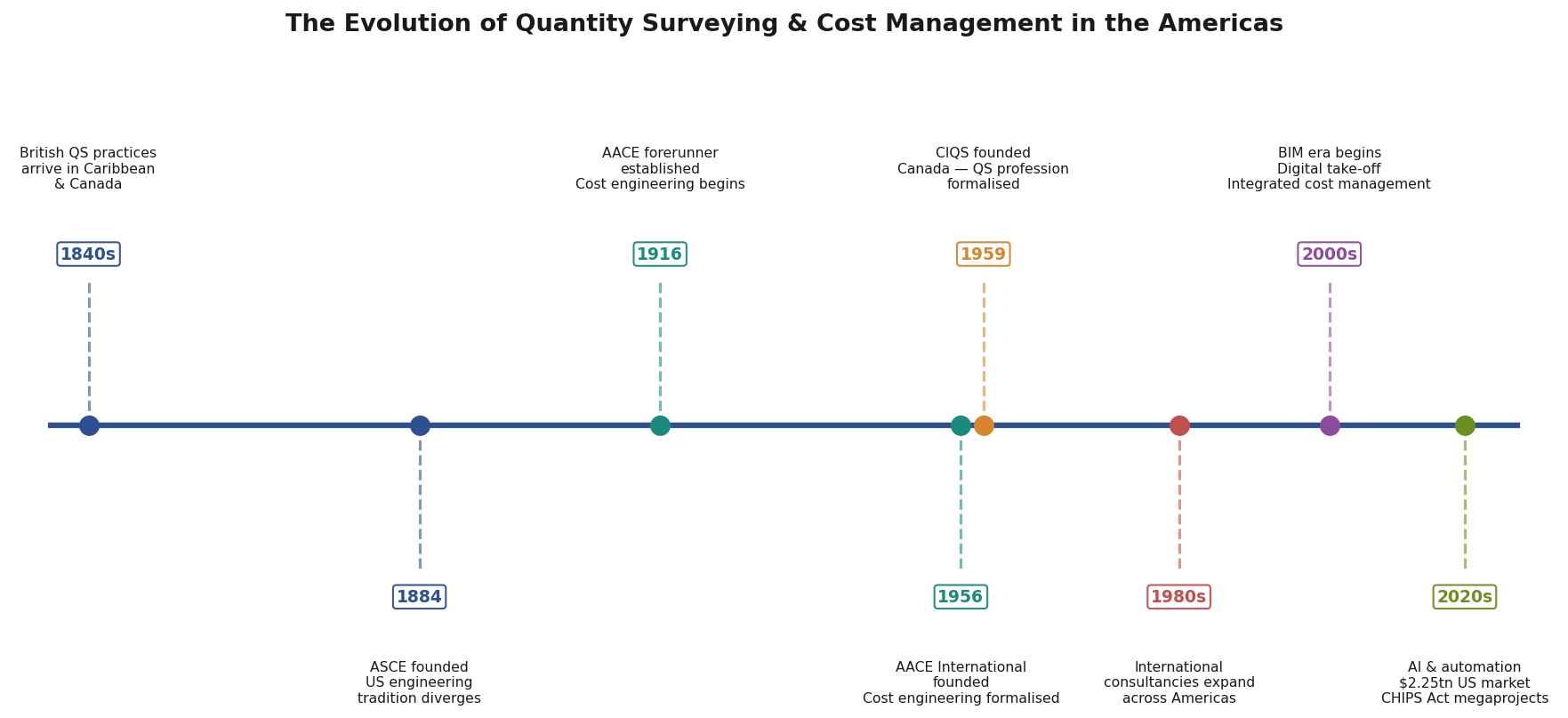
The British Quantity Surveying tradition arrived in the Americas through colonial influence — first in Canada (then British North America), the Caribbean colonies, and British Guiana. The earliest QS practices in the Western Hemisphere were established in Jamaica, Trinidad, Barbados, and British Guiana in the 19th century, following the UK model of bills of quantities, competitive tendering, and independent cost advice.
In the United States, construction cost management evolved differently. The American tradition developed through civil engineering (ASCE was founded in 1852), construction contracting, and — from the early 20th century — professional estimating. The separation between design (architecture/engineering) and construction (general contracting) in the American system created distinct professional streams. Where the UK Quantity Surveyor sat between architect and contractor as an independent cost adviser, the American model embedded cost management within the contractor’s estimating department (contractor-side) and within construction management firms (client-side).
AACE International (originally the American Association of Cost Engineers) was founded in 1956, formalising cost engineering as a discipline rooted in engineering principles, scheduling, and project controls — a parallel but distinct tradition from UK quantity surveying. The Canadian Institute of Quantity Surveyors (CIQS) was founded in 1959, maintaining the QS title and professional structure in Canada.
In Latin America, construction cost management developed within engineering traditions shaped by Spanish, Portuguese, and French colonial influence. The cost engineer (ingeniero de costos) and estimator (presupuestador) traditions evolved separately from the Anglo-Saxon QS model, though the core function — managing construction costs — remained the same.
Evolution of the Profession
| Period | Development | Impact on Cost Profession |
|---|---|---|
| 1840s–1900 | British QS practices arrive in Caribbean and Canada. ASCE founded (1852). | QS tradition established in British colonies. US develops separate engineering-led approach to cost management. |
| 1900–1950 | Post-war construction boom. US highway system. Estimating professionalises. | American estimating tradition develops independently. Cost engineering emerges in heavy industry. |
| 1956–1970s | AACE founded (1956). CIQS founded (1959). Infrastructure expansion. | Cost engineering formalised. Canadian QS profession established. Project controls emerge. |
| 1980s–1990s | International consultancies expand into Americas. RICS grows globally. | British QS firms establish US and Canadian offices. Cost management as independent advisory service grows. |
| 2000s | BIM era. Digital take-off. Latin American infrastructure boom. | Digital measurement transforms QS practice. Mining boom drives demand in Chile, Peru, Brazil. |
| 2010s–present | CHIPS Act, IIJA, data centres, AI, energy transition. | $2.25tn US market. Semiconductor megaprojects. AI-assisted estimating. Global cost management convergence. |
The United States: Cost Management and Quantity Surveying
The United States has the largest construction market in the world — valued at approximately $2.25 trillion in 2026. Yet the “Quantity Surveyor” title is rarely used. Understanding why requires understanding how the American construction industry developed.
The American system separates design professionals (architects, engineers) from construction professionals (general contractors, construction managers). Where the UK model positions the Quantity Surveyor as an independent cost adviser working alongside the architect, the US model distributes cost management across several roles: the owner’s construction manager provides cost advice on the client side; the contractor’s estimating department handles pricing on the contractor side; and independent cost consultancies provide cost management services. International firms — Turner & Townsend, AECOM, Arcadis, RLB, Cumming Group — use the “Cost Manager” or “Quantity Surveyor” title in their US offices, but these titles remain unfamiliar to much of the domestic industry.
UK vs US Terminology
| UK Term | US Equivalent | Notes |
|---|---|---|
| Quantity Surveyor | Cost Manager / Cost Consultant / Estimator | Title depends on client-side vs contractor-side |
| Cost Plan | Cost Estimate / Budget | US uses AACE classification (Class 1–5) |
| Bill of Quantities (BOQ) | Quantity Take-Off / Schedule of Values | BOQs uncommon in US — lump sum and GMP dominate |
| Tender | Bid / Proposal | Competitive bidding is the US term |
| Contractor QS | Commercial Manager / Project Accountant / Estimator | Commercial Manager title growing |
| Final Account | Final Cost / Closeout / Reconciliation | Process is similar; terminology differs |
| Valuation / Interim Certificate | Payment Application / Draw Request | AIA G702/G703 forms standard in US |
| Contract Administration | Construction Administration / Contract Management | Often performed by architect or CM in US |
| Variation | Change Order | Same concept, different terminology |
| Preliminaries | General Conditions / General Requirements | Division 01 in CSI MasterFormat |
US Professional Institutions
AACE International (founded 1956) is the primary professional body for cost engineering and total cost management. Its flagship certification is the Certified Cost Professional (CCP) — a 5-hour examination covering cost management, project controls, and earned value. Eligibility requires 8 years of experience (or 4 years plus a relevant degree). AACE has over 10,000 members worldwide.
ASPE (American Society of Professional Estimators) awards the Certified Professional Estimator (CPE) designation. CMAA (Construction Management Association of America) awards the Certified Construction Manager (CCM). RICS has a significant Americas presence and is recognised by major consultancies, though it is not a domestic regulatory requirement.
US Salary Ranges (2026)
Graduate / Junior Estimator: $70,000–$92,000/year. Senior Estimator / Cost Manager: $108,000–$142,000/year. Preconstruction Manager: $140,000–$190,000/year. Director of Cost Management: $160,000–$230,000+/year. Chief Estimator / VP: $170,000–$280,000+/year. Salaries are highest in New York, San Francisco, Los Angeles, Houston, and Washington DC.
Canada
Canada is one of the few countries in the Americas where the Quantity Surveyor title is formally used and professionally regulated. The Canadian Institute of Quantity Surveyors (CIQS), founded in 1959, awards the Professional Quantity Surveyor (PQS) and Construction Estimator Certified (CEC) designations. CIQS represents over 2,000 members and recognises RICS MRICS holders for PQS designation.
The Canadian construction market is valued at approximately CAD 222 billion ($374 billion USD) in 2026. The Ontario government alone plans to invest CAD 210 billion over 10 years in hospitals, highways, transit, and community infrastructure. The federal Build Communities Strong Fund provides CAD 51 billion over 10 years for housing, health, transit, and education.
Contract forms: CCDC (Canadian Construction Documents Committee) contracts are standard — CCDC 2 (Stipulated Price) is broadly equivalent to JCT SBC. FIDIC is used on some internationally funded projects. NEC has limited but growing use.
Salary ranges (2026): Graduate QS CAD 55,000–78,000/year; Senior QS / Cost Manager CAD 95,000–140,000/year; Director CAD 140,000–200,000+/year. Toronto and Vancouver command the highest salaries.
Major sectors: Transit (Ontario Line, Eglinton Crosstown, Broadway Subway Vancouver), infrastructure (highways, bridges), healthcare, residential (affordable housing programmes), energy (LNG Canada, hydroelectric, nuclear refurbishment), mining, and data centres.
Mexico and Central America
Mexico has a construction market valued at approximately $98 billion in 2026. Cost management is practised by cost engineers (ingenieros de costos) and estimators (presupuestadores) within the civil engineering tradition. The Colegio de Ingenieros Civiles de México (CICM) is the leading professional body. FIDIC is used on internationally funded projects; domestic contracts follow the Mexican Federal Procurement Law for public works. Major sectors include infrastructure (Tren Maya, Dos Bocas Refinery, Felipe Ángeles Airport), energy, commercial, and residential.
Panama is the standout Central American market — the Panama Canal expansion, metro system (Lines 1–3), and Panama City commercial development have created consistent demand for cost professionals. FIDIC is widely used. English and Spanish bilingual professionals are in high demand.
Costa Rica has a growing construction sector driven by commercial, tourism, and residential development. Guatemala and Honduras have infrastructure investment driven by development bank funding. Throughout Central America, FIDIC is the standard contract form on internationally funded projects.
The Caribbean
The English-speaking Caribbean — Jamaica, Trinidad and Tobago, Barbados, Bahamas, and Guyana — maintains the British QS tradition. Quantity surveyors practise under the UK model, using bills of quantities, competitive tendering, and JCT or FIDIC contracts. The Caribbean construction market is valued at approximately $12.4 billion, with tourism, residential, port, and infrastructure projects driving demand.
Trinidad and Tobago has the strongest QS market in the Caribbean, driven by oil and gas, petrochemicals, and government infrastructure. Jamaica has a growing construction sector with port development, tourism, and highway projects. Guyana is experiencing a construction boom driven by offshore oil (ExxonMobil’s Stabroek block), creating rapid demand for cost professionals.
Dominican Republic and Puerto Rico follow different professional models — the DR uses the Spanish engineering tradition, while Puerto Rico follows US construction practices (as a US territory).
RLB has a significant Caribbean presence, providing quantity surveying and cost management services across the region.
Brazil
Brazil has the largest construction market in South America, valued at approximately BRL 708 billion ($135 billion USD) in 2026, growing at 5.1% annually. Infrastructure is the fastest-growing subsector (5.45% CAGR through 2030), fuelled by the Novo PAC (Growth Acceleration Program).
The Quantity Surveyor title is not used in Brazil. The equivalent functions are performed by cost engineers (engenheiros de custos), estimators (orçamentistas), and construction economists. Professional practice is regulated by CREA (regional engineering councils — Conselho Regional de Engenharia e Agronomia). IBEC (Instituto Brasileiro de Engenharia de Custos) is the professional body for cost engineering.
Contract forms: Brazilian Civil Code provisions, FIDIC on internationally funded projects, EPC for industrial and energy. Language: Portuguese is essential — all documentation, procurement, and contract administration is in Portuguese.
Major sectors: Infrastructure (Novo PAC — roads, rail, ports, airports), energy (Petrobras pre-salt deepwater, renewables, biofuels), mining (iron ore, bauxite, nickel), residential (Minha Casa Minha Vida housing programme), commercial (São Paulo, Rio de Janeiro), data centres, and sanitation (privatisation-driven investment).
South American Construction Markets
Chile is the world’s largest copper producer, with mining infrastructure driving consistent demand. The construction market is supported by mining (BHP, Codelco, Anglo American), renewable energy (world-leading solar resources in Atacama), transport (Santiago Metro — one of the most modern in Latin America), and residential. Cost professionals work with both FIDIC (mining, international) and Chilean domestic contracts.
Colombia has invested heavily in infrastructure through the 4G (Fourth Generation) road programme — COP 110 trillion ($27 billion) in road and rail networks. The Bogotá Metro (Line 1, under construction) is one of Latin America’s largest current infrastructure projects. Mining (gold, coal, emeralds), energy, and commercial development also drive demand.
Peru is forecast to have the fastest construction growth in South America (8.45% CAGR through 2031). Mining infrastructure (copper, gold, zinc — major projects by Freeport-McMoRan, Southern Copper, Newmont), Lima Metro, and highway development create demand for cost professionals. FIDIC is used on major mining and infrastructure projects.
Argentina has a significant construction market affected by economic volatility and currency instability. Major sectors include energy (Vaca Muerta shale gas — one of the world’s largest unconventional reserves), mining (lithium — Argentina has the world’s second-largest lithium reserves), and infrastructure.
Major Construction Markets
Professional Institutions
| Institution | Country | Qualification | Focus |
|---|---|---|---|
| AACE International | USA (global) | CCP, CCE, EVP, PSP | Cost engineering, project controls, total cost management |
| CIQS | Canada | PQS, CEC | Quantity surveying, construction estimating |
| RICS (Americas) | US, Canada, Caribbean | AssocRICS, MRICS, FRICS | Quantity surveying, cost management, project management |
| ASPE | USA | CPE | Professional estimating |
| CMAA | USA | CCM | Construction management |
| IBEC | Brazil | — | Cost engineering (Brazilian) |
| CICM | Mexico | — | Civil engineering (includes cost management) |
Education Pathways
| Country | University | Qualification | Duration | Recognition |
|---|---|---|---|---|
| USA | Purdue University | BS Construction Management | 4 years | ACCE accredited |
| USA | Georgia Tech | BS Building Construction | 4 years | ACCE accredited |
| USA | Texas A&M | BS Construction Science | 4 years | ACCE accredited |
| USA | Virginia Tech | BS Building Construction | 4 years | ACCE accredited |
| Canada | University of Calgary (Cont. Ed.) | Diploma in QS | 2 years | CIQS accredited |
| Canada | University of Alberta (Cont. Ed.) | Certificate in QS | Part-time | CIQS accredited |
| Brazil | USP (São Paulo) | BSc Civil Engineering | 5 years | CREA |
| Brazil | UFRJ (Rio de Janeiro) | BSc Civil Engineering | 5 years | CREA |
| Chile | Universidad de Chile | Ingeniería Civil | 6 years | National accreditation |
| Colombia | Universidad de los Andes | Ingeniería Civil | 5 years | National accreditation |
| Mexico | UNAM | Ingeniería Civil | 5 years | CICM |
| Argentina | Universidad de Buenos Aires | Ingeniería Civil | 6 years | National accreditation |
Career Pathways

Salaries and Compensation
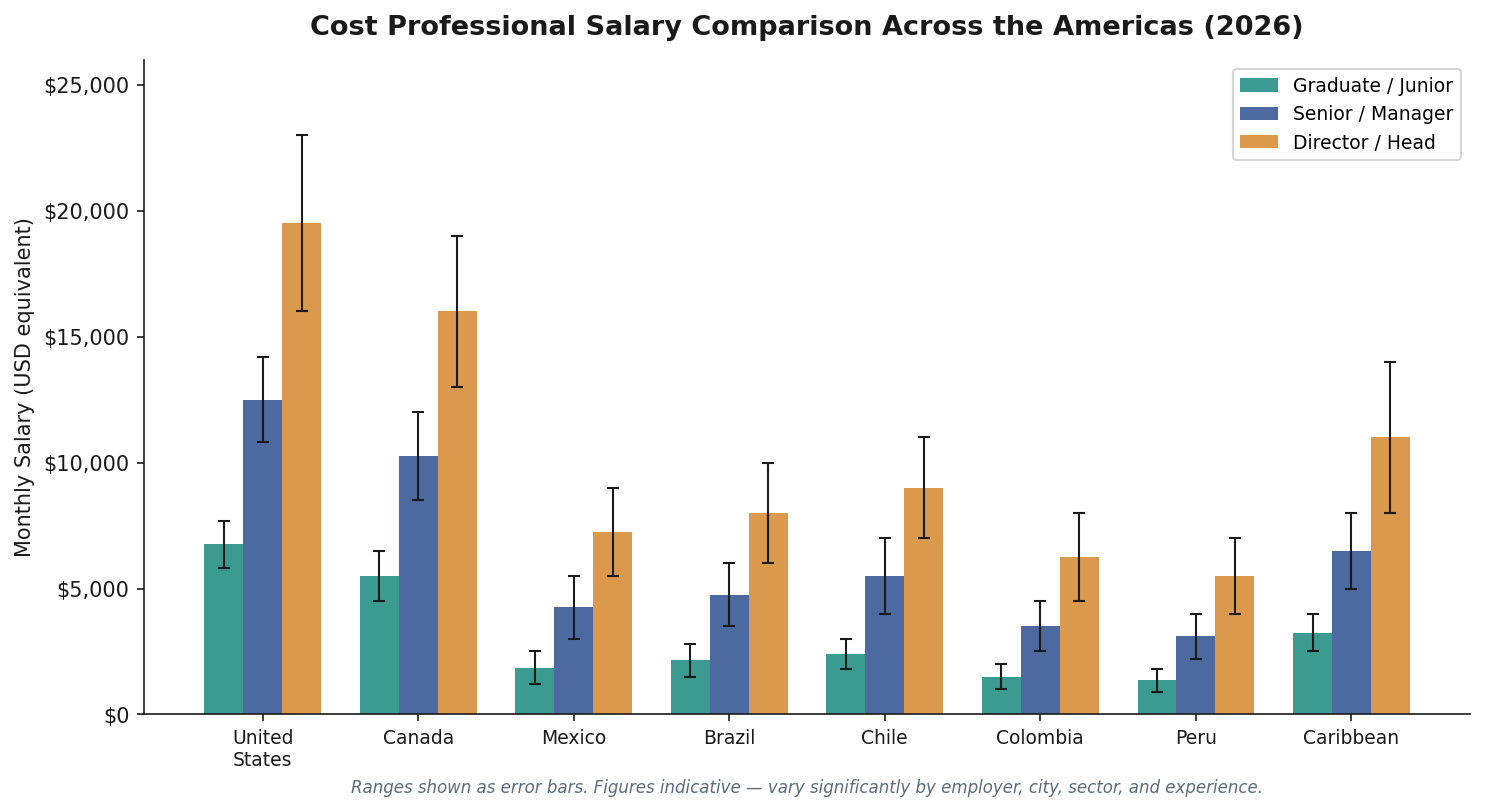
| Country | Graduate (annual) | Senior (annual) | Director (annual) | Currency |
|---|---|---|---|---|
| United States | $70,000–$92,000 | $108,000–$142,000 | $160,000–$230,000+ | USD |
| Canada | CAD 55,000–78,000 | CAD 95,000–140,000 | CAD 140,000–200,000+ | CAD |
| Mexico | MXN 15,000–30,000/mo | MXN 40,000–65,000/mo | MXN 80,000–130,000+/mo | MXN |
| Brazil | BRL 5,000–8,000/mo | BRL 12,000–20,000/mo | BRL 25,000–45,000+/mo | BRL |
| Chile | CLP 1,200,000–2,000,000/mo | CLP 2,500,000–4,500,000/mo | CLP 5,000,000–8,000,000+/mo | CLP |
| Colombia | COP 3,000,000–5,500,000/mo | COP 8,000,000–14,000,000/mo | COP 18,000,000–30,000,000+/mo | COP |
| Peru | PEN 3,500–6,000/mo | PEN 8,000–15,000/mo | PEN 18,000–30,000+/mo | PEN |
| Caribbean | $30,000–$48,000 | $60,000–$96,000 | $96,000–$168,000+ | USD equivalent |
Major Construction Sectors
Major Projects in the Americas
| Project | Country | Est. Value | Sector | Status (2026) |
|---|---|---|---|---|
| TSMC Arizona Fab Complex | USA | $165 billion | Semiconductor | Three fabs planned. Fab 1 production commenced. Fab 2 under construction. |
| Micron Semiconductor Plants | USA | $200 billion | Semiconductor | Idaho, New York, Virginia. CHIPS Act funded. Under construction. |
| California High-Speed Rail | USA | $128 billion | Rail | Under construction (Central Valley). PPP model being explored. |
| Ontario Line | Canada | CAD 19 billion | Metro / transit | Under construction. Toronto’s largest transit expansion. |
| LNG Canada | Canada | CAD 40 billion | Energy (LNG) | Phase 1 operational. Phase 2 planning. |
| Bogotá Metro Line 1 | Colombia | $4.3 billion | Metro | Under construction. China Harbour / Xi’an Metro consortium. |
| Santiago Metro Expansion | Chile | $3.5 billion | Metro | Lines 7, 8, 9 programme. Under construction / planning. |
| Novo PAC Infrastructure | Brazil | $350 billion (total programme) | Infrastructure | Multi-year programme. Roads, rail, ports, sanitation, housing. |
| Quellaveco Copper Mine | Peru | $5.3 billion | Mining | Operational (Anglo American). Expansion planned. |
| Panama Metro Line 3 | Panama | $2.8 billion | Metro | Under construction. |
| Vaca Muerta Shale Development | Argentina | $30 billion+ (cumulative) | Energy (shale gas) | Active development. One of world’s largest shale reserves. |
| Guyana Oil & Gas Infrastructure | Guyana | $10 billion+ | Energy (offshore oil) | ExxonMobil Stabroek block. Multiple FPSOs operational. |
Major Cost Consultancy and Construction Firms
| Firm | HQ | Americas Presence | Graduate Programmes |
|---|---|---|---|
| Turner & Townsend | Leeds, UK (70% CBRE) | New York, San Francisco, Los Angeles, Houston, Seattle, Toronto, Vancouver, São Paulo, Mexico City | Yes — RICS APC support |
| AECOM | Dallas, USA | US-wide, Canada, Brazil, Mexico, Chile, Peru, Colombia | Yes |
| Arcadis | Amsterdam, Netherlands | New York, Houston, San Francisco, Toronto, Brazil, Chile | Yes |
| Rider Levett Bucknall | London / Sydney | New York, Los Angeles, Honolulu, Caribbean | Yes |
| Cumming Group | Los Angeles, USA | US-wide (30+ offices). Major US-headquartered cost consultancy. | Yes |
| Linesight | Dublin, Ireland | New York, Dallas, San Francisco. Data centres specialist. | Yes |
| AtkinsRéalis | Montréal, Canada | Canada-wide, US, Latin America. Nuclear, infrastructure. | Yes |
| WSP | Montréal, Canada | US-wide, Canada-wide, Latin America | Yes |
| Jacobs | Dallas, USA | US-wide, Canada. Infrastructure, water, government. | Yes |
| Gleeds | London, UK | New York, Washington DC, Caribbean | Yes |
Contracts and Procurement
| Contract Form | Countries | Typical Use | QS / Cost Manager Role |
|---|---|---|---|
| AIA A201 | USA (dominant) | General Conditions — design-bid-build. Most widely used US form. | Cost management, change orders, payment applications. |
| ConsensusDocs | USA | Balanced industry coalition forms. Backed by AGC. | Risk allocation, cost control, dispute resolution. |
| CCDC 2 | Canada (dominant) | Stipulated Price Contract. Equivalent to JCT SBC. | Traditional QS role. BOQ, valuations, final account. |
| GMP (Guaranteed Maximum Price) | USA, Canada | Cost Plus with ceiling. Very common in US commercial. | Open-book cost management, subcontract procurement, savings sharing. |
| FIDIC | Latin America, Caribbean | International / donor-funded infrastructure. Mining, energy. | BOQ, IPC, variations, claims, final account. |
| FAR (Federal Acquisition Regulation) | USA (federal government) | Government construction. Complex compliance requirements. | Cost proposals, auditing, change management, claims. |
| EPC / EPCM | Americas-wide (energy, mining) | Turnkey / management. Oil & gas, mining, power. | Cost engineering, earned value, project controls. |
| P3 / PPP | Canada, Latin America, growing in US | Public-private partnerships. Infrastructure, transit. | Lifecycle costing, financial modelling, FM pricing. |
| NEC4 | Very limited in Americas | Some UK-linked projects. Not a standard form. | Defined Cost, compensation events, early warning. |
North America vs South America Comparison
| Category | USA | Canada | Brazil | Chile | Colombia |
|---|---|---|---|---|---|
| Professional title | Cost Manager / Estimator | Quantity Surveyor / Cost Consultant | Engenheiro de Custos | Ingeniero de Costos | Ingeniero de Costos |
| Main qualification | CCP, MRICS, CPE | PQS (CIQS), MRICS | CREA registration | Engineering degree | Engineering degree |
| Major institution | AACE, ASPE, CMAA | CIQS | IBEC, CREA | CChC (Cámara Chilena) | SCI (Sociedad Colombiana) |
| Typical contracts | AIA, ConsensusDocs, GMP | CCDC, FIDIC (some) | Civil Code, FIDIC, EPC | Domestic, FIDIC, EPC | Domestic, FIDIC |
| Main sectors | Data centres, semiconductor, infrastructure, healthcare | Transit, energy, healthcare, mining | Infrastructure, energy, mining, residential | Mining, energy, metro, residential | Infrastructure (4G roads), metro, mining |
| Language | English | English / French | Portuguese | Spanish | Spanish |
| Demand level | Very high | High | Moderate–high | Moderate–high | Growing |
Working in the Americas as a UK Quantity Surveyor
What transfers directly: Cost planning, measurement, contract administration, claims management, commercial reporting, and RICS chartership. The core QS skill set is highly valued by international consultancies in the US and Canada.
What you need to learn: AIA contract forms (A201 General Conditions), ConsensusDocs, CCDC (Canada), CSI MasterFormat (the US equivalent of NRM/SMM for organising costs), American estimating terminology (see the UK vs US terminology table above), GMP and Cost Plus procurement models, US tax and insurance structures, and American construction documentation standards.
Visa and work permits: The US requires an employer-sponsored H-1B visa (capped annually) or L-1 (intracompany transfer — common for international consultancies). Canada offers Express Entry (points-based immigration) and the International Experience Canada programme. Latin American countries generally require employer-sponsored work permits.
RICS recognition: RICS is recognised by all major international consultancies in the US and Canada. However, it is not a domestic regulatory requirement — AACE CCP, ASPE CPE, and CMAA CCM are the primary domestic certifications. In Canada, CIQS recognises MRICS holders for PQS designation.
Working in Latin America
Spanish is essential for working in Chile, Colombia, Peru, Argentina, Ecuador, Mexico, and the rest of Spanish-speaking Latin America. Portuguese is essential for Brazil. While some multinational firms operate in English internally, all local documentation, procurement, contracts, and client communication will be in the local language.
The combination of international QS experience + local language proficiency + FIDIC expertise is extremely valuable in Latin America, particularly on mining, energy, and infrastructure projects funded by international development banks.
Digital Quantity Surveying in the Americas
The United States and Canada are global leaders in construction technology adoption. BIM is standard on major commercial and public projects. 5D BIM (cost-linked models) is growing. CostX, Bluebeam, Autodesk Construction Cloud, Procore, Primavera P6, and Power BI are widely used. AI-assisted estimating and automated quantity take-off are emerging as transformative technologies.
Latin American BIM adoption varies — Brazil, Chile, and Colombia are leading adopters, with BIM mandates emerging on public projects. Traditional measurement and Excel-based estimating remain common in many markets.
Challenges Facing Cost Professionals
Key challenges across the Americas include labour shortages (the US construction industry has an estimated 500,000+ unfilled positions), material price volatility, inflation and interest rates affecting development viability, tariffs and trade policy uncertainty, regulatory complexity (particularly in federal procurement and interstate licensing), and the pace of digital transformation requiring continuous upskilling. In Latin America, currency volatility, political instability, and informal construction sectors add further challenges.
The Future of Quantity Surveying and Cost Management in the Americas
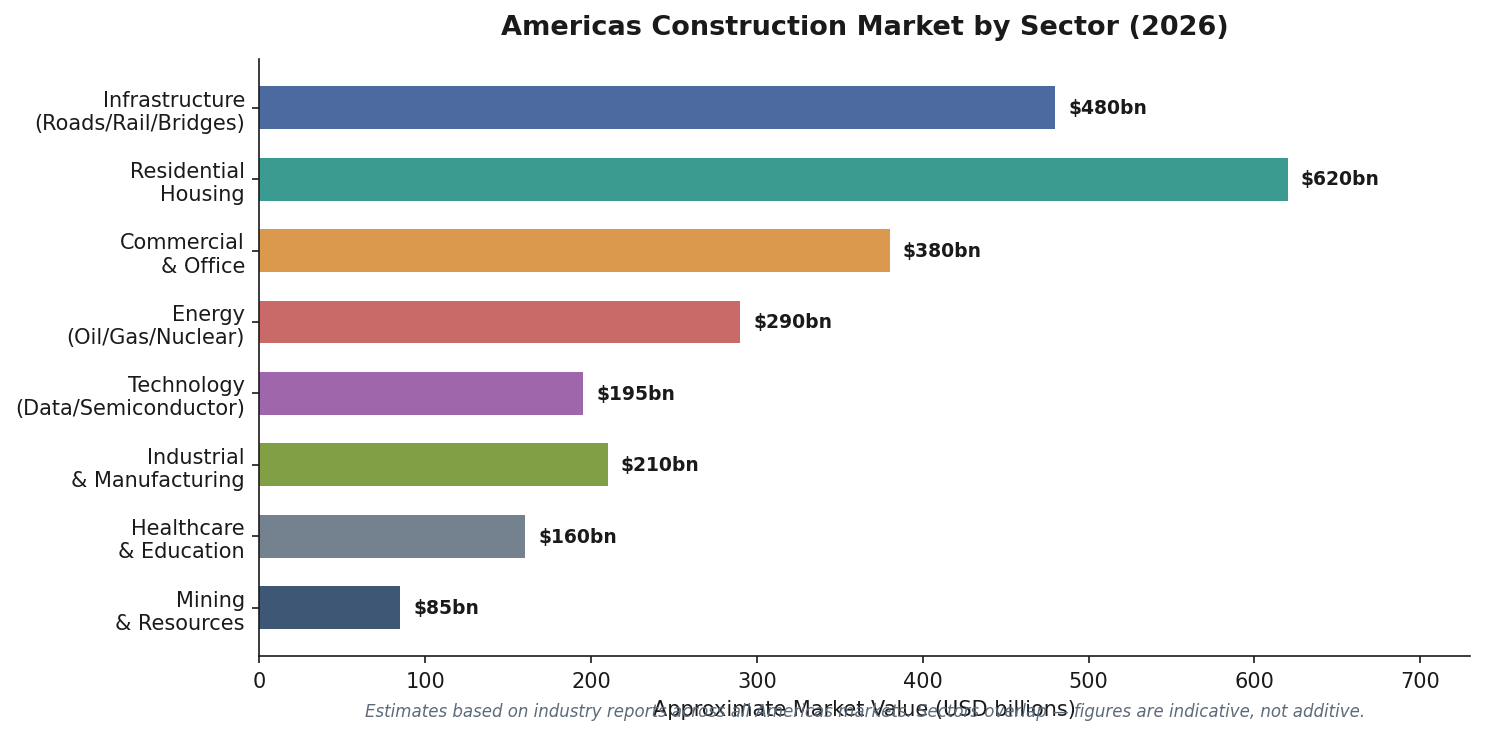
The outlook for cost management professionals in the Americas is exceptionally strong. The CHIPS and Science Act is driving over $500 billion in semiconductor manufacturing investment. The Infrastructure Investment and Jobs Act (IIJA) is funding road, bridge, rail, and water infrastructure across the US. Data centre construction is growing at an unprecedented rate — Amazon, Meta, Microsoft, and Google are collectively investing hundreds of billions of dollars. The energy transition (nuclear, solar, wind, battery storage, hydrogen) is creating new construction sectors. Housing demand across the US and Canada remains acute.
In Latin America, the Novo PAC in Brazil, the 4G road programme in Colombia, mining investment in Chile and Peru, and the offshore oil boom in Guyana are driving growth. The Inter-American Development Bank continues to fund infrastructure across the region.
The cost professional who combines traditional QS/estimating skills with digital fluency (BIM, AI, data analytics), FIDIC or AIA expertise, and commercial leadership will be extraordinarily well positioned — whether as a Quantity Surveyor, Cost Manager, Cost Engineer, or Commercial Manager. The title may change from country to country, but the fundamental discipline of managing construction costs professionally remains universal.
Career Opportunities by Country — Ranking
| Rank | Country | Strength | Notes |
|---|---|---|---|
| 1 | United States | World’s largest market. Highest salaries. CHIPS Act, data centres, IIJA. | QS title uncommon domestically. H-1B visa required. |
| 2 | Canada | QS title recognised. CIQS/PQS. Strong infrastructure pipeline. | Express Entry immigration. MRICS recognised for PQS. |
| 3 | Brazil | Largest South American market. Novo PAC. Energy, mining. | Portuguese essential. Currency volatility. |
| 4 | Chile | Mining (copper, lithium). Renewables. Santiago Metro. | Most stable South American economy. FIDIC on mining. |
| 5 | Colombia | 4G roads programme. Bogotá Metro. Mining. | Growing market. Strong infrastructure pipeline. |
| 6 | Peru | Fastest South American growth (8.45% CAGR). Mining, Lima Metro. | Strong mining-driven demand. |
| 7 | Panama | Canal, metro, commercial. Regional gateway. | FIDIC used. Bilingual market. |
| 8 | Caribbean | British QS tradition. Tourism, ports, oil (Guyana). | Small market. Guyana oil boom transformative. |
This ranking is indicative and based on a composite assessment of construction activity, salary potential, demand for cost professionals, professional infrastructure, and long-term pipeline. It is not absolute.
Frequently Asked Questions
Is Quantity Surveying a profession in America?
The core disciplines of quantity surveying — cost planning, estimating, measurement, contract administration, and commercial management — are practised extensively in North America, but under different professional titles. In the United States, the equivalent roles are typically called Cost Estimator, Cost Manager, Cost Consultant, Cost Engineer, or Commercial Manager. In Canada, the Quantity Surveyor title is used and regulated by the Canadian Institute of Quantity Surveyors (CIQS).
What is a Quantity Surveyor called in the USA?
The most common equivalent titles in the United States are Cost Estimator, Cost Manager, Cost Consultant, Cost Engineer, Preconstruction Manager, and Commercial Manager. International consultancies such as Turner & Townsend, AECOM, and RLB use the Quantity Surveyor and Cost Manager titles in their US offices.
Can a UK Quantity Surveyor work in America?
Yes. UK-qualified Quantity Surveyors — particularly MRICS holders — are valued in the United States and Canada, especially by international consultancies. A work visa (H-1B or equivalent) is required for the US; Canada offers points-based immigration. FIDIC, NEC, and international project experience are attractive to employers.
Is RICS recognised in the USA?
Yes. RICS has a significant Americas presence with offices in New York and Washington DC. RICS is recognised by major consultancies and on internationally funded projects. However, RICS is not a regulatory requirement in the US — AACE, ASPE, and CMAA certifications are more commonly sought by domestic employers.
Is RICS recognised in Canada?
Yes. RICS is well recognised in Canada. CIQS accepts MRICS holders for Professional Quantity Surveyor (PQS) designation. Many Canadian consultancies actively recruit RICS-chartered professionals, particularly in Ontario, British Columbia, and Alberta.
What is the American equivalent of a Quantity Surveyor?
The closest US equivalents are Cost Manager (client-side), Cost Estimator or Estimator (contractor-side), and Cost Engineer (project controls). The US does not have a single direct equivalent — the QS role is distributed across several specialisms.
What is a Cost Manager?
A Cost Manager provides independent cost advice to clients throughout the project lifecycle — from feasibility and cost planning through procurement, construction, and final account. It is the closest US equivalent to the UK client-side Quantity Surveyor role.
What is a Cost Engineer?
A Cost Engineer applies engineering principles to the management of project costs, schedules, and risk. It is the primary designation of AACE International. Cost Engineers typically work in project controls, earned value management, and cost forecasting, particularly in oil and gas, energy, mining, and heavy infrastructure.
What is the difference between an Estimator and a Quantity Surveyor?
An Estimator (in the US sense) focuses primarily on pricing construction work during the preconstruction phase — quantity take-off, unit pricing, and bid preparation. A Quantity Surveyor covers the full project lifecycle including cost planning, procurement, contract administration, valuations, variations, claims, and final account. The QS role is broader in scope.
How much does a Quantity Surveyor earn in the USA?
Cost Managers and Quantity Surveyors in the US earn approximately $70,000–$92,000 at graduate level, $108,000–$142,000 at senior level, and $160,000–$230,000+ at director level (2026 figures). Salaries vary significantly by city.
How much does a Cost Manager earn in the USA?
Senior Cost Managers at major consultancies earn $120,000–$170,000 base salary plus bonuses. Directors and Vice Presidents earn $160,000–$250,000+. Salaries are highest in New York, San Francisco, Los Angeles, Houston, and Washington DC.
Can I work in Canada with a UK QS degree?
Yes. Canada actively recruits internationally qualified QS professionals. CIQS recognises MRICS holders for PQS designation. Canada’s Express Entry immigration system provides a pathway for skilled professionals.
Is FIDIC used in America?
FIDIC is rarely used in the domestic United States or Canada. AIA, ConsensusDocs, and EJCDC contracts dominate in the US; CCDC contracts are standard in Canada. However, FIDIC is used on Latin American infrastructure projects funded by international development banks, and in the Caribbean.
Is NEC used in the USA?
NEC has very limited use in the United States. Some US projects with UK client involvement have adopted NEC, but it is not a standard contract form. AIA A201 and ConsensusDocs are the dominant standard forms.
What contracts are used in the United States?
The most common contract forms are AIA (American Institute of Architects) documents, ConsensusDocs, EJCDC (engineers’ contracts), DBIA (design-build), and FAR (Federal Acquisition Regulation) for government work. GMP (Guaranteed Maximum Price) and Cost Plus contracts are common procurement models.
What is an AIA contract?
AIA contracts are the most widely used standard form construction contracts in the United States, published by the American Institute of Architects. AIA A201 (General Conditions) is the foundational document. AIA contracts cover design-bid-build, design-build, construction management, and IPD delivery methods.
What is the Canadian equivalent of JCT?
The Canadian Construction Documents Committee (CCDC) publishes standard form construction contracts in Canada. CCDC 2 (Stipulated Price Contract) is the most widely used and is broadly equivalent to JCT SBC.
Is Quantity Surveying popular in Brazil?
The Quantity Surveyor title is not widely used in Brazil. The equivalent functions are performed by cost engineers (engenheiros de custos), construction economists, and estimators (orçamentistas). Professional practice is regulated by CREA (regional engineering councils). International consultancies use the Cost Manager title in Brazil.
Do I need Spanish to work as a QS in South America?
For Spanish-speaking South American countries (Chile, Colombia, Peru, Argentina, Ecuador), Spanish is essential for domestic projects and highly valuable on international ones. English may suffice on some internationally funded mining and energy projects, but career prospects improve dramatically with Spanish proficiency.
Do I need Portuguese to work in Brazil?
Portuguese is essential for working in Brazil, even on international projects. Cost professionals combining international experience with Portuguese fluency are in high demand.
Which country has the highest demand for cost professionals?
The United States has the highest absolute demand, driven by its $2.25 trillion construction market, CHIPS Act semiconductor projects, data centre construction, and IIJA infrastructure spending. Canada also has strong demand, particularly in Ontario, British Columbia, and Alberta.
Which American country pays the highest salary?
The United States offers the highest salaries for cost management professionals, followed by Canada. Within the US, New York, San Francisco, Los Angeles, Houston, and Washington DC are the highest-paying markets.
What are the biggest QS firms in North America?
The largest cost management and quantity surveying firms include Turner & Townsend, AECOM, Arcadis, Rider Levett Bucknall, Cumming Group, Linesight, AtkinsRéalis, WSP, Jacobs, Mace, Gleeds, and Currie & Brown.
What are the biggest construction companies in South America?
Major South American construction companies include Odebrecht/Novonor (Brazil), Andrade Gutierrez (Brazil), Camargo Corrêa (Brazil), Salfacorp (Chile), SACYR (Spain with major LatAm operations), Graña y Montero (Peru), and Conconcreto (Colombia).
What is AACE International?
AACE International (formerly the Association for the Advancement of Cost Engineering) is the leading professional body for cost engineering and total cost management. AACE awards the Certified Cost Professional (CCP) and other certifications. Founded in 1956, it has over 10,000 members worldwide.
What is CIQS?
The Canadian Institute of Quantity Surveyors (CIQS) is the professional body for quantity surveyors and construction economists in Canada. Founded in 1959, CIQS awards the Professional Quantity Surveyor (PQS) and Construction Estimator Certified (CEC) designations.
What qualifications do I need to work as a Cost Manager in the US?
A bachelor’s degree in construction management, civil engineering, quantity surveying, or a related field is typically required. Professional certifications include AACE CCP, RICS MRICS, ASPE CPE, and CMAA CCM. MRICS is particularly valued by international consultancies.
What is the future of Quantity Surveying in the Americas?
Exceptionally strong. The US CHIPS Act, IIJA infrastructure programme, data centre boom, energy transition, and housing demand are driving unprecedented construction activity. AI, BIM, and digital cost management are transforming the profession. The cost professional who combines traditional skills with digital fluency will be extraordinarily well positioned.
Is BIM used in the Americas?
BIM adoption is most advanced in the United States and Canada, where it is standard on major commercial and public projects. 5D BIM (cost-linked models) is growing. Latin American adoption varies — Brazil, Chile, and Colombia are leading adopters.
What challenges do cost professionals face in the Americas?
Key challenges include labour shortages (particularly in the US and Canada), material price volatility, inflation, tariffs and trade policy uncertainty, regulatory complexity, currency volatility in Latin America, and the pace of digital transformation requiring continuous upskilling.
Americas Quantity Surveying Knowledge Hub
This article is the pillar page for ProQS.site’s Americas Quantity Surveying and Cost Management content network. Future dedicated country guides are planned for: United States, Canada, Brazil, Chile, Colombia, Peru, Mexico, Panama, Trinidad and Tobago, Jamaica, and Argentina — each covering history, education, professional bodies, qualifications, career pathways, salaries, major firms, major projects, contracts, jobs, professional development, and future outlook.
Cross-Links
- Quantity Surveying in the Middle East
- Quantity Surveying in Africa
- Post-Contract Cost Management
- NRM 1 and Cost Planning
- Early Warning Under NEC4
- Bonds, Guarantees and Warranties
- Role of the Employer’s Agent
- Key Performance Indicators in Construction
External References
- AACE International
- Canadian Institute of Quantity Surveyors (CIQS)
- Royal Institution of Chartered Surveyors (RICS)
- American Society of Professional Estimators (ASPE)
- Construction Management Association of America (CMAA)
- US Bureau of Labor Statistics — Cost Estimators
- Mordor Intelligence — North America Construction Market